IBM and MeitY Startup Hub, the startup platform of India's Ministry of Electronics and Information Technology, have signed a memorandum of understanding to help Indian deeptech startups develop, test and commercialise their technologies. The partnership is aimed squarely at one of the ecosystem's most persistent weaknesses: turning promising research into products that large enterprises will buy.
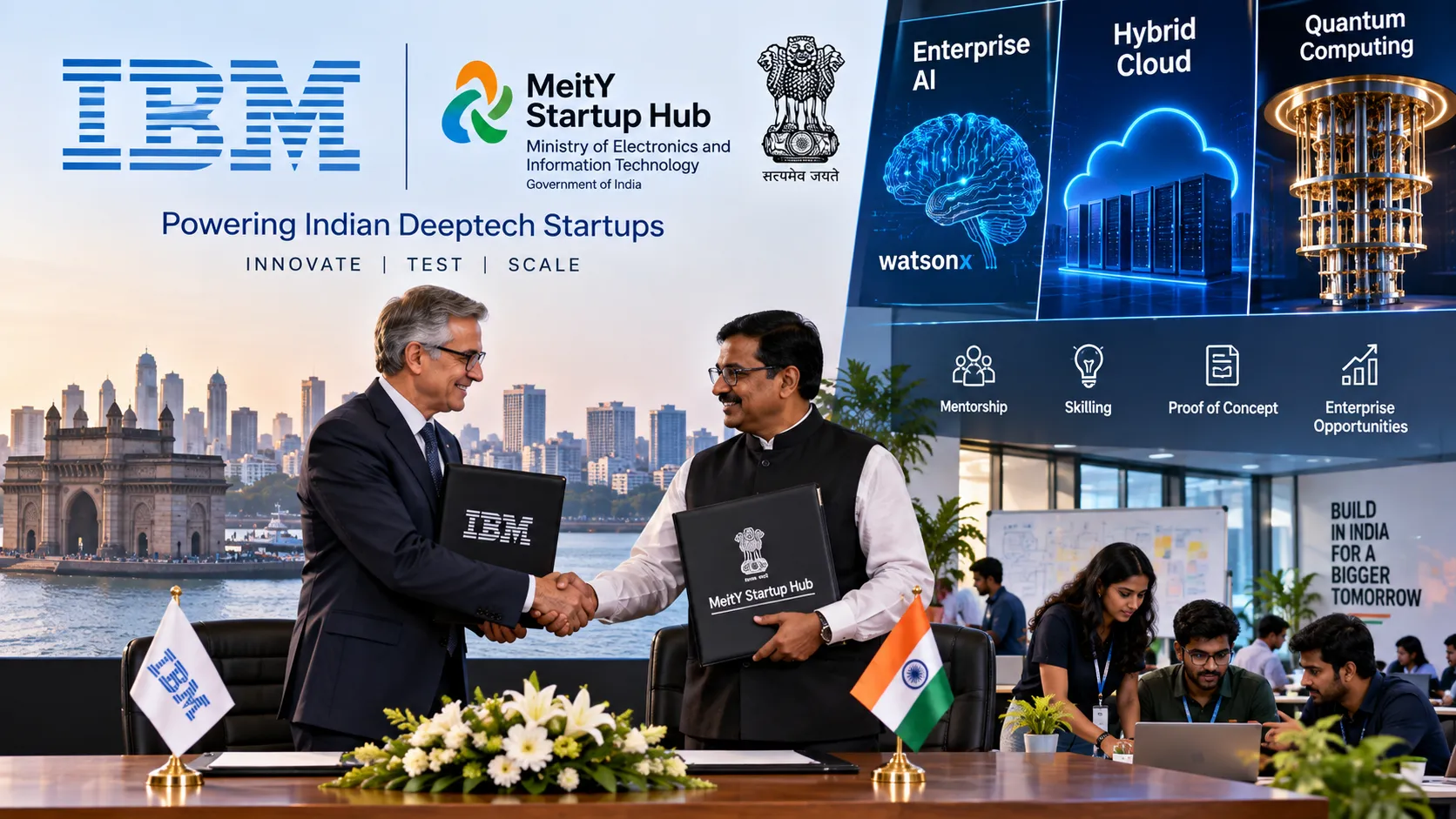
The agreement was announced in Mumbai on October 13. Startups will get access to IBM's enterprise technology portfolio, technical guidance, mentorship and skilling programmes, as well as opportunities to present their solutions to enterprises and investors. The two organisations will also explore enterprise proof-of-concept projects, in which startups test their technologies against real business problems.
The focus areas are enterprise artificial intelligence, hybrid cloud and quantum computing. The partners say they will give particular priority to identifying and supporting innovators from India's Tier 2 and Tier 3 cities.
What startups get
The MoU gives founders access to a range of IBM platforms. These include watsonx, IBM's enterprise AI and data platform; IBM Bob, an AI coding agent designed for enterprise software development; and IBM Sovereign Core, an AI-ready software stack built to help organisations meet digital sovereignty requirements. Startups will also receive technical orientation on hybrid cloud, quantum computing, security and automation.
Beyond technology access, the partnership is designed to address the commercial side of building a deeptech company. The two organisations plan joint initiatives across banking and financial services, government, industrial applications and other sectors. The emphasis will be on founder mentorship, open-source ecosystem development and technical skilling.
The agreement complements IBM Ventures' existing work in India, which follows what the company describes as a "capital-plus" model, combining investment with access to IBM's global network and industry experts.
The scale-up gap
India has one of the world's largest startup ecosystems, but deeptech companies, those building on advances in fields such as AI, semiconductors, quantum technologies and advanced materials, face distinctive hurdles. Their products often take years to develop, need specialised infrastructure and must be validated in demanding enterprise or government environments before customers commit.
Many promising Indian deeptech startups stall at exactly this point. They have working technology but struggle to secure the pilots, references and enterprise relationships needed to win large contracts. Corporate buyers, particularly in regulated sectors such as banking, are often reluctant to bet on young companies without evidence that their solutions can integrate with existing systems and meet security and compliance standards.
Structured proof-of-concept programmes are designed to bridge that gap. By helping startups test their technology on real enterprise problems, with the backing of a global technology company and a government platform, the MoU could give founders the credibility they need to move from pilot to production.
Why sovereign AI is on the agenda
The inclusion of sovereign AI and IBM Sovereign Core reflects a broader shift in how governments and enterprises think about artificial intelligence. Many countries, India among them, increasingly want to ensure that sensitive data and critical AI systems are hosted, governed and controlled within their own jurisdictions.
For Indian startups, sovereignty requirements present both a constraint and an opportunity. Companies building AI for government, defence, finance or healthcare must meet strict rules on data residency and control. Those that can do so credibly, using tools designed with sovereignty in mind, may find themselves well placed as public and private buyers favour domestic, compliant solutions.
The quantum dimension is also notable. India has made quantum technology a national priority through its National Quantum Mission, and a small but growing cluster of startups is working on quantum hardware, software, communication and post-quantum cryptography. Early access to quantum computing platforms and expertise could help these companies develop and test applications years before the technology matures commercially.
The policy backdrop
The MoU slots into a wider set of government initiatives aimed at building strategic technology capabilities. The IndiaAI Mission, approved in 2024 with an outlay of more than ₹10,000 crore, is funding computing infrastructure, foundation models and startup support. The National Quantum Mission, approved in 2023 with an outlay of about ₹6,000 crore through 2030–31, aims to develop quantum computers, communication networks and sensors. The government has also created a ₹1 lakh crore Research, Development and Innovation fund to channel long-term capital into deeptech.
Public money alone, however, cannot give startups the enterprise customers and real-world deployments they need to grow. Partnerships with global technology companies such as IBM, which bring established relationships with banks, manufacturers and government agencies, are intended to fill that gap.
Reaching beyond the metros
The commitment to Tier 2 and Tier 3 cities addresses a long-standing imbalance in Indian venture capital. Funding, mentorship and enterprise networks remain heavily concentrated in Bengaluru, Delhi-NCR, Mumbai and a handful of other large cities, even though engineering talent is spread widely across the country.
Programmes that actively scout and support founders in smaller cities can widen the pipeline of deeptech companies and help retain talent that might otherwise migrate to metros or abroad. They also align with government efforts to spread the benefits of the digital economy more evenly.
The partners' view
Dr. Panneerselvam Madanagopal, chief executive of MeitY Startup Hub, said: "India's startup ecosystem is emerging as a global engine for technology innovation." He added that, through the collaboration with IBM, the hub aims to strengthen India's indigenous deeptech capabilities.
Sandip Patel, managing director of IBM India and South Asia, said: "Together with MeitY Startup Hub, we aim to help founders innovate faster, scale responsibly."
What to watch
The MoU does not specify how many startups will be supported, the duration of the programme or any financial commitments, details that will determine how much impact it ultimately has. Partnerships of this kind are only as valuable as their execution: the quality of mentors, the seriousness of enterprise partners about running pilots, and the speed with which successful proofs of concept turn into paid contracts.
Still, the pairing of a global enterprise technology company with the government's flagship startup platform sends a useful signal. As India tries to build domestic capability in AI, quantum and other strategic technologies, the bottleneck is less about ideas than about the path from prototype to production. If this partnership can shorten that path for even a few dozen companies, it will have done something valuable for the ecosystem.