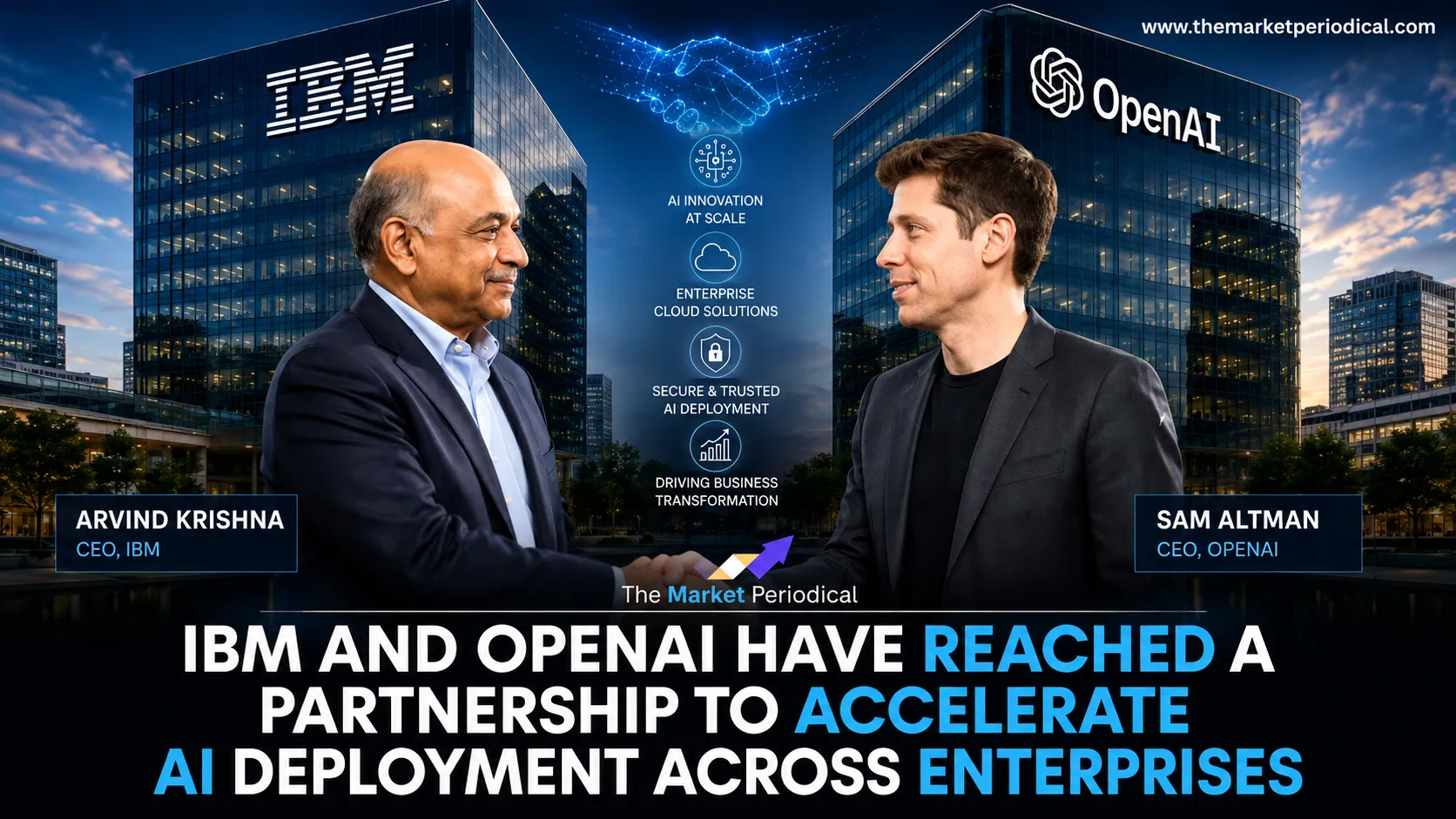
IBM announced a strategic partnership with OpenAI on August 13, 2026, aimed at helping large enterprises deploy artificial intelligence at scale across core business operations while strengthening cyber defence and operational resilience. The partnership embeds OpenAI's frontier models, including GPT-5.6, alongside products such as Codex and ChatGPT Work, into IBM Consulting Advantage — IBM's platform for delivering AI-driven consulting services to enterprise clients — combining OpenAI's model capabilities with IBM's industry-specific consulting assets and implementation expertise.
The deal, whose financial terms were not disclosed, targets large-scale AI deployments across financial services, government, telecommunications and retail, alongside enterprise functions including finance, procurement, customer operations and human resources. As part of the agreement, IBM will join OpenAI's Elite partner tier, while the companies plan to jointly develop industry-specific AI solutions tailored to individual sectors' regulatory and operational requirements.
Central to the partnership's structure is IBM's newly launched dedicated OpenAI Practice, which will staff thousands of consultants and engineers trained and certified under OpenAI's Partner Network. IBM also plans to deploy specialised forward-deployed units of engineers to work directly with clients on AI implementation within regulated environments — a model that mirrors how OpenAI itself has increasingly worked with major systems integrators, following earlier comparable agreements with Infosys and Tata Consultancy Services.
Andy Baldwin, IBM Consulting's global senior vice president, framed the partnership's rationale around a specific problem: that enterprise AI adoption is no longer bottlenecked by access to capable models, but by the difficulty of integrating those models securely and reliably into complex, often heavily regulated operational environments. Denise Dresser, OpenAI's Chief Revenue Officer, echoed that framing, describing the collaboration's aim as helping organisations deploy AI that is secure, operational and aligned with genuine business priorities rather than experimental pilot projects that never reach production scale.
The partnership's cybersecurity dimension builds directly on groundwork the two companies laid earlier in 2026, when IBM joined the OpenAI Daybreak Cyber Partner Program in June. The expanded agreement now formally combines that program with IBM Autonomous Security, IBM's multi-agent cybersecurity service, reflecting heightened industry attention to securing AI systems themselves — a concern sharpened by a string of cybersecurity incidents in recent months involving compromised or rogue AI agents operating with excessive autonomy inside corporate networks.
For IBM, the OpenAI alliance extends a deliberately model-agnostic AI strategy that pairs the company's own Granite family of AI models with third-party frontier models accessed through its watsonx platform, rather than betting exclusively on in-house model development. That approach positions IBM as an integrator capable of matching different AI models to different enterprise use cases — one model for software development tasks, another for regulated financial services workflows — rather than forcing clients into a single-vendor AI stack. The timing is notable: the partnership arrives weeks after IBM lowered its 2026 revenue forecast following weaker-than-expected quarterly results, with CEO Arvind Krishna continuing to describe AI as a long-term growth driver that complements, rather than threatens, IBM's core mainframe business.
For OpenAI, the IBM partnership represents a further extension of its enterprise go-to-market strategy through major systems integrators — a channel increasingly important for reaching large, complex organisations that lack the internal technical capacity to deploy frontier AI models directly, and that often require the kind of regulatory, compliance and change-management expertise consulting firms like IBM specialise in. Combined with its earlier agreements with Infosys and TCS, OpenAI is steadily building a network of implementation partners spanning multiple geographies and consulting cultures.
The partnership's ultimate significance will likely be measured less by the announcement itself and more by execution over the coming year: whether IBM's newly trained consultant workforce can genuinely help regulated enterprises move AI projects from pilot to production at meaningful scale, and whether the combined IBM-OpenAI offering can differentiate itself against a crowded field of competing enterprise AI integration approaches from rivals including Accenture, Deloitte and the major cloud providers, all of whom are racing to establish themselves as the trusted intermediary between frontier AI labs and the world's largest, most risk-averse organisations.