India's mid-sized private banks are reporting a strong set of quarterly results, as lower bad loans and steady growth in lending lift profits, even as the broader economy faces pressure from high oil prices.
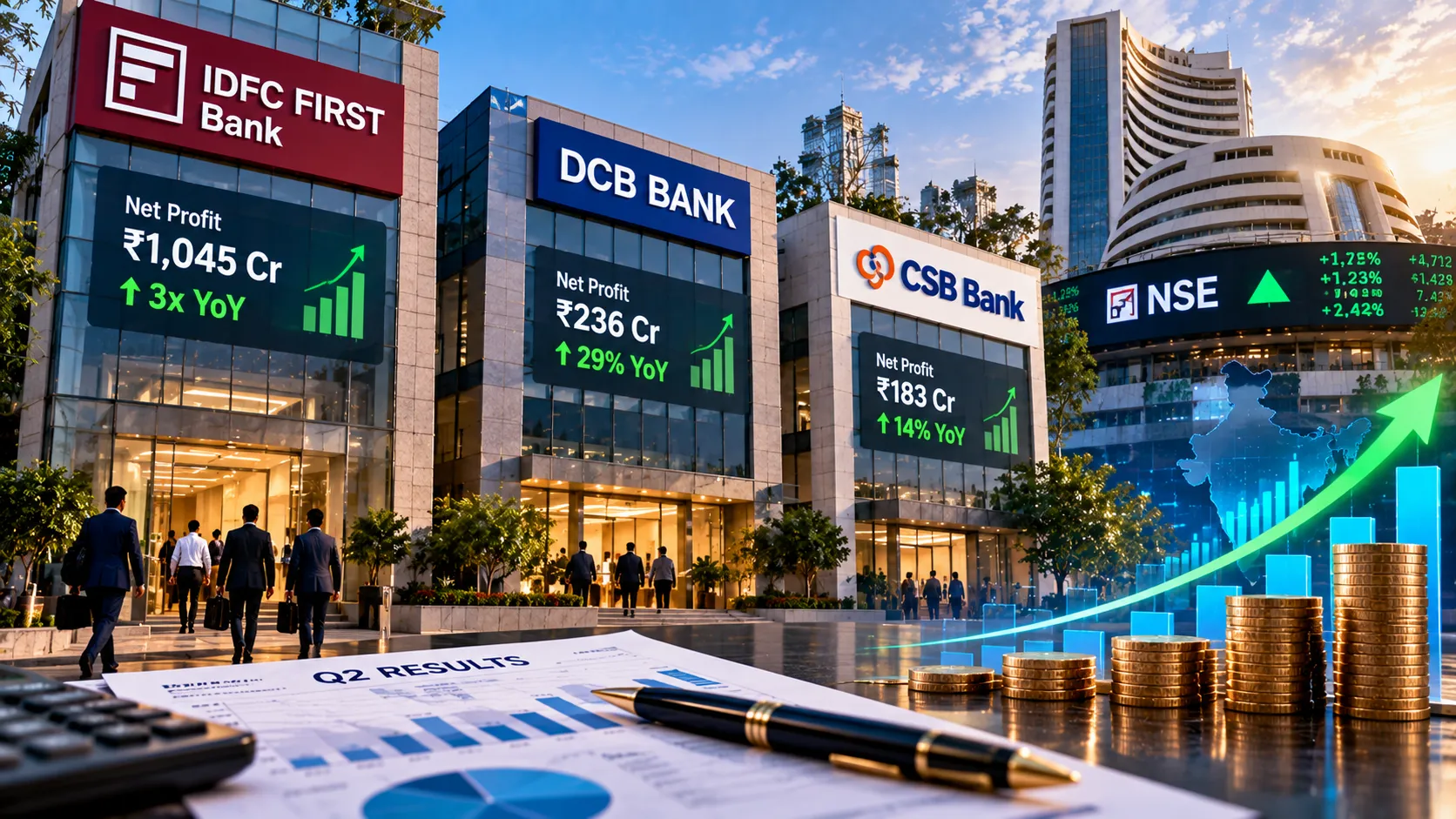
IDFC First Bank led the way, reporting net profit of ₹1,045 crore for the July-September quarter, nearly three times the ₹352 crore it earned a year earlier. Total income rose to ₹14,218 crore from ₹11,828 crore, and interest income increased to ₹11,922 crore from ₹9,937 crore.
The bank's asset quality improved significantly. Gross non-performing assets (NPAs), loans on which borrowers have stopped paying, fell to 1.32% of total loans from 1.86% a year earlier. Net NPAs, after provisions, declined to 0.4% from 0.52%. The capital adequacy ratio, a measure of financial strength, rose to 14.67% from 14.11%.
Why IDFC First's profit jumped
The sharp rise in profit reflects a sharp drop in a year-earlier base that was depressed by elevated credit costs. In 2025, IDFC First Bank, like several other lenders, faced stress in its microfinance portfolio, where borrowers in some regions struggled to repay loans. Provisions for those bad loans weighed heavily on profit.
As the microfinance stress has eased and the bank has reduced its exposure to the segment, provisions have fallen, allowing more of the bank's operating income to flow through to profit. Growth in interest income, reflecting expansion of the loan book, has also contributed.
The IDFC First transformation
IDFC First Bank was formed in 2018 through the merger of IDFC Bank, which had focused on infrastructure lending, and Capital First, a non-bank lender focused on retail and small business loans. Under managing director and chief executive V Vaidyanathan, the founder of Capital First, the bank has shifted its focus to retail banking, building a large deposit base and expanding consumer, small business and rural lending.
The transformation has involved significant investment in branches, technology and brand building, which weighed on profitability in the early years. The latest results suggest the strategy is beginning to deliver stronger earnings.
DCB Bank's strong quarter
DCB Bank reported net profit of ₹236 crore, up 29% from ₹184 crore a year earlier. Total income rose to ₹2,300 crore from ₹2,009 crore. Gross NPAs fell to 2.29% from 2.91%, and net NPAs to 0.73% from 1.21%, marking a significant improvement in asset quality.
The bank, which focuses on small businesses, mortgages and agricultural lending, has been working to reduce bad loans and improve profitability.
CSB Bank's steady growth
CSB Bank, the Kerala-based lender controlled by Fairfax Financial Holdings, reported net profit of ₹183 crore, up 14% from ₹160 crore. Total income rose to ₹1,612 crore from ₹1,458 crore, and net interest income increased 20% to ₹510 crore from ₹424 crore. Gross NPAs declined to 1.58% from 1.81%.
CSB Bank has been expanding beyond its traditional base in Kerala and its strong gold loan business, investing in technology and new branches across India.
A sector-wide improvement
The improvement in asset quality at these banks reflects broader trends in Indian banking. Over the past several years, banks have cleaned up the large bad loans that accumulated during the previous credit cycle, strengthened their capital and improved risk management.
Larger lenders have also reported strong results. Kotak Mahindra Bank's consolidated profit rose 26%, helped by loan growth of 25%. However, not all lenders are faring equally well. Some non-bank lenders focused on rural and small business customers have faced rising credit costs, and shares of Shriram Finance have been under pressure.
Risks ahead
High oil prices pose a risk to borrowers, particularly small businesses, transport operators and rural households, whose costs rise with fuel prices. If the oil shock persists, banks could see an increase in defaults in some segments.
Margins are another concern. Interest rate cuts by the Reserve Bank of India earlier in the cycle reduced yields on many loans, while competition for deposits has kept funding costs elevated. Banks with strong deposit franchises and diversified lending are better positioned to manage these pressures.
What it means for investors
For investors, the results suggest that mid-sized private banks have become more resilient, with cleaner balance sheets and stronger capital positions. Banks with improving asset quality and steady growth have attracted buying interest during the recent market sell-off, as investors look for companies with solid fundamentals.
Valuations for mid-sized banks are generally lower than for the largest private lenders, which could make them attractive if earnings growth continues.
The deposit challenge
Raising deposits remains a key challenge for mid-sized banks, which compete with larger banks that have extensive branch networks and strong brands. IDFC First Bank has invested heavily in building its deposit franchise, offering competitive rates and digital banking services, and has grown customer deposits substantially since its formation.
How Indian banks cleaned up
The improvement in asset quality across Indian banking has been a long process. After a surge in bad loans in the mid-2010s, driven by lending to infrastructure, steel and power companies, the Reserve Bank of India ordered an asset quality review that forced banks to recognise hidden problem loans. The Insolvency and Bankruptcy Code, introduced in 2016, gave lenders new tools to recover money from defaulting borrowers.
Banks raised capital, wrote off bad loans and tightened lending standards. The result has been a sharp fall in non-performing assets across the system, leaving banks in a much stronger position to support economic growth. The latest results from mid-sized lenders show that this improvement has extended beyond the largest banks to smaller and regional players, which historically had weaker risk management and less access to capital.
What comes next
Investors will watch whether these banks can sustain their improvement in asset quality as economic conditions become more challenging. Loan growth, margins and the trend in fresh bad loans will be key indicators in coming quarters.
For IDFC First Bank in particular, the challenge will be to show that its strong profit growth can continue as the benefit of lower provisions fades, and that its retail banking strategy can deliver sustainable returns comparable to those of more established private lenders. The trajectory of microfinance and unsecured retail loans, which caused stress for several lenders in 2025, will remain an important indicator. Steady improvement in these segments would support further gains in profitability across the mid-sized banking sector.