Start-up competitions are a familiar fixture of India's entrepreneurial calendar. Most follow a similar format: founders deliver a short pitch, judges ask a few questions and prizes are awarded within a day. The Entrepreneurship Cell at the Indian Institute of Technology Kanpur is trying something more demanding with this year's edition of its flagship contest.
E-Cell IIT Kanpur has launched UpStart 2026, a national start-up competition built around screening, mentoring and refinement of business models rather than short-format pitching alone. The announcement was made on September 25.
The competition offers a prize pool of up to ₹18 lakh, along with potential funding, incubation support and access to industry networks. Early-stage start-ups across sectors are eligible, with the organisers highlighting fintech, healthtech, deeptech, Web3 and cybersecurity.
The calendar
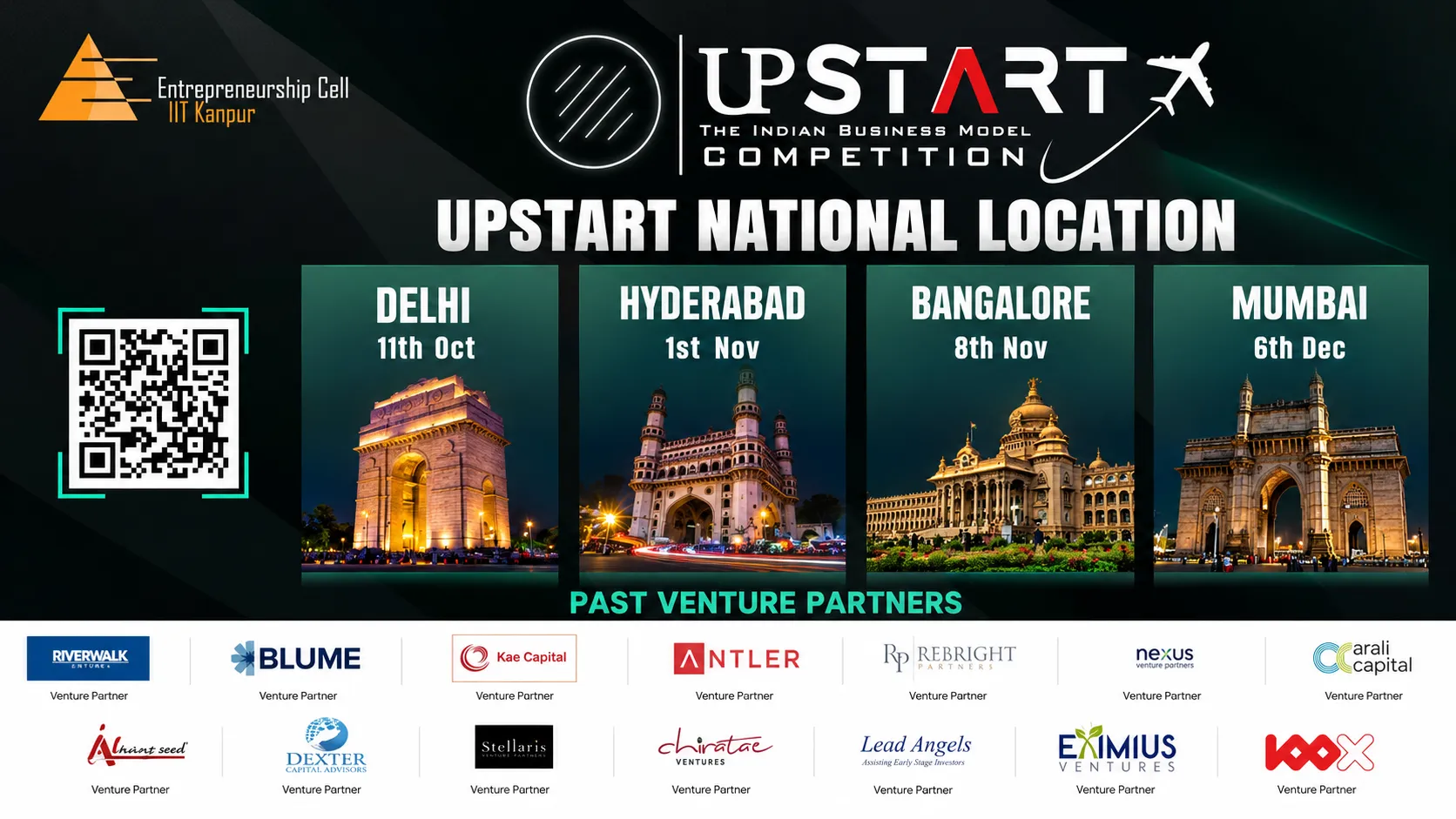
UpStart 2026 will run in four cities before a national finale at IIT Kanpur:
Delhi will host its regional round on October 10, 2026.
Bengaluru and Hyderabad will both hold regional rounds on October 24, 2026.
Mumbai's round is scheduled for December 5, 2026.
Applications close on different dates for each region, between September 30 and November 26, allowing founders to choose the round that best fits their location and readiness.
Selected finalists will receive multi-week mentorship before the national finale on January 23, 2027, at IIT Kanpur. The finale is expected to form part of the institute's E-Summit, one of the largest student-run entrepreneurship gatherings in the country.
Why the format matters
The emphasis on mentoring is the most distinctive feature of UpStart. Rather than judging start-ups only on a single presentation, the competition includes multiple screening rounds, structured brainstorming sessions and one-on-one mentoring before finalists pitch.
That approach reflects a common criticism of pitch competitions. A polished five-minute presentation can reward charisma and slide design more than the underlying strength of a business. Founders often leave with a certificate or a cheque, but little practical guidance on how to improve their model, find customers or prepare for institutional investment.
By building mentorship into the process, UpStart aims to leave participants better prepared regardless of whether they win. Founders who reach the later stages will have spent several weeks refining their business models with experienced advisers, which can be as valuable as prize money for an early-stage company.
"Our objective at E-Cell, IIT Kanpur is to support the country's early-stage ventures with deep industry mentorship and investor access," said Gunjan, manager of events at E-Cell IIT Kanpur.
Kumar Anubhav, founder of Bridgers, which is the official media partner for the event for the second consecutive year, described the model in similar terms. "UpStart has consistently demonstrated a practical, mentorship driven framework that prepares founders for institutional scale," he said.
What founders can gain
For early-stage founders, the benefits of a competition like UpStart go beyond the prize pool.
The first is access to investors. Previous editions have drawn on a network of more than 50 venture capital firms, according to the organisers, and have offered opportunities for on-the-spot funding discussions.
The second is incubation. Winners and promising participants may gain access to incubation centres, including the ecosystem around IIT Kanpur, which has supported a growing number of technology start-ups.
The third is visibility. Being selected as a finalist in a national IIT competition provides credibility with customers, partners and future investors, particularly for founders who do not have established networks.
The fourth is peer learning. Competitions bring together founders facing similar challenges, and the relationships formed during mentoring sessions and events often outlast the competition itself.
IIT Kanpur's place in India's start-up story
IIT Kanpur has played an important role in India's start-up ecosystem, both through its alumni and through its own incubation efforts. The institute's incubator has supported companies in areas such as healthcare devices, drones, clean energy and advanced materials, and it has been active in connecting research with entrepreneurship.
The E-Cell, run largely by students, organises a year-round programme of events, workshops and competitions designed to encourage entrepreneurship on campus and beyond. Its E-Summit brings together founders, investors, policymakers and students, and has become a notable fixture in the national start-up calendar.
UpStart extends that mission to founders outside the IIT system. By holding regional rounds in Delhi, Bengaluru, Hyderabad and Mumbai, the competition reaches start-up communities in four of India's most important entrepreneurial hubs.
Sector focus reflects market trends
The sectors highlighted by the organisers mirror where early-stage investment and innovation are concentrated in India.
Fintech remains one of the country's most active start-up categories, driven by the success of digital payments and the growing demand for credit, insurance and wealth products. Healthtech has gained momentum since the pandemic, with start-ups focused on diagnostics, telemedicine and hospital software. Deeptech, covering areas such as semiconductors, space, robotics and advanced materials, has attracted growing government and investor support. Cybersecurity has become a priority as more of the economy moves online. Web3, while more volatile, continues to attract founders exploring blockchain applications beyond cryptocurrency.
How to decide whether to apply
For founders considering UpStart, the key question is readiness. The competition's multi-stage format rewards teams that have a clear problem, early evidence of demand and a willingness to refine their approach based on feedback. Founders at the idea stage may benefit from the mentoring, but those with a working product and some customer traction are likely to get the most from the process.
Choosing the right regional round also matters. With application deadlines staggered between September 30 and November 26, founders can plan their participation around product milestones or fundraising timelines.
More than a prize
UpStart 2026 is a reminder that India's start-up ecosystem increasingly values substance over spectacle. By putting mentoring and business model refinement at the centre of the competition, E-Cell IIT Kanpur is betting that founders need guidance as much as they need prizes.
With a ₹18 lakh prize pool, four regional rounds and a finale at one of India's premier engineering institutions, the competition offers early-stage founders a structured path to investors, mentors and visibility. For many, the weeks of mentoring between the regional rounds and the January finale may prove to be the most valuable prize of all.