The International Monetary Fund has raised its 2026 growth forecast for India to 7%, singling out the country as a bright spot in a world economy it says is showing “resilience under strain”, as finance ministers, central bankers and business leaders gather in Bangkok for the annual meetings of the IMF and World Bank Group.
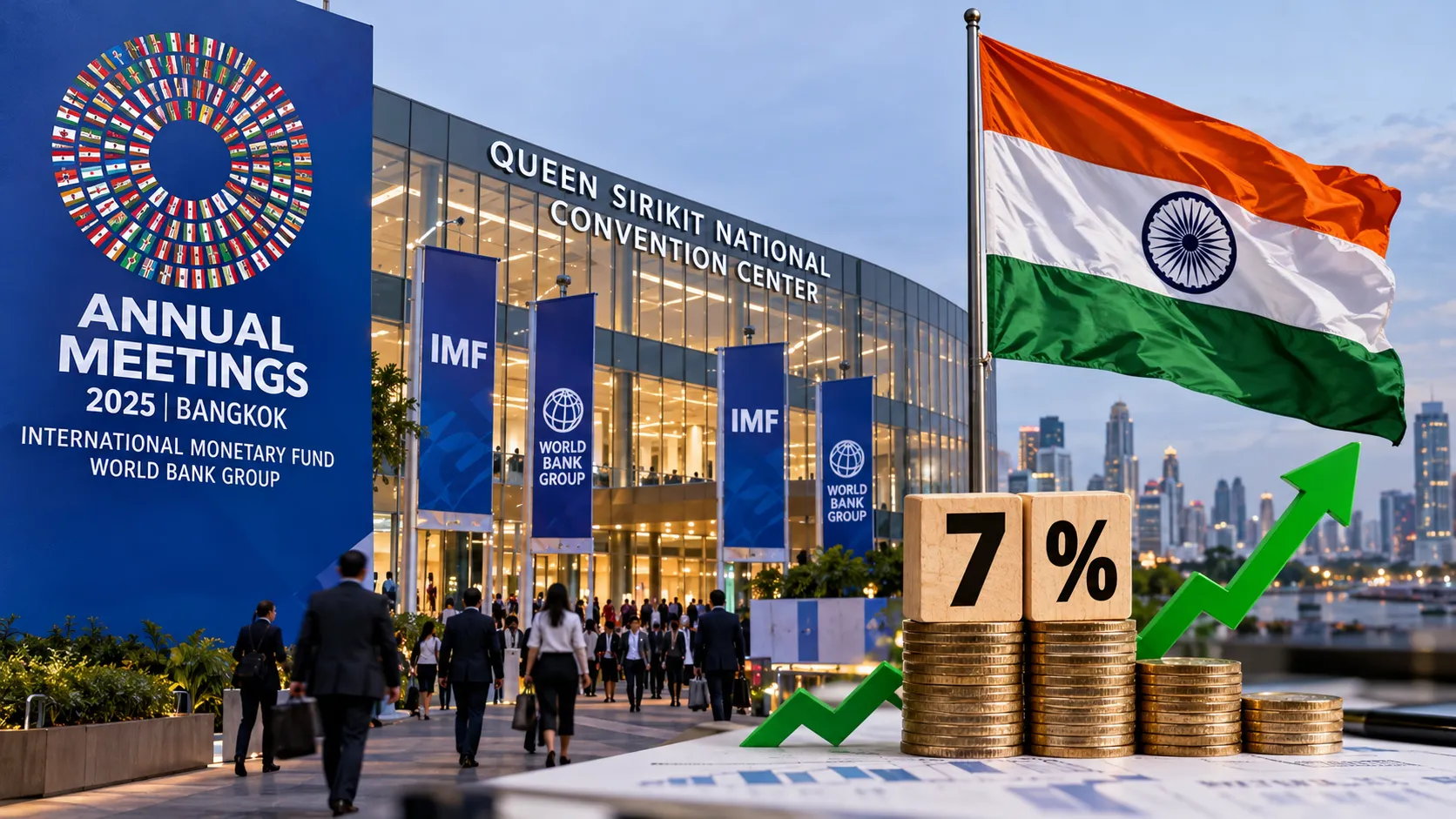
The meetings, which run from October 12 to 18 at the Queen Sirikit National Convention Center, are the first held in Thailand since 1991. More than 15,000 participants from 191 member countries are expected, making it one of the largest gatherings of economic policymakers this year.
They open against an unusually difficult backdrop. War in the Middle East has disrupted energy flows and sent oil prices sharply higher, public debt is at record levels, and rapid advances in artificial intelligence are reshaping labour markets and financial systems. In her curtain-raiser speech, IMF Managing Director Kristalina Georgieva named those three forces, AI, persistently high energy prices and record debt, as the defining risks facing the global economy.
India stands out
In its October World Economic Outlook, titled “Resilience Under Strain, Urgent Choices”, the IMF projected India’s economy will grow 7% in 2026, an upgrade of about half a percentage point from its earlier forecast, and 7% again in 2027. On a calendar-year basis, the Fund sees growth of 7.4% in 2026. The upgrade was attributed to strong domestic demand and services activity.
The IMF cautioned, however, that India is not insulated from the energy shock. As a large importer of crude oil and gas, India is exposed to higher prices through its trade balance, inflation and fiscal subsidies. Elevated fuel costs can squeeze household budgets and corporate margins, even as consumption remains robust; Indian e-commerce platforms recorded about ₹24,000 crore in sales in the first two days of this year’s festive season.
India’s upgrade is a vote of confidence in its domestic engine, but the energy shock is a reminder that no economy is an island.
A slower world
The global picture is more subdued. The IMF projects world output growth of 3.1% in 2026, down from 3.5% in 2025, before a recovery to 3.4% in 2027. Growth in emerging market and developing economies is expected to slow from 4.5% in 2025 to 3.7% in 2026, then rebound to 4.4% in 2027. China is forecast to grow 4.5% in 2026.
The Fund said global growth is increasingly being shaped by two forces pulling in different directions: a war-related supply shock that has raised energy costs, and strong demand tied to the global technology cycle, particularly investment in AI infrastructure.
Its baseline assumes the Strait of Hormuz, the chokepoint for a large share of the world’s seaborne oil and liquefied natural gas, reopens in March 2027, with a broad return to pre-war conditions by October 2027. Even so, energy prices are expected to remain above pre-war levels, and the IMF warned that some emerging and developing economies without adequate inventories could face shortages as countries compete for cargoes.
What is on the agenda
The week’s programme reflects these pressures. The IMF is releasing its flagship reports in sequence: the World Economic Outlook and the Global Financial Stability Report on October 13, followed by the Fiscal Monitor on October 14, when Georgieva will also hold her main press conference.
The World Bank Group, led by President Ajay Banga, is focusing on jobs. Sessions include a flagship event titled “Small AI: More and Better Jobs”, a discussion on using data to expand finance for micro, small and medium enterprises, and a session on mobilising private capital to create employment. Roundtables will examine whether AI can create jobs in developing economies or will mainly displace them.
On October 16, the annual plenary will be followed by a fireside chat between Georgieva and Kevin Warsh, chairman of the US Federal Reserve, and sessions on AI and the global economy, financing a resilient green economy, and AI and cyber risks. Swiss President Guy Parmelin and Singapore President Tharman Shanmugaratnam are among the leaders attending.
Thailand’s moment
For Thailand, the meetings are a chance to showcase its economy 35 years after it last hosted, a period that spans the 1997 Asian financial crisis, which began with the collapse of the Thai baht. Prime Minister Anutin Charnvirakul, Deputy Prime Minister and Finance Minister Ekniti Nitithanprapas and Bank of Thailand Governor Vitai Ratanakorn are leading the host delegation.
Thailand’s main initiative is the Bangkok Blueprint for Fraud-Resilient Financial Services, to be launched on October 14, which aims to improve cooperation among policymakers, regulators and financial institutions against the rising tide of digital financial fraud, a problem that has hit Southeast Asian economies particularly hard.
Georgieva’s prescription
Georgieva has called for a coordinated global response that combines prudent monetary and fiscal policy with structural reforms. She argued that the necessary policy tools exist, but that their effectiveness depends on governments using them appropriately and cooperating internationally. For central banks, the challenge is to keep inflation expectations anchored as energy prices rise without choking off growth. For finance ministries, it is to rebuild fiscal buffers while protecting the vulnerable and investing in productivity.
How governments can balance fiscal discipline with productive investment and job creation is one of the central items on the meetings’ agenda, and the Fiscal Monitor, due on October 14, will set out the IMF’s latest assessment of public finances worldwide.
Debt and the developing world
Debt will be a recurring theme. Many developing countries face high borrowing costs and heavy repayment schedules just as energy and food prices rise, limiting their capacity to protect vulnerable households or invest in growth. Pressure is mounting on the IMF, the World Bank and creditor nations, including China, to speed up debt restructurings and expand concessional finance.
For India, which has championed Global South priorities on debt, climate finance and multilateral development bank reform since its G20 presidency, the Bangkok meetings offer a platform to press those issues. Indian officials are expected to engage on development finance, digital public infrastructure and the regulation of AI.
For business leaders, investors and the global Indian diaspora, the message from Bangkok is clear: India’s growth story remains intact and is outperforming most peers, but it is being written in a more dangerous world. The choices policymakers make this week on energy security, debt and the governance of AI will shape the environment in which that story unfolds.


