FundingMarket Data Women5 MIN READ

Copper, Freight and Fuel Squeeze India's Consumer Companies as Price Hikes Struggle to Keep Pace

Appliance and consumer goods makers raised prices again from 1 October, but rising copper, aluminium, freight and energy costs are outrunning what they can pass on to shoppers, even as festive demand stays strong.

3 October 2026New
Copper, Freight and Fuel Squeeze India's Consumer Companies as Price Hikes Struggle to Keep Pace

India's consumer companies are heading into the most important selling season of the year with strong demand but shrinking room to protect their margins. Manufacturers of appliances and other consumer goods raised prices again from 1 October, yet the costs of metals, freight and energy have risen faster than they can pass on to shoppers.

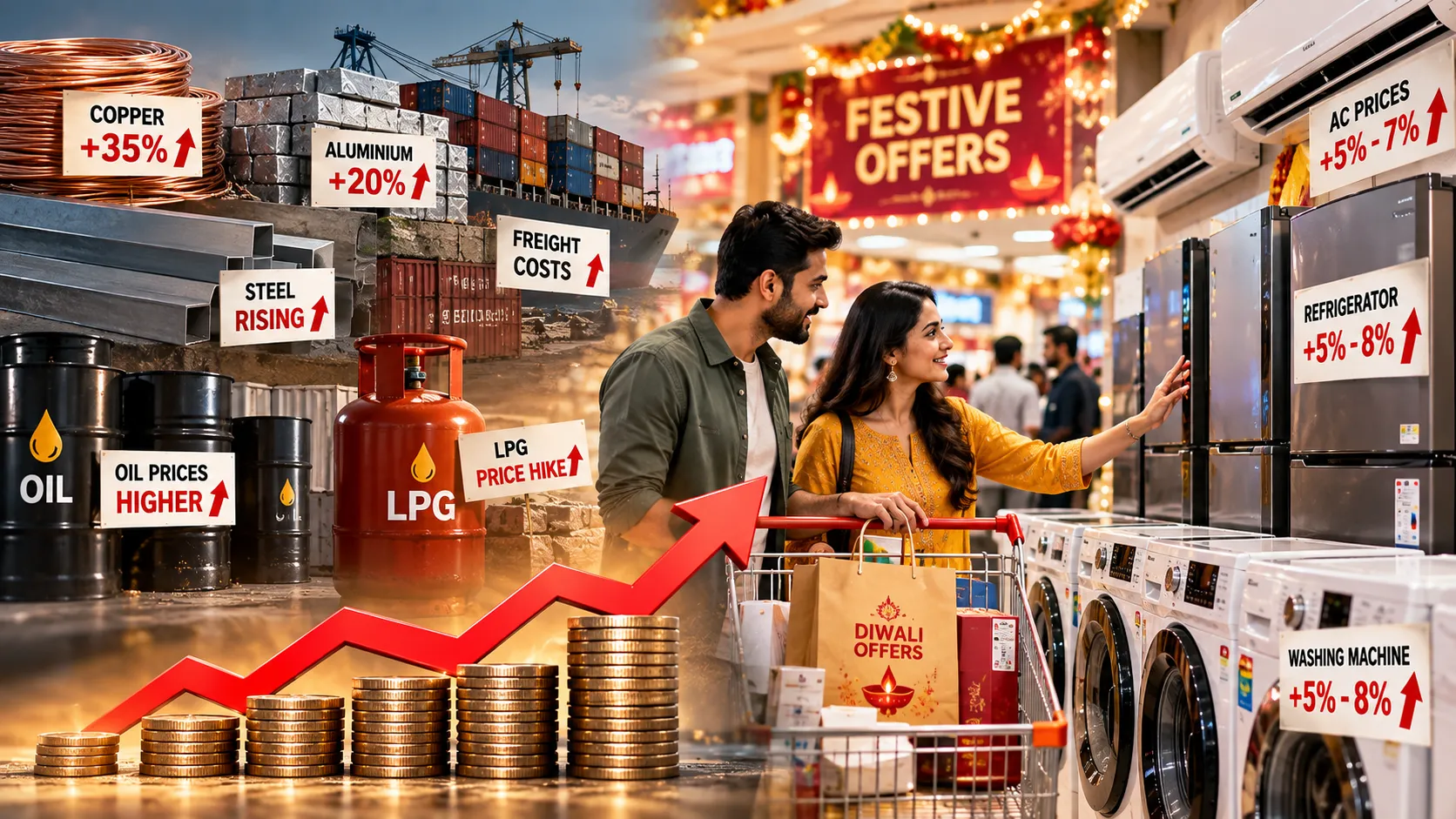
The squeeze is most visible in consumer durables. LG Electronics India raised air conditioner prices by 5% to 7% from 1 October, according to a report published on 30 September. Across air conditioners, refrigerators and washing machines, retail prices have risen 10% to 12% in total through three rounds of increases since January. Other manufacturers have also moved: Intex Technologies raised prices by 2% to 3% on select categories, and industry reports put the latest round of increases across appliances at 5% to 8%.

Even so, companies say they have absorbed much of the pressure. Summercool Home Appliances estimated its blended input-cost inflation at about 15%, and companies have passed on only around a quarter of their cost increases to consumers, according to the same report. The rest has come out of margins.

Business publications on 3 October highlighted the same pattern across the broader consumer sector: input costs are running ahead of the price increases companies can make without hurting volumes.

What is driving costs

The biggest pressure comes from metals. Copper, used extensively in air conditioners, refrigerators, motors and wiring, has risen about 35% so far in 2026. Aluminium, another key input, is up about 20%. Deutsche Bank has estimated that copper could rise by a further 50%, a forecast that, if borne out, would deepen the challenge for manufacturers.

Steel prices and freight rates have also climbed, adding to costs across categories. Energy is a further factor. Global oil prices have been elevated through much of the year because of the conflict in West Asia, and Petroleum Minister Hardeep Singh Puri said this week that Brent crude had eased to around $95 a barrel. The government raised the price of 19-kilogram commercial LPG cylinders in major cities on 1 October, increasing operating costs for restaurants, hotels and food businesses.

Electronics makers face an additional problem in memory chips. "The pressure is most acute at the entry level, where memory forms a larger share of the device cost," said Bharat Birla of Anand Rathi Advisors. Entry-level products are also where consumers are most price-sensitive, which makes it harder to pass on cost increases.

Weather has played a role too. Below-normal monsoon conditions in parts of the country have affected agricultural prices and rural incomes, adding to inflationary pressure on food-linked consumer goods.

Demand is holding up, for now

The paradox is that demand remains robust. Air conditioner sales rose about 25% in the July–September quarter, while refrigerator and washing machine sales grew 13% to 14%, according to industry estimates. A hot summer, rising incomes and the replacement cycle for appliances bought during earlier boom years have all supported sales.

The festive season is expected to be strong as well. Industry projections put festive ecommerce sales at ₹1.50 lakh crore to ₹1.55 lakh crore, growth of 25% to 29% from last year. Quick commerce platforms are expected to account for about 16% of festive sales, roughly ₹24,000 crore, reflecting how rapidly ten-minute delivery services have expanded beyond groceries into electronics and household goods.

“The pressure is most acute at the entry level, where memory forms a larger share of the device cost.”
— Bharat Birla, Anand Rathi Advisors

Retailers are also seeing customers trade up. Electronics Mart India, a large retail chain, reported an average selling price of ₹23,474 in the first quarter of FY27. Higher average prices partly reflect inflation, but they also show that many buyers are choosing more expensive models.

Broader indicators suggest consumption remains healthy. Net GST revenue rose 18.1% to ₹1.77 lakh crore in September, the fastest pace in six months, pointing to solid economic activity.

The margin arithmetic

For companies, the problem is the gap between cost inflation and pricing. A manufacturer facing 15% input-cost inflation that raises prices by 5% to 8% must find the rest through efficiency, product mix, lower discounts or accepting thinner margins. Some of that can be managed by cutting promotional spending or shifting production to more efficient plants, but in a festive season where competitors are fighting for market share, few companies want to be the most expensive option on the shelf.

The squeeze tends to be harshest for smaller brands with less purchasing power and limited ability to hedge commodity exposure. Larger players with scale, backward integration and stronger brands are usually better placed to protect margins, and periods of sustained cost inflation often end with market share consolidating towards them. ## Rural and urban demand diverge

The impact of rising prices is not felt evenly. Urban consumers in higher income brackets have so far kept spending, helped by stable employment and easy access to consumer credit. Rural demand is more exposed to the monsoon and to food prices, and below-normal rainfall in parts of the country risks squeezing farm incomes just as prices for packaged goods and appliances rise.

Companies with large rural exposure, particularly in packaged foods, personal care and entry-level appliances, will be watching closely. Many have responded in past cycles by shrinking pack sizes rather than raising headline prices, a practice known as grammage reduction, which preserves affordable price points while protecting margins. Retail investors will also feel the effect, since consumer durables and FMCG stocks are widely held by Indian mutual funds and tend to be re-rated quickly when margin expectations change.

ede3686d-fb9a-40c7-880a-23f08a964580.png

The interest rate wildcard

Monetary policy adds another layer of uncertainty. With inflation persistent, economists have discussed the possibility that the Reserve Bank of India could raise its repo rate by 25 basis points at its October meeting, with some expecting a further increase in December. Higher rates would make consumer loans and EMI-based purchases more expensive, which matters because a large share of appliance and smartphone sales in India are financed.

For investors, the coming quarterly results season will be revealing. Revenue growth is likely to look healthy on the back of price increases and strong demand, but gross margins may tell a different story. Analysts will watch management commentary closely for signs of further price increases after the festive season and for any indication that demand is starting to soften at higher price points.

For consumers, the message is simpler: the air conditioner, refrigerator or smartphone bought this Diwali is likely to cost noticeably more than it did a year ago, and if metal prices keep climbing, the increases may not be over.

TagsConsumer DurablesFMCGMarginsInput CostsCopperAluminiumInflationFestive SeasonLG ElectronicsGodrejAppliancesAir ConditionersRBIIndia EconomyMarket Data

Reader reviews

Sign in to rate and review this article.
Loading reviews…