India's merchandise exports grew across every major region of the world in the first half of the 2026-27 financial year, with Africa emerging as the fastest-growing destination. The data underlines the diversification of India's trade beyond its traditional Western markets.
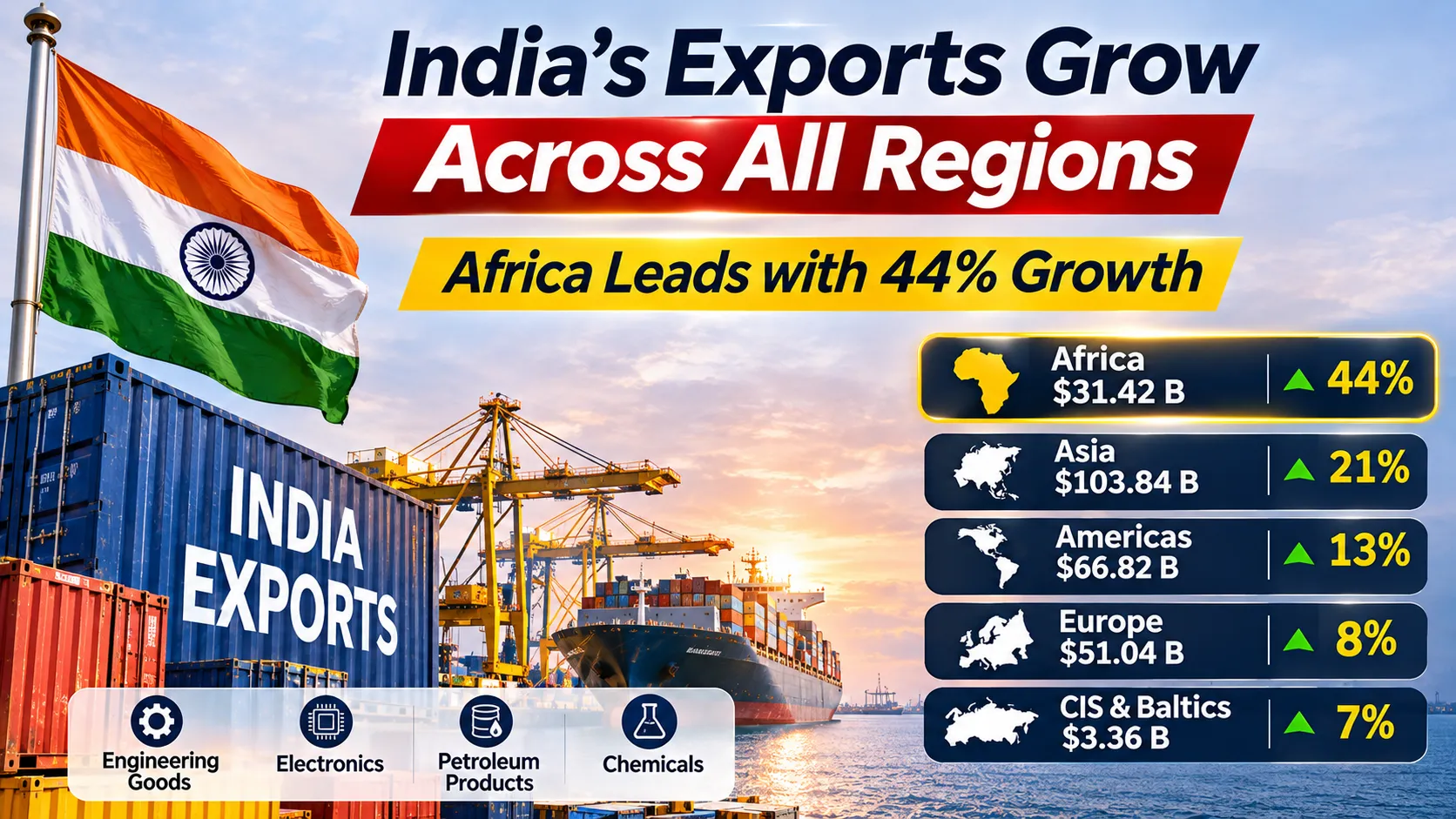
According to a government backgrounder released through the Press Information Bureau on November 21, India's exports to Africa rose 44% in April-September 2026-27, from $21.87 billion in the same period a year earlier to $31.42 billion. South Africa was the largest African market, at $5.69 billion.
Exports to Asia rose 21%, from $85.84 billion to $103.84 billion. China, at $11.39 billion, and Singapore, at $11.07 billion, were the largest Asian destinations.
Exports to the Americas grew 13% to $66.82 billion, with the United States accounting for $50.80 billion. Shipments to Europe rose 8% to $51.04 billion, and exports to the CIS and Baltic states grew 7% to $3.36 billion.
Engineering goods, electronics, petroleum products and chemicals featured prominently across these regional baskets.
Africa's rising importance
Africa's emergence as India's fastest-growing export market reflects years of deepening economic ties. India has expanded lines of credit, development partnerships and diplomatic engagement across the continent, and Indian companies have invested in sectors ranging from telecom and automobiles to pharmaceuticals and agriculture.
Africa's fast-growing population, urbanisation and expanding middle class create demand for the kinds of products India exports competitively. These include affordable vehicles and two-wheelers, pharmaceuticals, machinery, textiles, processed food and electronics.
Indian generic medicines have long been a cornerstone of trade with Africa, providing affordable treatments for diseases such as HIV, malaria and tuberculosis. Indian automakers and two-wheeler companies have also built strong positions in many African markets.
The large Indian diaspora in East and Southern Africa, particularly in countries such as Kenya, Tanzania, Uganda and South Africa, has historically played a role in trade networks. Diaspora-owned businesses often act as distributors, importers and partners for Indian companies.
A record October
The half-year figures follow a record performance in October. India's merchandise exports surged about 45% year-on-year to $49.47 billion in October, the highest monthly figure on record. Engineering goods exports rose 36% to $12.74 billion, petroleum product shipments jumped about 140%, and electronics exports rose sharply.
Five sectors, namely engineering goods, petroleum products, electronic goods, gems and jewellery, and chemicals, accounted for about 83% of the increase in October exports, according to the Global Trade Research Initiative.
Why exports are booming
Several factors have contributed to the export surge. Global supply chain diversification has led many multinational companies to expand sourcing and manufacturing in India, particularly in electronics. Apple's suppliers, for example, have significantly increased iPhone production in India for export.
Production-linked incentive schemes have supported manufacturing in sectors including electronics, pharmaceuticals, automobiles and specialty chemicals. Higher global prices for petroleum products during parts of the year also boosted the value of refined fuel exports.
A weak rupee for much of 2026 made Indian goods more competitive in global markets, although it also raised the cost of imported inputs.
The US relationship
The United States remains India's largest single export market, at $50.80 billion in the first half. Engineering goods exports to the US have shown strong demand in recent months despite trade tensions.
India has faced high US tariffs on some products in recent years, which prompted exporters to look for alternative markets. The strong growth in exports to Africa and Asia may partly reflect that diversification effort.
Trade negotiations with major partners continue. India is negotiating trade agreements with several countries and blocs, including the European Union and Canada, which could further open markets for Indian exports.
Asia: neighbours and supply chains
The 21% growth in exports to Asia reflects India's integration into regional supply chains. Exports to China, at $11.39 billion, remain much smaller than India's imports from China, leaving a large bilateral trade deficit. However, growth in exports to China suggests some Indian products are finding demand in the Chinese market.
Singapore's position as the second-largest Asian destination reflects its role as a trading and refining hub, as well as a major investor in India. Southeast Asia more broadly has become an important market for Indian goods, from petroleum products to engineering items.
Challenges and risks
Despite the strong numbers, India's exporters face risks. Global demand could weaken if major economies slow. Trade protectionism remains a concern, and changes in tariff policies by major partners can quickly affect competitiveness.
The trade balance also remains an issue. India continues to import more than it exports, particularly energy, electronics components and gold. The combined merchandise and services trade deficit narrowed to about $20 billion in October, but managing the deficit remains important for the rupee and the current account.
What it means for businesses
For Indian companies, the data highlights opportunities in emerging markets, particularly Africa. Firms that have invested in distribution, local partnerships and products tailored to African consumers are well positioned to benefit.
For the global Indian diaspora, including entrepreneurs and professionals in Africa, the Gulf and Southeast Asia, growing trade flows create opportunities in distribution, logistics, finance and manufacturing.
For policymakers, the broad-based growth supports India's ambition of reaching $1 trillion in merchandise exports. Sustaining that growth will require continued improvements in infrastructure, logistics, trade facilitation and access to finance for exporters.
The first half of 2026-27 shows that India's export base is becoming more diversified, both in products and destinations. If that trend continues, it could make India's trade more resilient to shocks in any single market.
Services add to the story
Merchandise exports tell only part of India's trade story. Services exports, led by IT, business services, and increasingly global capability centres, have grown steadily and now generate a large surplus. Cumulative merchandise and services exports in April-October 2026-27 reached an estimated $568.84 billion, up about 16.7% from a year earlier, according to the Federation of Indian Export Organisations. The combination of fast-growing goods exports to new markets and a strong services surplus gives India a more balanced external position than in previous years, even as it continues to import large amounts of energy and electronics.