StartupsTrending5 MIN READ

India’s Festive E-Commerce Sales Hit ₹24,000 Crore in Two Days as Small-Town Shoppers Drive Demand

Indian e-commerce platforms recorded about ₹24,000 crore in gross sales in the first two days of the festive season, according to Redseer, with mobiles leading and Tier II and smaller cities powering a surge of 8–9 crore orders.

By Nisha Omkumar · Author13 October 2026Trending
India’s Festive E-Commerce Sales Hit ₹24,000 Crore in Two Days as Small-Town Shoppers Drive Demand

India’s online festive shopping season has opened with a bang. E-commerce platforms recorded gross sales of about ₹24,000 crore in the first two days of their annual festive sales, according to estimates from consulting firm Redseer Strategy Consultants, signalling resilient consumer demand despite inflation, high energy prices and global economic uncertainty.

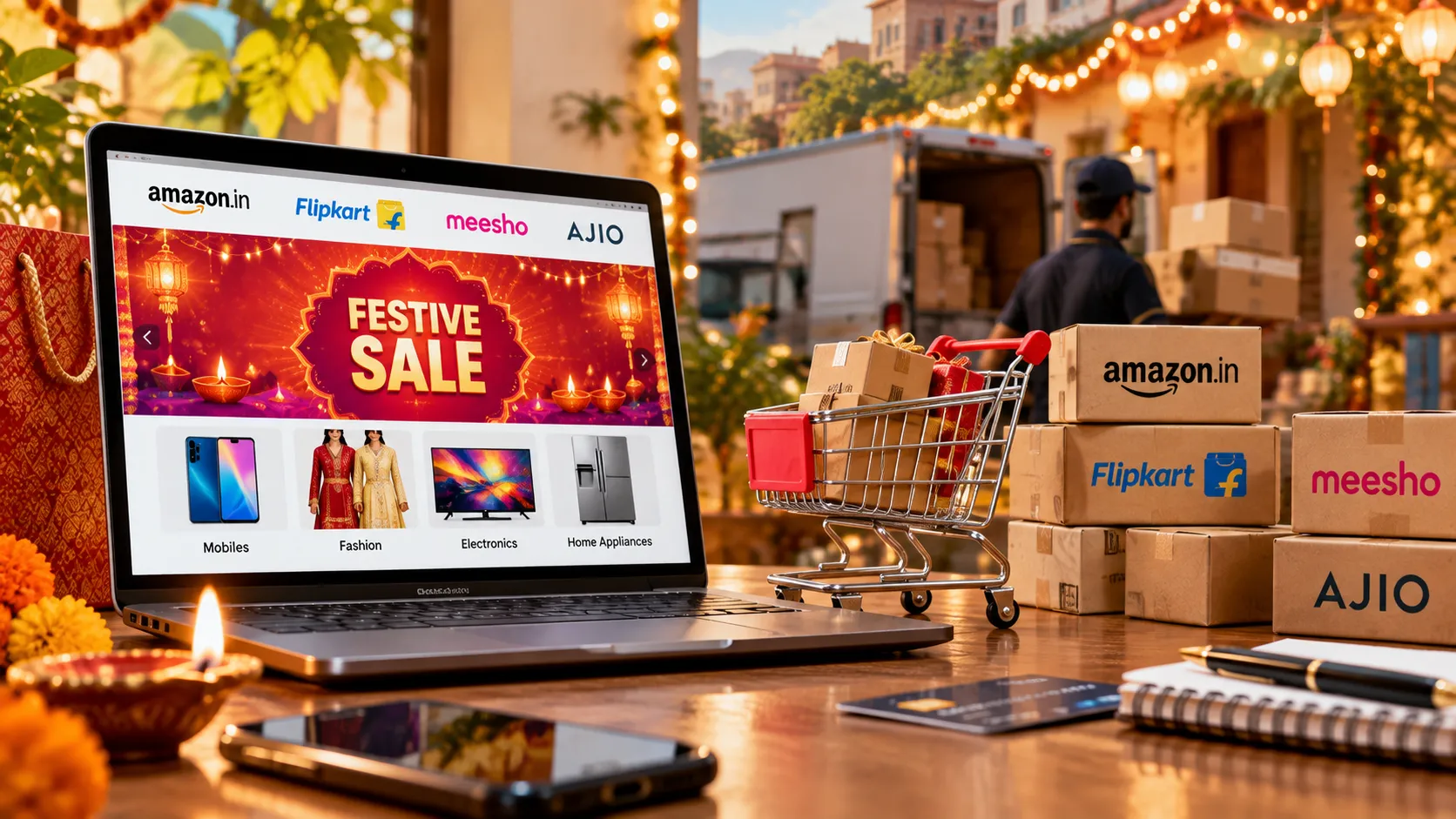
Between 6 and 6.5 crore shoppers placed 8 to 9 crore orders across platforms including Amazon, Flipkart, Meesho and Reliance’s Ajio, Redseer estimates. Mobile phones led sales by value, while fashion, consumer electronics and home appliances also saw strong demand.

The most striking feature of the opening weekend was its geography. Redseer said demand was especially strong in Tier II cities and smaller towns, extending a multi-year shift in which India’s e-commerce growth has increasingly come from outside the largest metropolitan areas.

Why the first 48 hours matter

India’s festive season, stretching from Navratri through Dussehra to Diwali, is the single most important trading period for retailers and consumer brands. For e-commerce platforms, the opening days of the big sales are the peak of the peak, when steep discounts, bank card offers and no-cost EMIs pull forward months of purchases.

The early numbers therefore act as a barometer for the season and for consumer sentiment more broadly. A ₹24,000 crore start suggests households are still willing to spend on discretionary items, particularly big-ticket purchases that can be financed through instalments.

Redseer’s Nikhil Dalal pointed to the breadth of demand across categories and regions as a sign of a healthy season. Analysts typically look at whether growth is coming from more shoppers or higher spending per shopper; the large number of unique buyers suggests the platforms have succeeded in widening their reach.

Mobiles lead, value rules

Smartphones dominating by value is a familiar pattern. Festive sales are when many Indians upgrade their phones, and manufacturers time launches and price cuts accordingly. Premium phones have gained share in recent years, helped by financing options that lower the upfront cost.

Fashion, by contrast, typically leads by volume. Value-focused platforms such as Meesho have built large followings in smaller towns by offering unbranded and low-priced apparel and household goods, and their presence in the season’s headline numbers underlines how price-sensitive much of India’s online consumer base remains.

Appliances, from televisions and refrigerators to washing machines and air conditioners, form another important pillar, supported by rising rural incomes, wider electrification and easier credit.

The small-town story

The strength of demand beyond the metros is the most important long-term takeaway. Over the past five years, cheap mobile data, improved logistics networks and vernacular-language interfaces have brought tens of millions of first-time online shoppers into the market. Platforms have invested heavily in delivery infrastructure to reach smaller pin codes, and payment innovations such as UPI and cash-on-delivery have lowered barriers.

For brands, this shift changes strategy. Consumers in smaller towns tend to be more price-conscious and value-driven, but they are also increasingly aspirational. Companies that can offer affordable versions of premium products, or recognisable brands at accessible prices, stand to gain most. That trend helps explain why investors continue to back consumer brands built for mass India, such as fitness label Boldfit, which raised more than ₹400 crore this week.

The centre of gravity in Indian e-commerce has moved decisively beyond the metros, and the festive season is where that shift is most visible.


“The centre of gravity in Indian e-commerce has moved decisively beyond the metros.”
— The Impactful Global Indian
e9d30818-7a85-4248-8add-b46eaa17d923.png

A contrast with startup funding

The strength of consumer spending contrasts with a muted week for venture capital. Indian startups raised about $168 million across 28 deals in the week of October 3 to 9, down from $418 million the previous week, according to industry trackers. Funding remains well below the levels of the 2021 boom, and investors are concentrating capital in companies with clear paths to profitability.

That gap is not necessarily contradictory. Strong consumer demand benefits large platforms and established brands first, while venture investors remain cautious about funding new entrants in crowded categories. Over time, however, a healthy consumption backdrop tends to support funding for consumer startups, as investors gain confidence in the size of the opportunity.

The platform battle

The festive season is also the most intense period of competition among India’s e-commerce platforms. Flipkart, backed by Walmart, and Amazon have long dominated the big festive sales, with Flipkart’s Big Billion Days and Amazon’s Great Indian Festival anchoring the calendar. Meesho has grown into a major force by targeting value-conscious buyers in smaller towns, while Reliance has pushed its Ajio fashion platform and broader retail ecosystem.

Quick-commerce companies have added a new dimension. Platforms such as Blinkit, Zepto and Swiggy Instamart have expanded well beyond groceries into electronics, beauty and gifting, and their promise of delivery within minutes makes them attractive for last-minute festive purchases. Their share of festive spending is still small compared with the large marketplaces, but it is growing quickly.

The intensity of competition means platforms are spending heavily on discounts, cashback, marketing and logistics. Investors will be watching whether the volumes justify the cost, particularly for companies preparing for public listings or under pressure to improve profitability.

Logistics capacity is another test. Delivering 8 to 9 crore orders in two days requires an enormous network of warehouses, sorting centres and delivery partners. Third-party logistics providers such as Shadowfax, whose shares have risen sharply on the back of quick-commerce and e-commerce growth, are among the beneficiaries of the surge.

Payments infrastructure has scaled alongside. UPI, card-based instalment plans and buy-now-pay-later products have made it easier for first-time buyers to finance purchases, helping to explain why higher-value categories such as smartphones and appliances continue to lead the value table.

What to watch for the rest of the season

Two days do not make a season. Analysts will watch whether demand sustains through the rest of the sale period and into Diwali, and whether quick-commerce players, which promise delivery in minutes, take a larger share of festive spending than in previous years. Return rates, which can be high in fashion, will also determine how much of the gross sales figure translates into net revenue.

The macro backdrop adds uncertainty. Elevated energy prices linked to conflict in the Middle East have pushed up costs for households and businesses worldwide, and the International Monetary Fund this week warned of pressures on emerging economies even as it raised its growth forecast for India.

For now, though, the opening numbers offer a reassuring signal for India’s consumer economy. For retailers, investors and the global Indian diaspora watching the world’s fastest-growing major economy, a ₹24,000 crore start suggests that Indian households, particularly outside the big cities, remain willing to spend when the price and the occasion are right.

TagsFestive SalesE-commerceRedseerAmazonFlipkartMeeshoAjioConsumer DemandTier II CitiesSmartphonesIndian EconomyRetailVenture FundingDiwali

Reader reviews

Sign in to rate and review this article.
Loading reviews…

