
FundingMarket Data Women5 MIN READ

Indian Bonds Post Their Longest Losing Streak in 30 Years as Crude and US Yields Rise, and Forex Reserves Fall $65 Billion

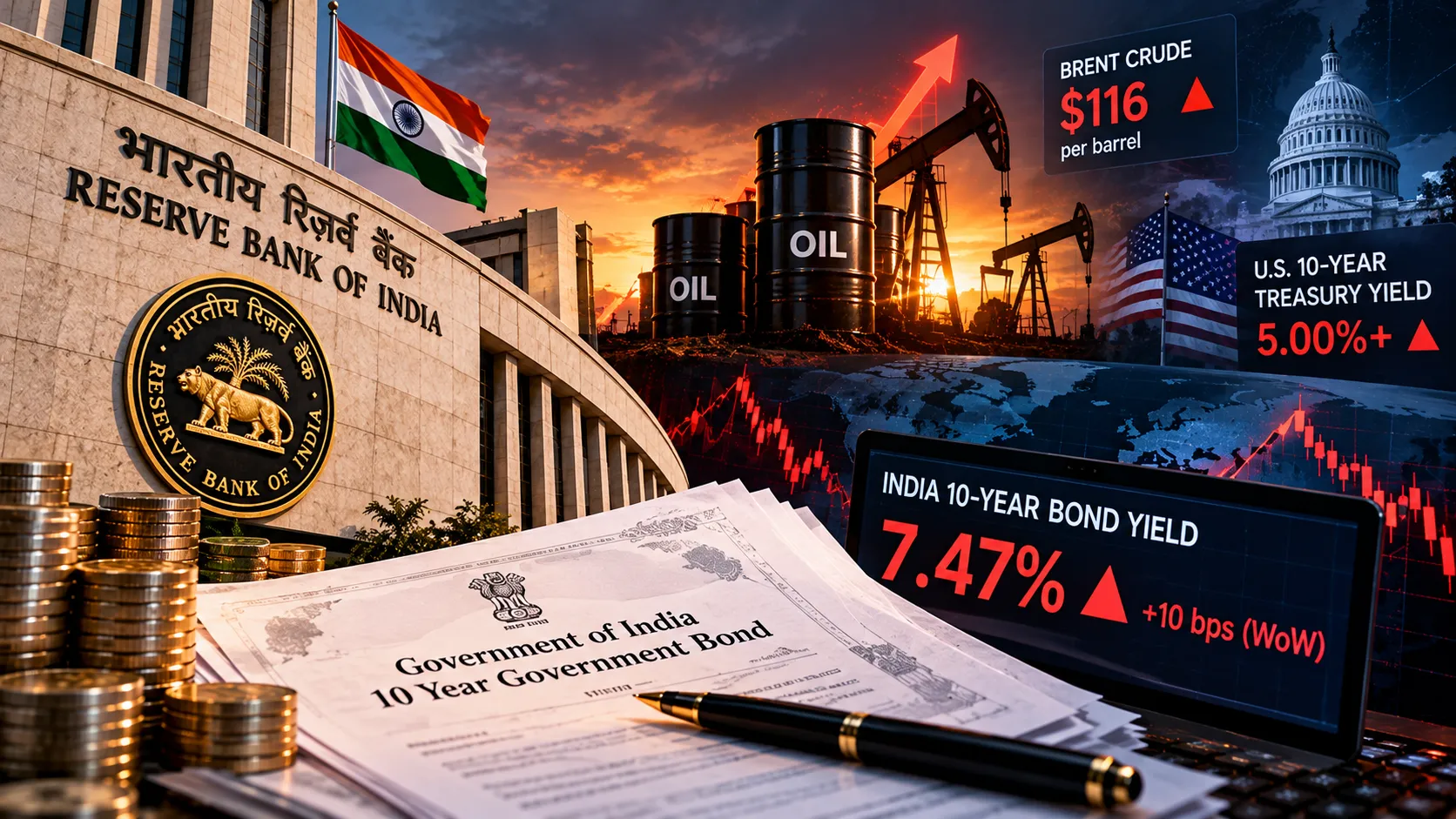
Indian government bond yields rose for a tenth straight week, the longest losing streak in about three decades, with the 10-year yield settling at 7.47% on October 23 as Brent crude neared $116 and US yields climbed. Forex reserves fell $5 billion to $721 billion in the week to October 16, down $65 billion in six weeks from a record $785.7 billion.

By Shaym Kumar · Author26 October 2026New
Indian Bonds Post Their Longest Losing Streak in 30 Years as Crude and US Yields Rise, and Forex Reserves Fall $65 Billion

India's government bond market is suffering its longest losing streak in a generation, as rising oil prices and surging US borrowing costs push investors to demand higher returns for lending to the government.

Indian government bond yields rose for a tenth straight week, the longest such run in about three decades, Business Standard reported on Friday, October 23. The benchmark 10-year government bond yield settled at 7.47%, up from 7.46% the previous day, and rose 10 basis points over the week. Bond yields move inversely to prices, so rising yields mean falling bond prices.

Oil and US yields drive the sell-off

Two global forces lie behind the sell-off. The first is oil. Brent crude was trading around $116 a barrel on Friday evening, a more than five-month high, and was on course for its third consecutive weekly gain, as attacks on Saudi Arabia and shipping in the Gulf raised fears of supply disruptions.

High oil prices threaten to push up inflation in India, which imports nearly 90% of its crude needs. Higher inflation erodes the real value of fixed bond payments and makes it less likely that the Reserve Bank of India will cut interest rates. The RBI's Monetary Policy Committee recently raised the repo rate by 25 basis points to 5.50% and shifted its stance to "calibrated tightening."

The second force is the rise in US Treasury yields, which have climbed above 5% on persistent inflation and expectations of further Federal Reserve rate increases. Higher US yields draw capital away from emerging markets, including India, and make Indian bonds relatively less attractive to foreign investors.

Forex reserves under pressure

The RBI's efforts to support the rupee are visible in the country's foreign exchange reserves. Reserves fell by $5.01 billion to $721.02 billion in the week ended October 16, according to data released on Friday. They have now fallen by about $65 billion in six weeks from a record $785.7 billion in the week ended September 4.

Foreign currency assets, the largest component, fell $5.76 billion to $591.85 billion. Gold reserves rose $706 million to $105.80 billion, reflecting higher gold prices. Special drawing rights edged up to $18.58 billion, and India's reserve position with the International Monetary Fund rose to $4.79 billion.

Despite the decline, India's reserves remain large by historical and international standards, providing a substantial buffer against external shocks.

The rupee holds steady

The rupee settled at 94.94 per dollar on Friday, slightly weaker than its previous close of 94.83. It had touched a six-week high of 94.30 on Thursday before reversing. The currency has gained 0.93% in October, helped by foreign inflows linked to the Jio Platforms IPO and RBI measures, and is roughly flat for the financial year.

Dilip Parmar of HDFC Securities sees support for the rupee at 94.70 and resistance at 95.30. Market participants expected the currency could move towards 95.25 if the RBI does not intervene.
c98ff832-b630-42e6-a917-2ca2432105a6.png

Why bond yields matter

Rising government bond yields have wide-ranging effects. They increase the government's cost of borrowing, adding to pressure on public finances at a time when the government is also facing higher subsidy bills due to elevated oil and fertiliser prices.


“Ten straight weeks of falling bond prices tell you the market no longer expects relief on interest rates any time soon.”
— TIGI Markets Desk

Bond yields also serve as a benchmark for other interest rates in the economy. Higher government yields tend to push up borrowing costs for companies issuing bonds and, over time, for loans to households and businesses. That can slow investment and consumption.

Banks, insurers and pension funds that hold large amounts of government bonds face mark-to-market losses when yields rise, which can affect their profitability and capital. The Financial Stability and Development Council flagged the "steep rise in global bond yields" as a risk at its meeting on Friday.

A tough week for markets

The bond sell-off coincided with a rout in equities. Midcap and smallcap stock indices suffered their worst week in 20 months, and the Sensex and Nifty fell for the week as investors reduced exposure to risk.

Bright spots

There are some offsetting factors. Net foreign direct investment inflows rose to $13.8 billion in April-August, and non-resident Indian deposits surged to $121.94 billion over the same period after the RBI introduced a concessional swap facility for banks raising foreign currency deposits. These inflows have helped support the rupee and the balance of payments.

The RBI also made record net dollar purchases of $43.26 billion in August, before the recent bout of pressure, building reserves that it can now deploy.

Who holds Indian bonds

Indian government bonds are held mainly by domestic institutions, including banks, insurance companies, pension funds and mutual funds, along with the RBI. Foreign investors' share has grown since India's inclusion in global bond indices such as JPMorgan's emerging market index in 2024, which attracted billions of dollars of passive inflows.

That inclusion has made Indian bonds more sensitive to global investor sentiment. When global yields rise sharply and the rupee weakens, foreign investors may reduce their holdings, adding to selling pressure. At the same time, index-tracking funds provide a base of steady demand.

Domestic institutions' appetite remains crucial. Banks are required to hold a portion of their deposits in government securities, and insurance and pension funds are natural long-term buyers, providing stability even during periods of foreign selling.

What comes next

The direction of oil prices and US Treasury yields will remain key for Indian bonds. A de-escalation in West Asia that pulls oil prices lower could provide relief, while further escalation could extend the losing streak.

The US Federal Reserve's policy meeting next week will be closely watched. A signal of further rate increases could push US yields higher and add pressure on Indian bonds and the rupee. Domestically, the RBI's actions on liquidity and its communication on inflation will shape expectations.

For now, bond investors appear braced for a prolonged period of higher interest rates. Corporate treasurers and borrowers will also be watching closely. Companies planning to raise money through bonds may face higher costs or choose to delay issuance, while banks may adjust lending rates as their own funding costs rise. Households with floating-rate loans could see higher payments if the trend persists, adding to pressure on consumption at a time when high fuel prices are already squeezing budgets.

Tagsgovernment bondsbond yields10-year yieldRBIforex reservesrupeeBrent crudeUS Treasury yieldsinflationmonetary policyrepo rateIndian economydebt marketsFCNRHDFC Securitiesgold reservesemerging marketsfiscal deficitinterest ratesDalal Street

Reader reviews

Sign in to rate and review this article.
Loading reviews…
