India's tax collections have delivered a powerful signal of economic momentum, with October's goods and services tax receipts rising to the second-highest level since the levy was introduced nearly a decade ago, powered by festive-season spending and a surge in taxes on imports.
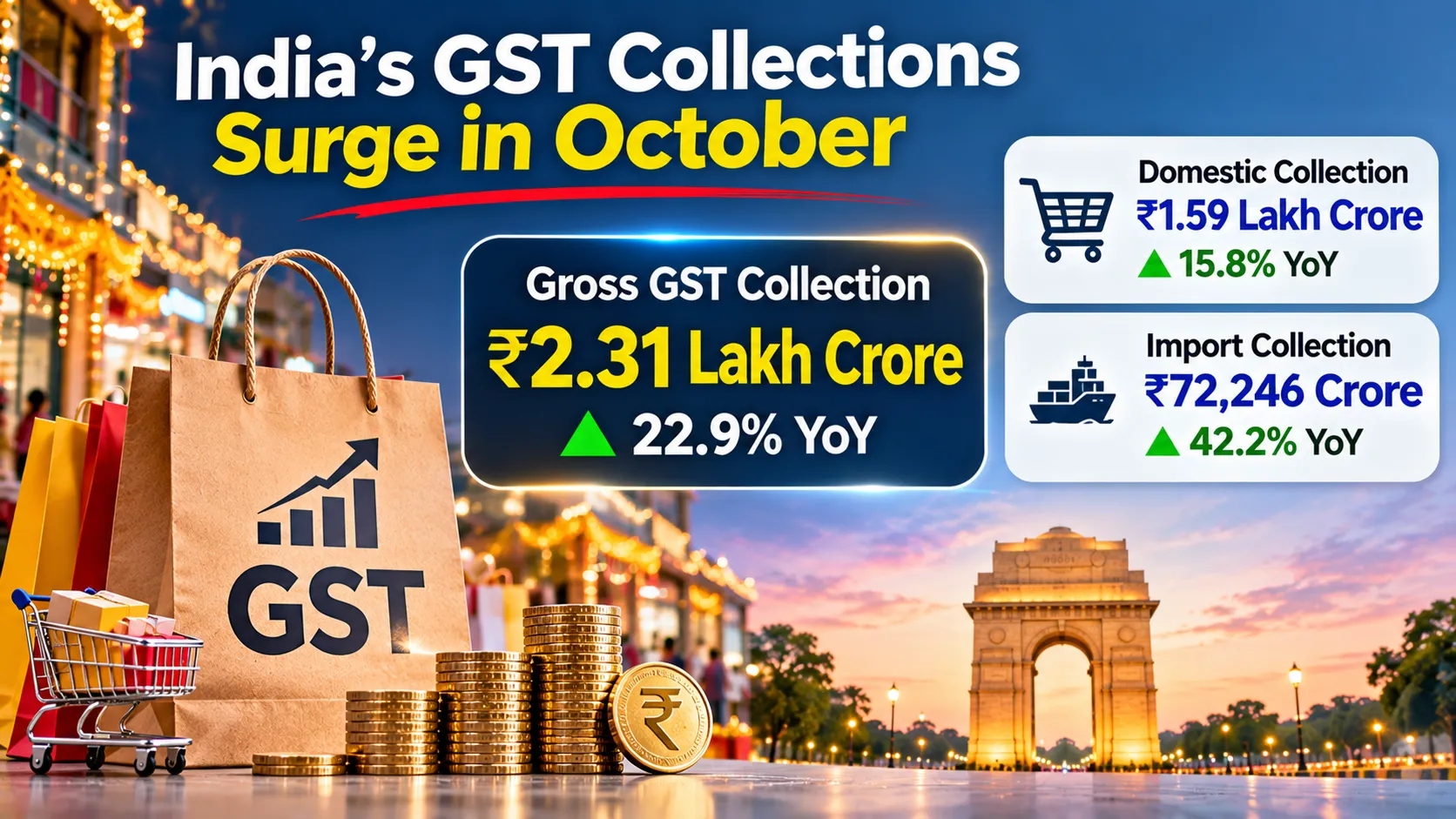
Gross GST collections rose 22.9% to ₹2.31 lakh crore in October 2026, from ₹1.88 lakh crore a year earlier, according to provisional data released by the finance ministry on Sunday, November 1, and reported by The Tribune. Net revenue after refunds rose 25.6% to ₹2.03 lakh crore from ₹1.61 lakh crore.
The figures, which largely reflect transactions carried out in September, come at a crucial moment for the government's finances, offering a cushion as subsidy costs climb because of the conflict in the Middle East.
Domestic and import collections
Domestic gross GST revenue rose 15.8% to ₹1.59 lakh crore from ₹1.37 lakh crore, reflecting strong consumption across the economy. GST collected on imports grew much faster, rising 42.2% to ₹72,246 crore from ₹50,796 crore.
The sharp rise in import-related GST is partly a reflection of higher prices. Crude oil, petroleum products, fertilisers and other commodities have become more expensive this year because of supply disruptions linked to the Middle East conflict. Because GST on imports is calculated as a percentage of value, higher prices automatically translate into higher tax receipts, even if volumes do not change much.
Within the domestic total, central GST (CGST) stood at ₹42,935 crore, state GST (SGST) at ₹51,340 crore and integrated GST (IGST), which applies to inter-state transactions, at ₹64,769 crore.
Refunds and net revenue
Refunds totalled ₹27,934 crore, up 6.5% from a year earlier. Domestic refunds rose 9.8% to ₹14,007 crore, while import-related refunds rose 3.4% to ₹13,927 crore. Exporters receive refunds of GST paid on inputs, so refund trends partly reflect export activity.
After refunds, net domestic GST revenue rose 16.4% to ₹1.45 lakh crore, and net customs-related GST jumped 56.2% to ₹58,319 crore.
The festive effect
October's collections capture the build-up to India's main festive season, when households traditionally buy cars, two-wheelers, electronics, appliances, clothing and gold. Data released on the same day showed passenger vehicle makers including Maruti Suzuki, Hyundai, Mahindra & Mahindra and Kia reporting record domestic sales in October, while digital payments through UPI hit an all-time high.
Retailers and e-commerce platforms reported strong demand during festive sales events, and quick commerce platforms have added to the convenience of spending. Strong consumption is a key driver of GST receipts, since the tax is levied on most goods and services.
States leading the way
Maharashtra, India's largest state economy, collected ₹35,150 crore in domestic GST, up 13% from a year earlier. Karnataka collected ₹15,922 crore, up 18%, Gujarat ₹13,516 crore, up 16%, and Haryana ₹11,529 crore, up 17%.
Some smaller and less industrialised states recorded faster growth. Assam's collections rose 47% to ₹1,934 crore, while Uttar Pradesh and Bihar each recorded growth of 24%. Rising consumption in populous states in the north and east suggests that growth is broadening beyond the traditional industrial centres of the west and south.
Year-to-date momentum
For the first seven months of the financial year, from April to October, gross GST collections rose 13.2% to ₹14.77 lakh crore from ₹13.05 lakh crore. Net collections rose 12.6% to ₹12.69 lakh crore.
The second-highest monthly total since GST's launch in July 2017 places October 2026 just behind the record month, typically April, when collections are boosted by year-end transactions from the previous financial year.
A cushion for the budget
The strong collections are welcome news for the finance ministry. Data released on October 30 showed the government's fiscal deficit for April-September at ₹7.14 lakh crore, or 42.1% of the full-year target, with subsidies running at 54% of the annual budget as fertiliser and fuel costs rose. Higher-than-expected tax receipts help offset this pressure and improve the chances of meeting the fiscal deficit target of 4.3% of gross domestic product for 2026-27.
GST revenue is shared between the centre and the states, so strong collections also support state finances, which fund a large share of public spending on health, education, police and infrastructure.
Inflation in the numbers
Not all of the growth reflects stronger real demand. Part of the increase in GST collections comes from inflation, as higher prices for fuel, transport, packaging and raw materials push up the value of transactions. Economists typically distinguish between nominal growth, which includes price increases, and real growth, which strips them out.
With commercial LPG and jet fuel prices raised again on November 1, and companies reporting higher input costs, inflation remains a concern for policymakers. The Reserve Bank of India will weigh strong consumption against inflation risks as it considers its next monetary policy decision.
The GST journey
GST replaced a complex web of central and state taxes in July 2017, creating a unified national market. Its early years were marked by teething problems, including technical glitches, frequent rate changes and compliance challenges for small businesses. Collections have grown steadily as compliance has improved through measures such as e-invoicing, e-way bills and data analytics to detect evasion.
The GST Council, which includes the union finance minister and state finance ministers, continues to refine rates and procedures. Debates over rationalising tax slabs and bringing petroleum products and electricity under GST remain on the agenda.
What economists will watch
Economists will look at whether GST momentum is sustained after the festive season, when consumption typically moderates. They will also watch the balance between domestic and import collections, since a slowdown in domestic consumption would be a more significant concern than fluctuations in import values driven by commodity prices.
The trajectory of oil prices will be particularly important. If prices ease, import-related GST could moderate, but domestic consumption could benefit from lower inflation.
What it means for business
For businesses, strong GST collections reflect healthy demand in many sectors, particularly automobiles, consumer durables and retail. Companies selling to Indian consumers have generally reported robust festive demand, although margins have been squeezed in some sectors by rising input costs.
Formalisation of the economy, encouraged by GST and digital payments, has also benefited organised businesses at the expense of the informal sector, contributing to stronger revenue growth for listed companies.
The diaspora view
For the Indian diaspora and global investors, robust tax collections reinforce the picture of an economy that continues to grow strongly despite external shocks. Healthy public finances support the rupee and the stability of Indian government bonds, which have attracted foreign investment since India's inclusion in global bond indices.
What comes next
November's collections, which will be released on December 1, will reflect transactions during the peak Diwali period and will provide a further indication of the strength of festive demand. The government will also watch revenue closely as it prepares the revised estimates for the Union Budget in February. For now, October's figures suggest that India's consumption engine is running strongly, even as the economy absorbs the impact of high global energy prices.