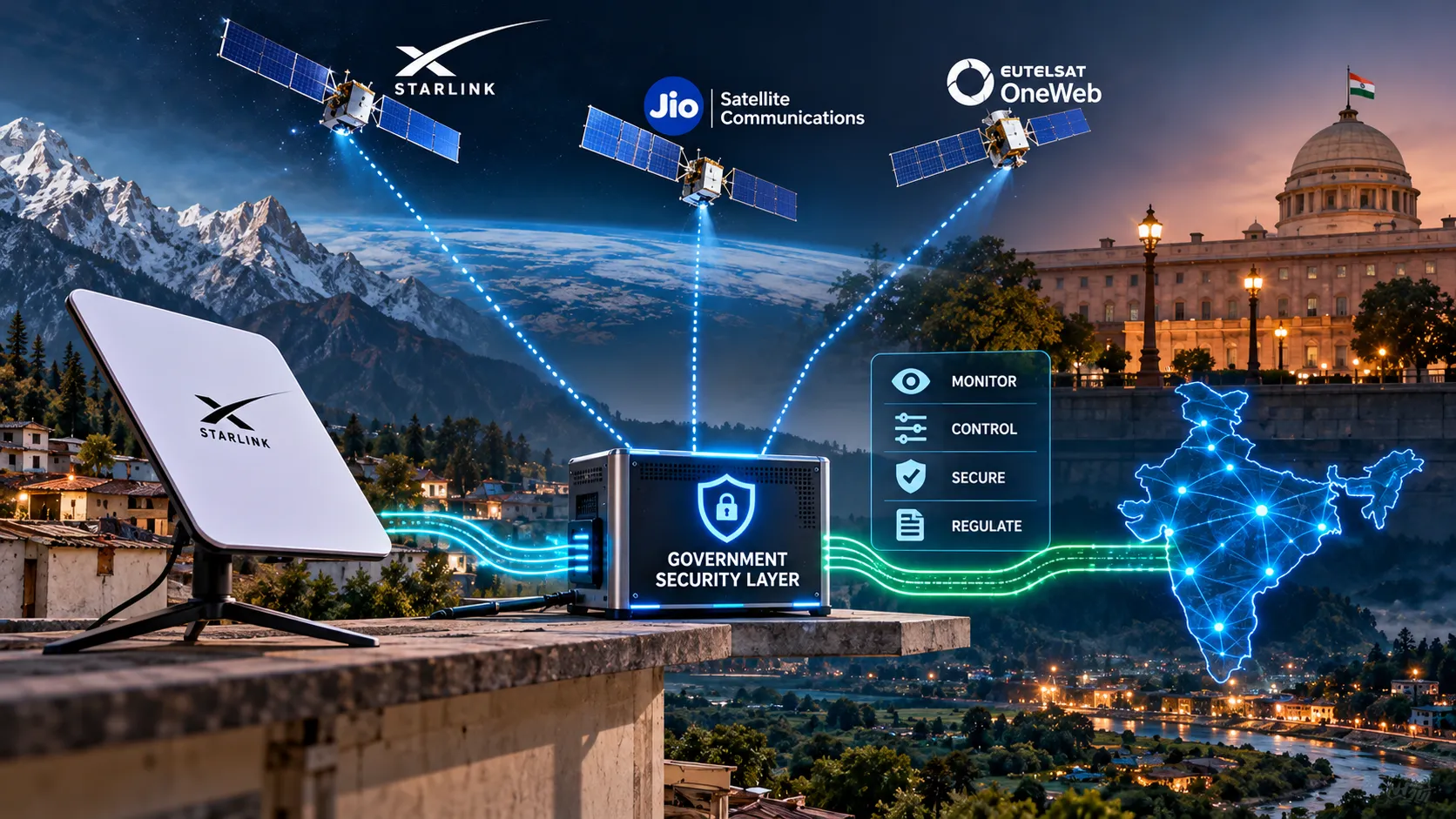
India's satellite internet market, still awaiting its first commercial launch, may face a new layer of security requirements. The government is considering a hardware device that would act as a control layer between users and satellite networks, with all satellite traffic routed through it, according to a report by Inc42 on October 20, citing the Economic Times.
The proposal is aimed at strengthening oversight of foreign-controlled satellite networks, particularly during conflicts or national security emergencies. An official quoted in the report said it would address risks from foreign satellite operators that may be treated as "untrusted transport carriers."
The device could be installed at subscriber premises or at satellite ground stations, known as gateways. The government is considering involving public sector research and development units with communications expertise, and select private companies may also take part. The proposal is still under discussion, and its technical specifications and implementation timeline have yet to be finalised.
Who would be affected
The requirement would apply to the three companies that hold licences to offer satellite broadband in India: Elon Musk's Starlink, Reliance's Jio Satellite Communications and Bharti-backed Eutelsat OneWeb.
All three hold Global Mobile Personal Communication by Satellite (GMPCS) licences, but none can yet sell services commercially. Each must complete security assessments and meet other conditions before spectrum is assigned and commercial service can begin. A licence and authorisation from IN-SPACe, the national space regulator, do not by themselves complete the security assessment or secure spectrum.
The Ministry of Communications has said the three operators are at broadly the same regulatory stage and has denied giving preferential treatment to any of them. Musk has publicly accused Indian business interests of blocking Starlink's entry, while Reliance has rejected those allegations and said Jio's satellite services are also awaiting clearances.
The Ukraine factor
The proposal reflects growing concern globally about the power that private satellite operators can wield. In Ukraine, Starlink has been a critical communications lifeline for the military and civilians since Russia's invasion in 2022. But its role has also raised questions about the influence of a single company over a country's wartime communications.
Ukrainian President Volodymyr Zelenskyy has accused Starlink of slowing connection speeds and impeding operations during the conflict with Russia, according to the report. A Wall Street Journal report this week said Musk had ordered a slowdown of the Starlink service used by Ukraine's military. Iran and South Africa have also raised concerns about Starlink in the past.
For Indian policymakers, these episodes illustrate the risks of depending on foreign-controlled infrastructure for critical communications. A hardware control layer under Indian supervision could, in theory, allow authorities to maintain oversight of traffic and ensure that services can be managed in accordance with Indian law, even in an emergency.
Expert views
Security experts have long argued that foreign satellite networks present unique challenges. Tarun Wig of cybersecurity company Innefu Labs said foreign-controlled satellite networks could create risks around data sovereignty, service continuity and external control of critical infrastructure. He added, however, that the Ukraine situation does not automatically mean India would face the same risks.
Sohom Banerjee of Quantive Advisory pointed to the kinds of operational checks regulators might seek, covering who can activate terminals, change routing or coverage, access sensitive network information and suspend services.
Balancing security and speed
The proposal raises difficult trade-offs. A mandatory hardware layer could add cost and complexity for operators, potentially raising prices for consumers in a market where affordability is crucial. It could also affect network performance if traffic must pass through additional equipment, and it may extend the already lengthy approval process.
Satellite operators have faced years of regulatory delay in India. OneWeb received its GMPCS licence in August 2021, Jio Satellite Communications in March 2022 and Starlink in June 2025. Security assessments and spectrum assignment remain pending for all three. Adding new technical requirements could push commercial launches further into the future.
On the other hand, clear and predictable security rules could provide certainty for operators and reassure policymakers, potentially smoothing the path to approval once the requirements are defined. India already requires telecom operators to comply with lawful interception rules, data localisation for certain categories of data, and trusted source requirements for network equipment.
The stakes for connectivity
Satellite broadband could help connect remote and underserved regions of India, from mountain villages to islands, where laying fibre or building mobile towers is expensive. It could also serve aviation, maritime, defence and enterprise customers. India's space sector reforms have opened the industry to private investment, and the country now has hundreds of spacetech startups.
However, no satellite internet service has yet launched commercially in India, and consumer pricing has not been announced. Analysts expect satellite broadband to complement rather than replace mobile and fibre networks for most users.
How satellite internet works
Satellite internet services such as Starlink use constellations of satellites in low Earth orbit to deliver broadband connectivity. Users connect through terminals that communicate with satellites passing overhead, which relay traffic to ground stations connected to the wider internet. Because the satellites orbit relatively close to Earth, latency is much lower than with traditional geostationary satellite services.
The technology can deliver high-speed internet to remote and rural areas where laying fibre or building mobile towers is expensive or impractical. That makes it attractive for a country like India, where millions of people in hilly, forested and remote regions still lack reliable connectivity. But because traffic can bypass domestic networks, governments are concerned about their ability to monitor communications and enforce laws, which is driving the push for control mechanisms.
What comes next
The proposal remains under discussion, and its final form will depend on technical evaluations and consultations with industry. Key questions include who would design and operate the control layer, who would bear the cost, and how it would interact with operators' own security systems.
For Starlink, Jio and OneWeb, the development adds another variable to an approval process that has already stretched for years. For India, it signals that in the age of satellite internet, national security considerations will shape not only who can operate networks, but how those networks are built. Whatever the final design, the outcome will shape how quickly satellite broadband reaches Indian consumers and on what terms.