India's factories continued to expand at a healthy pace in October, with strong demand from overseas customers helping to offset a slight moderation in overall growth, according to a closely watched business survey.
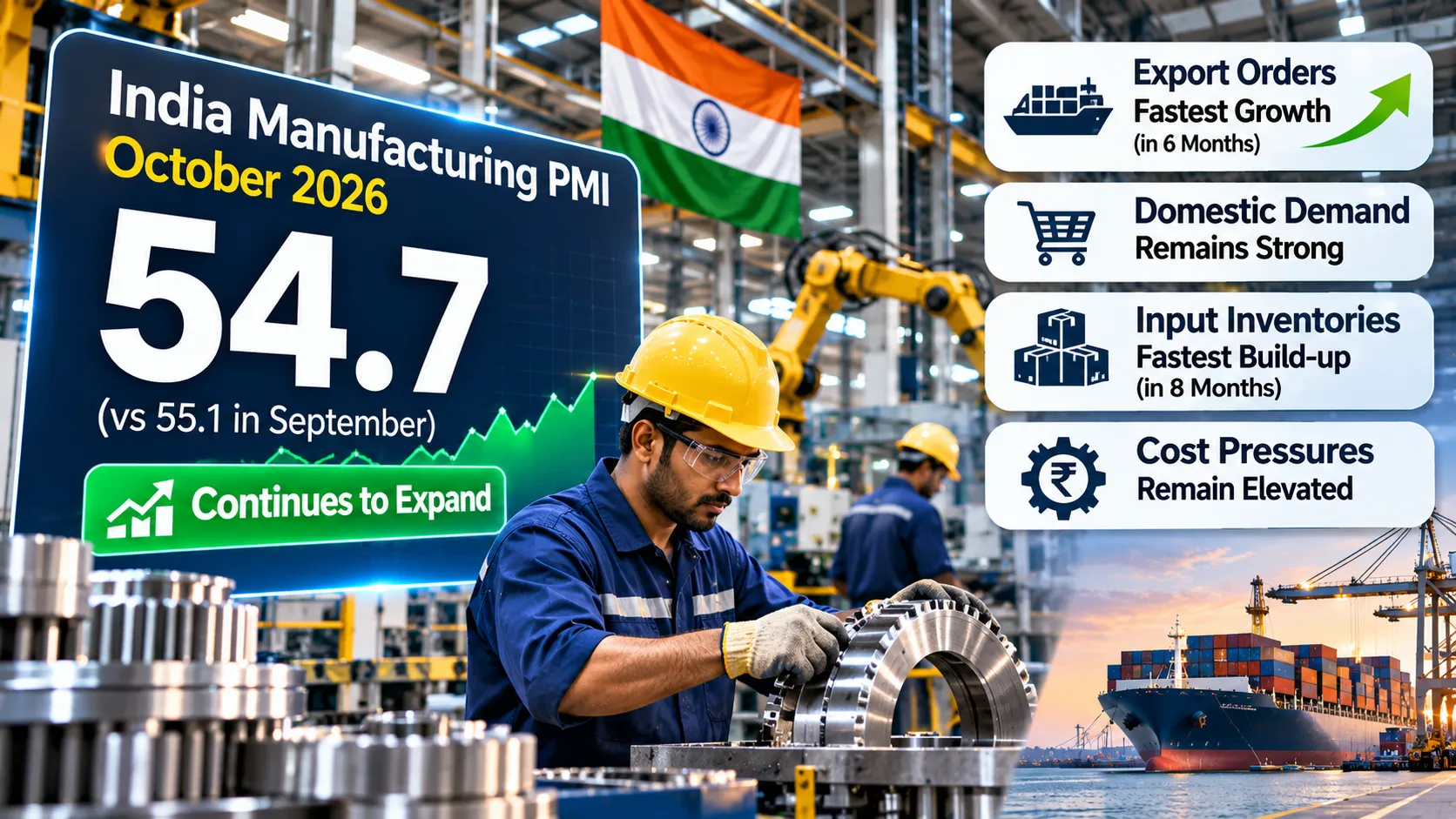
The HSBC India Manufacturing Purchasing Managers' Index (PMI), compiled by S&P Global, eased to 54.7 in October from 55.1 in September, according to data released on Monday, November 2, and reported by IANS. A reading above 50 indicates expansion, and the index remained above its long-run average.
The index "remained firmly in expansionary territory and above its long-run average," said Pranjul Bhandari, chief India economist at HSBC.
Export demand accelerates
The standout feature of the October survey was export demand. New export orders grew at their fastest pace in six months, with manufacturers reporting gains from markets including Bangladesh, Canada, the United States, the United Kingdom and the United Arab Emirates, according to the survey.
"Strong international demand pushed growth of new export orders to a six-month high," Bhandari said.
The rise in export orders is encouraging given the challenges facing global trade, including US tariffs and disruptions to shipping routes caused by the Middle East conflict. Indian manufacturers have benefited from global companies seeking to diversify their supply chains away from China, as well as from a weaker rupee, which makes Indian goods more competitive abroad.
Domestic demand remains strong
New orders overall rose sharply, although growth slipped slightly from September's seven-month high and remained strong by historical standards. "Panel members cited favourable demand trends, new client wins and successful marketing campaigns," according to the S&P Global data.
Output rose at a sharp pace, above its long-run average, though the increase was softer than in September. The festive season, which drove record car sales and GST collections, has supported demand for manufactured goods across sectors.
Building inventories
Manufacturers built up stocks of inputs at the fastest rate in eight months, according to the survey. This reflects both strong demand and precautionary buying, as companies seek to protect themselves against supply disruptions and rising prices linked to the Middle East conflict.
Higher inventory holdings require more working capital, which is consistent with reports that Indian companies' working-capital needs have risen by between 12% and 20% in recent months, increasing demand for bank credit.
Price pressures
Some material and energy costs climbed during October, the survey found, reflecting higher prices for fuel, chemicals and other inputs. Output price pressures eased slightly compared with September, according to the HSBC economist's assessment, suggesting that manufacturers have limited ability to pass on all cost increases to customers.
Commercial LPG and jet fuel prices were raised again on November 1, the third and fourth consecutive monthly increases respectively, adding to cost pressures for businesses that rely on these fuels.
Hiring subdued, confidence weakens
Firms continued to add jobs in October, but hiring was subdued, according to the survey. Business confidence about the year ahead weakened, which may reflect uncertainty about the global economy, energy prices and trade policy.
Weaker confidence could affect investment decisions if it persists, although strong order books provide some reassurance.
How the PMI works
The PMI is based on monthly surveys of purchasing managers at around 400 manufacturing companies. It measures changes in new orders, output, employment, suppliers' delivery times and stocks of purchases. Because it is released early each month and focuses on direction rather than levels, it is closely watched as an early indicator of economic conditions.
India's manufacturing PMI has remained above 50 for several years, reflecting the sector's consistent expansion since the pandemic.
Comparison with other economies
India's manufacturing performance compares favourably with many other major economies. China's private RatingDog manufacturing PMI stood at 52.0 in October, while the country's official PMI fell into contraction at 49.3. Many European economies have seen manufacturing struggle with high energy costs. India's strong domestic demand and growing role in global supply chains have helped it outperform.
Policy implications
For the Reserve Bank of India, strong manufacturing activity supports the case for keeping monetary policy focused on inflation, given rising input costs. The government will also see the data as evidence that its manufacturing initiatives, including production-linked incentives and infrastructure investment, are bearing fruit.
Make in India momentum
The government has set ambitious goals to increase manufacturing's share of the economy, through schemes supporting electronics, automobiles, pharmaceuticals, textiles, semiconductors and other sectors. Recent approvals include a ₹10,000 crore scheme to promote container manufacturing and an extension of the production-linked incentive scheme for textiles.
Electronics manufacturing, particularly smartphones, has been a notable success, with India becoming a major exporter of iPhones and other devices.
What it means for business
For manufacturers, the October survey suggests that demand conditions remain favourable, particularly for exporters. However, rising input costs and weaker confidence underline the need for careful cost management and supply chain planning.
Sector highlights
While the PMI survey does not publish sector-by-sector figures in its headline release, recent data from other sources point to strong activity in automobiles, electronics, pharmaceuticals and capital goods. Car makers reported record sales in October, and electronics manufacturers have benefited from government incentives and global supply chain shifts. Capital goods makers, supplying machinery and equipment for infrastructure and industrial projects, have reported strong order books.
Sectors exposed to high input costs, such as chemicals, plastics and textiles, face greater margin pressure, though export demand provides some support.
The rupee factor
A weaker rupee has helped Indian exporters by making their products cheaper for foreign buyers. The rupee has weakened significantly this year as high oil prices and foreign portfolio outflows have put pressure on the currency, with the Reserve Bank of India intervening to smooth volatility. While a weaker currency raises the cost of imported inputs, it can boost the competitiveness of exports, contributing to the rise in export orders reported in the survey.
What comes next
The services PMI, due later in the week, will show whether India's larger services sector is maintaining its strong momentum. Combined with the manufacturing data, it will provide a comprehensive picture of economic activity in October. Investors and policymakers will watch whether export strength continues as global trade conditions evolve and whether input cost pressures ease in the coming months.
Economists will also watch whether rising input costs begin to feed through more strongly into output prices, which would complicate the inflation outlook and the Reserve Bank of India's policy choices in the months ahead.