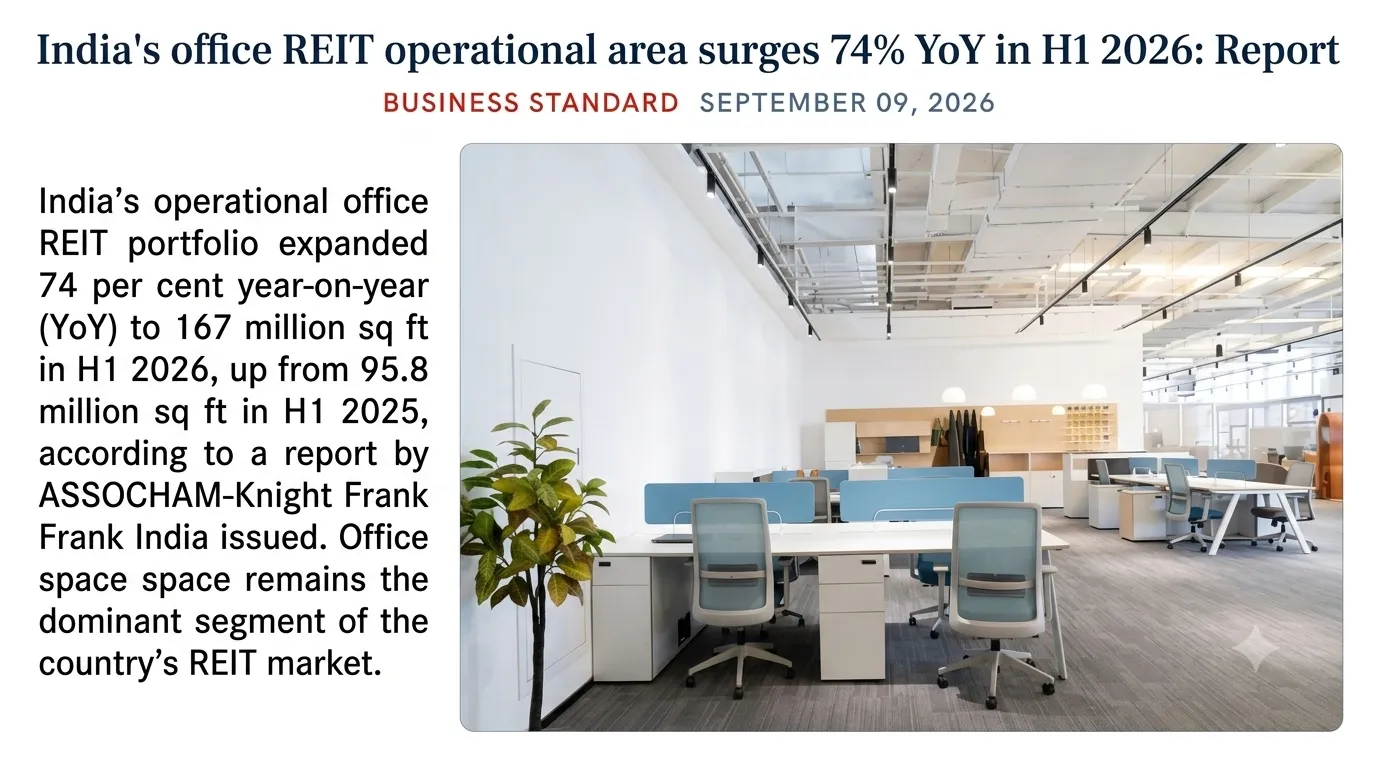
India's operational office real estate investment trust footprint surged 74% year-on-year to 167 million square feet in the first half of 2026, according to real estate market data, with REIT-held office space now representing approximately 16% of the country's total office stock, a substantial expansion that reflects both continued growth in India's commercial office market and the increasing adoption of the REIT structure as a preferred vehicle for institutional and retail investors seeking exposure to Indian commercial real estate. The scale of this year-on-year growth significantly outpaces the broader Indian commercial office market's own expansion rate, indicating that REIT-held properties have captured a disproportionate share of new office space additions and portfolio consolidation activity within the sector over the preceding twelve months.
India's REIT market remains considerably younger than comparable structures in more mature real estate investment markets internationally, having only been introduced as a regulated investment vehicle within the country roughly a decade ago, but the structure has steadily gained traction among both commercial real estate developers seeking efficient capital recycling mechanisms and investors seeking liquid, dividend-yielding exposure to Indian commercial property without the operational complexity and illiquidity that direct property ownership traditionally entails. The 74% year-on-year growth in REIT-held office footprint suggests this adoption curve has accelerated meaningfully over the past year specifically, potentially reflecting a combination of existing REITs acquiring additional properties to expand their portfolios and newer REIT vehicles entering the market to hold previously private office real estate assets. The expansion of REIT-held office space as a proportion of India's total office stock, now standing at approximately 16%, still leaves considerable room for continued growth relative to more mature markets internationally, where REIT structures often hold a meaningfully larger share of institutional-grade commercial office space, suggesting India's REIT market remains in a relatively early stage of its broader development trajectory even after this most recent period of accelerated expansion.
Institutional and retail investor demand for India REIT units has generally remained robust over recent years, drawn by the combination of relatively stable, contractually locked-in rental income from institutional-grade office tenants and the liquidity advantage that publicly traded REIT units offer relative to direct commercial property ownership, which typically requires substantially larger capital commitments and lacks comparable secondary market liquidity for investors seeking to exit their positions. This sustained investor demand has, in turn, provided commercial real estate developers with an increasingly attractive capital recycling mechanism, allowing them to monetise completed, stabilised office assets through REIT vehicles and redeploy the resulting capital toward new development projects rather than holding completed properties on their own balance sheets indefinitely. India's broader office real estate market has benefited from sustained demand from both domestic corporate occupiers and the global capability centre operations that multinational companies have increasingly established across major Indian cities, a demand driver that has provided the underlying occupancy and rental growth fundamentals supporting the office REIT sector's expansion, even as questions about the long-term impact of hybrid and remote work arrangements on office space demand have periodically weighed on commercial office market sentiment in other major global markets.
For India's broader capital markets, the accelerating growth of the REIT sector represents a meaningful expansion of the investment vehicles available to both institutional and retail investors seeking exposure to real estate as an asset class, historically underrepresented within organised Indian capital markets relative to the substantial role real estate has traditionally played within Indian household wealth allocation through direct property ownership. As REIT structures continue gaining broader market acceptance and additional REIT vehicles potentially enter the market covering additional property categories beyond office real estate, including retail and industrial or logistics real estate, the overall scale and diversity of India's REIT sector appears positioned for continued substantial growth over the coming years. The practical implications of this REIT sector expansion extend beyond capital markets structure to the broader commercial real estate development ecosystem, as developers increasingly factor the availability of REIT-based capital recycling into their own development financing strategies from the outset of new office project planning, a structural shift that could meaningfully influence the pace and geographic distribution of India's future commercial office development as REIT structures become an increasingly standard, rather than novel, financing mechanism within the sector. The specific composition of India's REIT sector has also begun diversifying beyond the initial wave of REITs that launched holding primarily premium office assets in India's largest metro markets, with more recent REIT vehicles increasingly exploring exposure to office assets in India's expanding tier-two city markets, where lower property acquisition costs and growing corporate occupier interest, particularly from global capability centres seeking lower-cost alternatives to the most expensive metro office markets, have created new opportunities for REIT portfolio expansion beyond the initial concentration in Bengaluru, Mumbai and Delhi-NCR that characterised the sector's earliest years. Retail investor participation in India's REIT market has grown steadily as awareness of the investment vehicle has spread beyond the institutional investor base that dominated the sector's earliest years, aided partly by regulatory changes that have progressively lowered the minimum investment thresholds required for retail participation in REIT units, a democratisation trend that has broadened the investor base supporting continued REIT sector growth beyond what institutional demand alone would likely have sustained at the current pace of expansion. Global institutional investors, including several large sovereign wealth funds, have reportedly increased their allocations to Indian REIT units over the past year, drawn by the combination of dollar-denominated rental income stability and India's continued strong underlying commercial real estate demand fundamentals relative to more mature global office markets. REIT sector analysts have also pointed to India's continued strength in attracting global capability centre operations as a structural demand driver likely to sustain office REIT growth over the medium term, given that these centres typically sign longer-duration leases with stronger corporate credit profiles than many domestic occupiers, characteristics that REIT portfolio managers particularly value when evaluating new tenant commitments. Analysts expect the pace of new REIT listings to continue over the coming years as additional developers explore the structure, further deepening the liquidity and investor choice available within India's still-maturing REIT market.