India's economy is expected to have grown at a robust pace in the July-September quarter, according to economists, despite a turbulent global backdrop that included a sharp rise in oil prices, US tariff pressures and volatile financial markets.
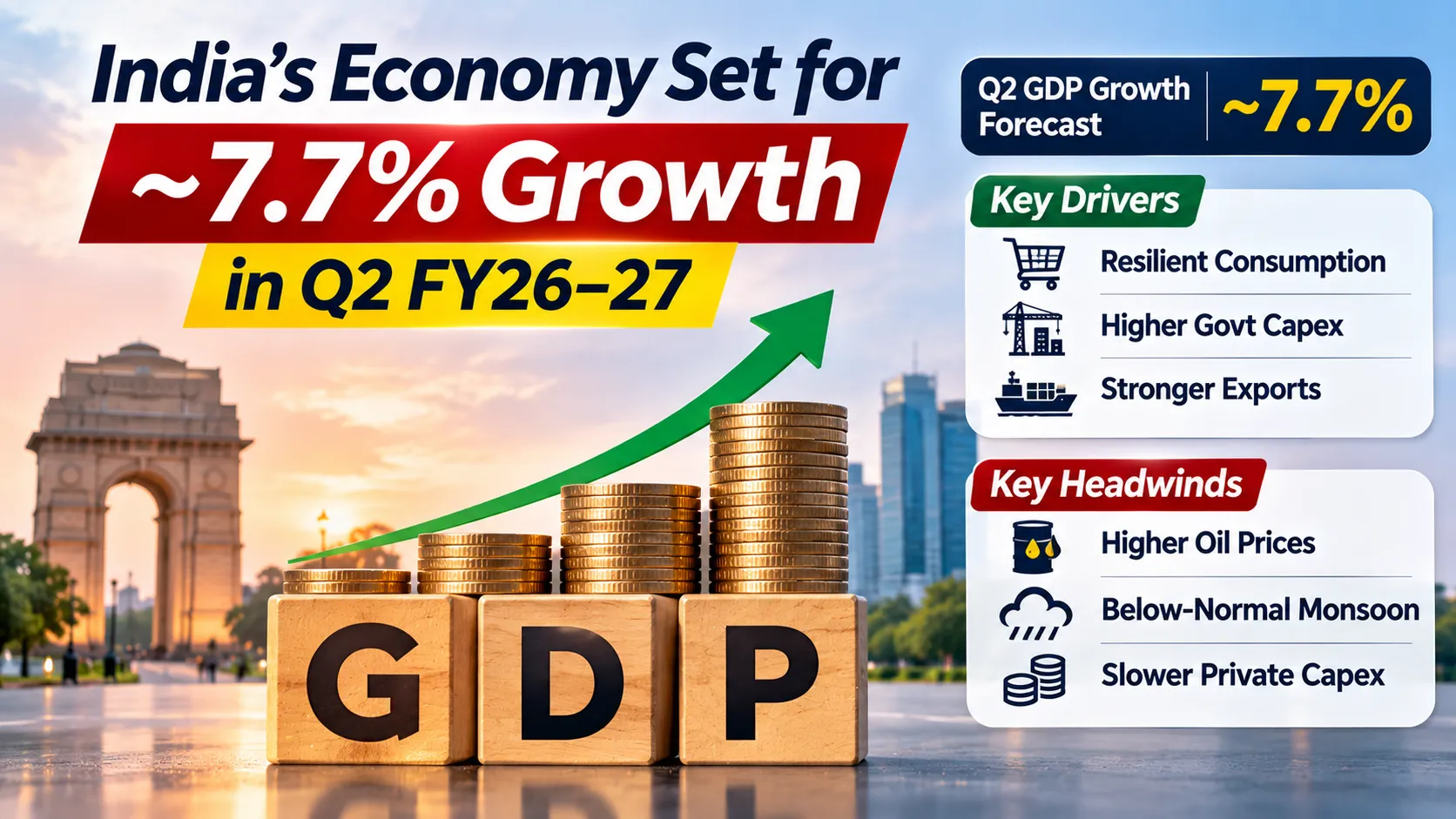
A poll of economists conducted by The Economic Times projects GDP growth of about 7.7% for the second quarter of the 2026-27 financial year. Reporting on November 22, Business Standard said robust demand likely kept growth resilient, with the median forecast pointing to 7.7% expansion despite drags from weather and capital expenditure.
The official estimate from the National Statistics Office (NSO) is due on November 30.
A range of forecasts
Forecasts for the quarter vary. The Finance Ministry has estimated real GDP growth of about 7.3% for the quarter. SBI's research team has been more optimistic, forecasting about 7.8%. Other estimates published in mid-November centred around 7.5%.
The Reserve Bank of India's earlier projection was considerably lower. The RBI forecast Q2 growth of 6.4% in August, before data for the first quarter showed that the economy had grown 7.8% in April-June. The central bank currently expects growth to average about 6.7% for 2026-27.
If the outcome comes in near 7.7%, it would mean India grew at close to 8% in the first half of the fiscal year. That would keep it among the fastest-growing major economies in the world.
What drove growth
Economists point to several drivers behind the strong performance. Domestic consumption has remained resilient, supported by rising incomes, lower inflation in some categories and tax changes that left more money in consumers' hands.
Government capital expenditure on infrastructure, including roads, railways and urban projects, has continued to support construction activity and related industries such as steel and cement.
Exports have also performed strongly in recent months. Merchandise exports surged to a record $49.47 billion in October, up about 45% from a year earlier. Engineering goods, petroleum products and electronics led the increase, and shipments to Africa and Asia grew particularly fast in the first half of the fiscal year.
Manufacturing activity has benefited from production-linked incentive schemes and from global companies diversifying their supply chains towards India.
Headwinds
The quarter was not without challenges. Below-average monsoon rains, linked to El Niño conditions, weighed on parts of the agricultural sector. Higher oil prices during the conflict involving Iran raised costs for businesses and households and pressured the rupee, which hit record lows during the year.
Some economists have flagged a slowdown in private capital expenditure, which has not kept pace with government investment. Business Standard reported that a drag from capex was among the factors that could limit growth.
Global uncertainty, including US trade policy and a sharp selloff in global technology stocks, also weighed on sentiment. Foreign investors were heavy sellers of Indian equities for much of the year before returning in force in recent weeks.
A slower second half?
Most economists expect growth to slow in the second half of the fiscal year. The effects of weaker rains on rural incomes, higher costs and a less supportive base effect could moderate growth in October-December and January-March.
Still, even a slowdown to the 6.5-7% range would leave India growing faster than most major economies. The full-year outlook will depend on the path of oil prices, global demand, and the pace of private investment.
Implications for policy
Strong growth data could influence the RBI's thinking on interest rates. If growth remains robust and inflation contained, the central bank may feel less urgency to cut rates. On the other hand, a slowdown in the second half could strengthen the case for easing.
For the government, strong growth supports tax revenues, which helps fund spending commitments while keeping the fiscal deficit on track. The upcoming Union Budget for 2027-28 will be prepared against the backdrop of these growth figures.
Why it matters for investors
GDP data is closely watched by investors as an indicator of corporate earnings potential. Strong growth supports profits in sectors tied to domestic demand, such as banking, consumer goods, autos and real estate.
The timing is notable. Indian equities have just recorded four consecutive weeks of gains, reaching nine-month highs on record foreign buying. A strong GDP print could reinforce the view among global investors that India offers reliable growth at a time when other markets face uncertainty.
However, markets often price in expectations ahead of data releases. A figure in line with forecasts may have limited impact, while a significant surprise in either direction could move markets.
Measuring growth
Economists sometimes caution that headline GDP figures can be affected by statistical factors, such as the GDP deflator used to adjust for inflation. When inflation is low, real growth can appear stronger. Gross value added (GVA), which measures output by sector, is often watched alongside GDP for a more stable picture.
India is also in the process of updating its national accounts methodology and base year, which could affect how growth is measured and compared in the future.
The bigger picture
For The Impactful Global Indian's readers, the expected figures reinforce India's position as one of the world's fastest-growing large economies. Sustained growth of 7% or more would help India move closer to becoming the world's third-largest economy and support the long-term goal of becoming a developed nation by 2047.
The coming data release on November 30 will show whether the economy performed as strongly as economists expect. Whatever the precise figure, the broader picture is of an economy that has held up well in the face of significant global and domestic challenges.
Sectors to watch in the data
When the figures are released, economists will look closely at the breakdown by sector. Manufacturing output will indicate whether production-linked incentives and supply chain diversification are translating into broad-based industrial growth. Construction will show the effect of government infrastructure spending. Agriculture will reveal the impact of the uneven monsoon on rural output, and services, which make up more than half of the economy, will show the strength of trade, transport, finance and real estate. On the demand side, private consumption and investment figures will help determine whether growth is being driven by households and businesses or primarily by the state.


