Indian companies raised a record amount of money from the stock market in the first half of the financial year, defying a lacklustre secondary market and underlining how domestic savings are reshaping the country's capital markets.
Companies raised ₹2.43 lakh crore, or about $25.3 billion, through equity offerings between April and September 2026, according to data from PRIME Database Group reported at the start of October. That was 75% more than in the same period a year earlier and the highest half-yearly total on record.
The surge came even though the benchmark Nifty 50 index rose only about 1.3% over the six months. Separate reporting noted that the Nifty fell around 6% in September alone, yet primary markets still raised record funds that month.
The divergence between a flat stock market and a booming new-issue market tells an important story about who is buying Indian equities and why.
IPOs lead the way
Mainboard initial public offerings raised about ₹94,205 crore across 78 issues, according to PRIME Database, roughly 35% more than the previous record set in the first half of FY26.
Investors in those IPOs did well on average. Listing-day gains averaged 19%, compared with 7% a year earlier, a return that has helped sustain enthusiasm for new issues.
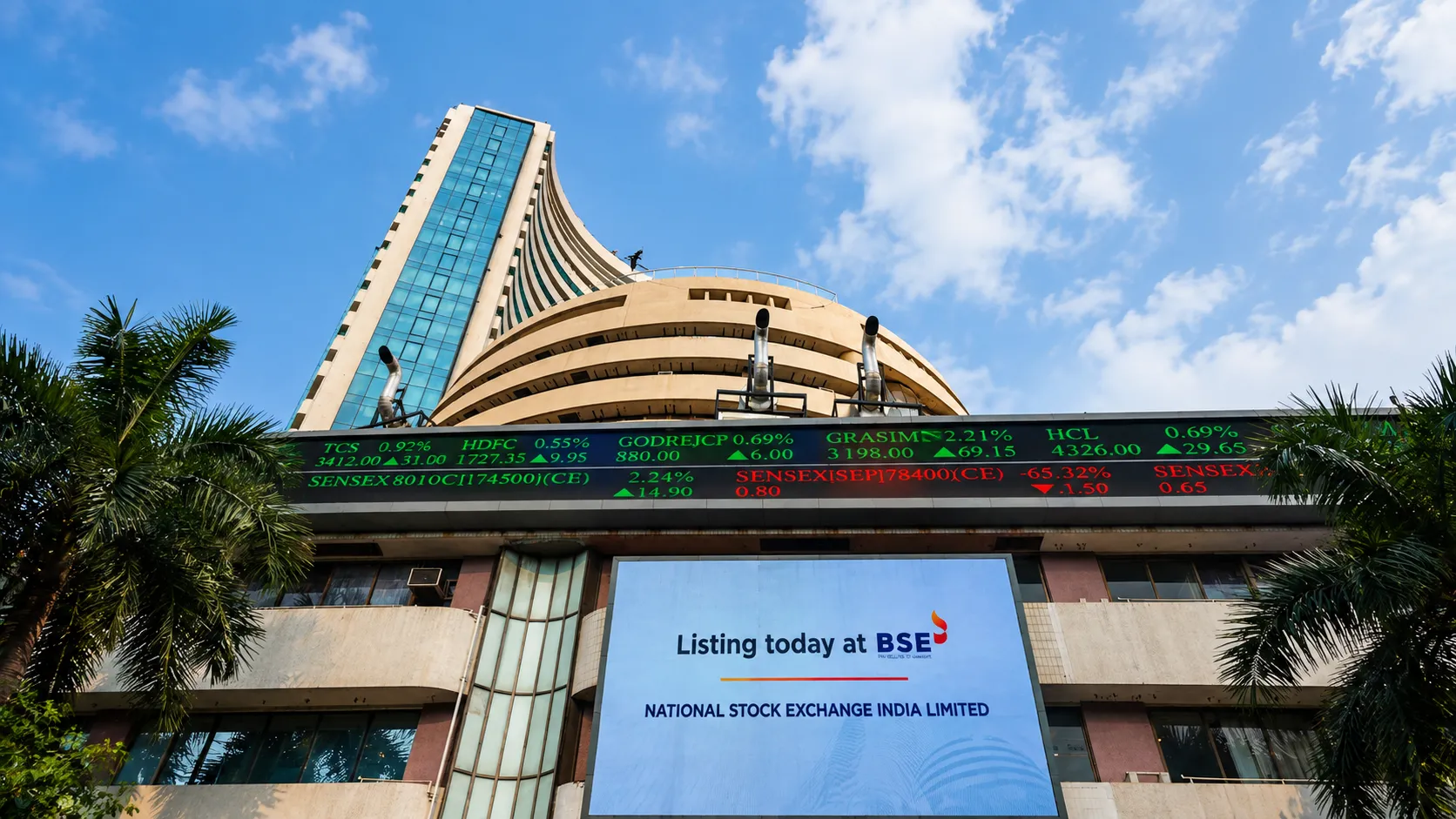
Three large offers dominated. The National Stock Exchange's long-awaited IPO raised about $2.3 billion, SBI Funds Management, the asset manager backed by the State Bank of India, raised about $1.03 billion, and Manipal Health Enterprises raised about $960 million. The NSE offer in particular was a landmark: the exchange operator had waited years for regulatory clearance, and its listing was oversubscribed several times over.
Fintech lender Moneyview's listing on 1 October offered a fresh example of investor appetite. Its shares debuted at a premium of about 64% on the BSE after the issue was subscribed roughly 100 times, delivering large returns for early backers.
Follow-on offers and QIPs also surge
The boom was not limited to first-time issuers. Secondary offerings by existing listed companies and their shareholders raised ₹55,337 crore, about five times the previous year's total. The largest single contributor was a sale of a 6.5% stake in Life Insurance Corporation of India, worth about ₹31,400 crore.
Qualified institutional placements, which allow listed companies to raise money quickly from institutional investors, brought in ₹61,553 crore, an increase of 36%.

Why primary and secondary markets have diverged
The main driver is the steady flow of domestic money into equities. Monthly contributions through systematic investment plans in mutual funds have become a reliable source of demand, and Indian households have been shifting a larger share of their savings from bank deposits and physical assets into financial markets. That money needs a home, and large new issues provide it.
Foreign portfolio investors, by contrast, tend to be more sensitive to valuations relative to other emerging markets, to global interest rates and to geopolitical risks, all of which have been in focus this year. When foreign investors sell in the secondary market while domestic investors buy new issues, index performance can stay muted even as fundraising booms.
There is also a supply-side story. Promoters, private equity firms and venture capital investors have been using strong domestic demand as an opportunity to sell. Many of the IPOs in recent quarters included large offer-for-sale components, which return money to existing shareholders rather than funding new investment by the companies themselves. That is a healthy exit route for long-term investors, but it also means that not all of the record sum represents fresh capital for expansion.
Risks for investors
Rising issuance can test market capacity. When the supply of new shares grows faster than incoming savings, prices of existing stocks can come under pressure as investors sell holdings to fund new subscriptions. Some analysts also watch for signs that pricing discipline is slipping as issuers try to capitalise on strong demand.
The macroeconomic backdrop adds uncertainty. India has faced higher energy costs this year, inflation has stayed sticky and economists have discussed the possibility of interest rate increases by the Reserve Bank of India later in 2026. Higher rates would raise the bar for equity valuations. ## Lessons from earlier booms
India has seen fundraising surges before, and they have not always ended well for investors. The rush of listings in 2007 was followed by a sharp market correction in 2008, and many issues from that period traded below their offer prices for years. The 2021 wave of new-age technology IPOs produced several high-profile disappointments, with some companies' shares falling well below issue price in the year after listing before recovering.
The current cycle differs in some respects. The mix of issuers is broader, spanning financial infrastructure, healthcare, asset management and manufacturing, and a larger share of demand comes from domestic institutions with long-term mandates rather than short-term flows. Regulators have also tightened disclosure norms and introduced measures to curb excessive speculation around listings. Even so, history suggests that investors should judge each offer on its own merits rather than assume that strong listing gains will continue indefinitely. Retail participation has also deepened. The number of demat accounts in India has grown many times over since the pandemic, and many first-time investors have entered the market through IPOs. That broadening of the investor base is a structural positive for Indian capital markets, but it also raises the importance of investor education and disclosure, because newer participants may be more exposed to losses if sentiment turns.
The pipeline ahead
The flow of deals shows no sign of slowing. About 250 companies are awaiting approval to launch IPOs, with plans to raise about ₹4.65 lakh crore, according to PRIME Database. One of the most anticipated is Jio Platforms, the digital arm of Reliance Industries, whose offer has been estimated at about $3.8 billion.
The Securities and Exchange Board of India continues to clear new issuers. This week it approved IPO plans for Carlsberg India, Matangi Rubber, Ujin Pharma and TMC Transformer, while companies including JSW One Platforms disclosed financials for upcoming offers.
For global investors and the Indian diaspora watching from abroad, the record half-year is a sign of how much India's capital market has matured. A decade ago, large Indian companies often looked overseas for listings and capital. Today, a deep pool of domestic savings is capable of absorbing multi-billion-dollar offers at home. Whether that pool keeps growing fast enough to match the swelling pipeline will be one of the defining questions for Indian markets in the second half of the year.