FundingMarket Data Women5 MIN READ

India's Retail Inflation Jumps to 6.09% in October, Breaching the RBI's Ceiling for the First Time in Two Years as Food Prices Surge

India's consumer price inflation rose to 6.09% in October from 5.54% in September, according to provisional data released on November 12, crossing the Reserve Bank of India's 6% upper tolerance limit for the first time in two years. Food inflation climbed to 8.94%, with onion prices more than doubling, and economists now expect the RBI to raise its policy rate at its December 4 meeting.

By Shaym Kumar · Author13 November 2026New
India's Retail Inflation Jumps to 6.09% in October, Breaching the RBI's Ceiling for the First Time in Two Years as Food Prices Surge

India's battle against inflation has taken a decisive turn for the worse. Consumer prices rose 6.09% in October from a year earlier, government data showed on Thursday, November 12, pushing inflation above the Reserve Bank of India's upper tolerance limit for the first time in two years and putting pressure on the central bank to raise interest rates.

The provisional figure, published by the Ministry of Statistics and Programme Implementation, was up sharply from 5.54% in September. Food inflation, measured by the Consumer Food Price Index, accelerated to 8.94%, according to IndexBox's analysis of the official release.

The RBI's mandate is to keep consumer inflation at 4%, within a band of 2% to 6%. A reading above 6% is a symbolic and practical breach: under India's inflation-targeting framework, the central bank must explain to the government if inflation stays outside the band for three consecutive quarters.

Rural India bears the brunt

Price pressures were sharper in villages than in cities. Rural inflation rose to 6.63% in October, while urban inflation was 5.41%, according to the data. Rural food inflation reached 9.09%, compared with 8.68% in urban areas.

The divergence matters because rural households spend a larger share of their income on food, making them more vulnerable to price spikes. It also complicates the outlook for consumer demand in rural India, which had been recovering after several difficult years.

Onions and garlic lead the surge

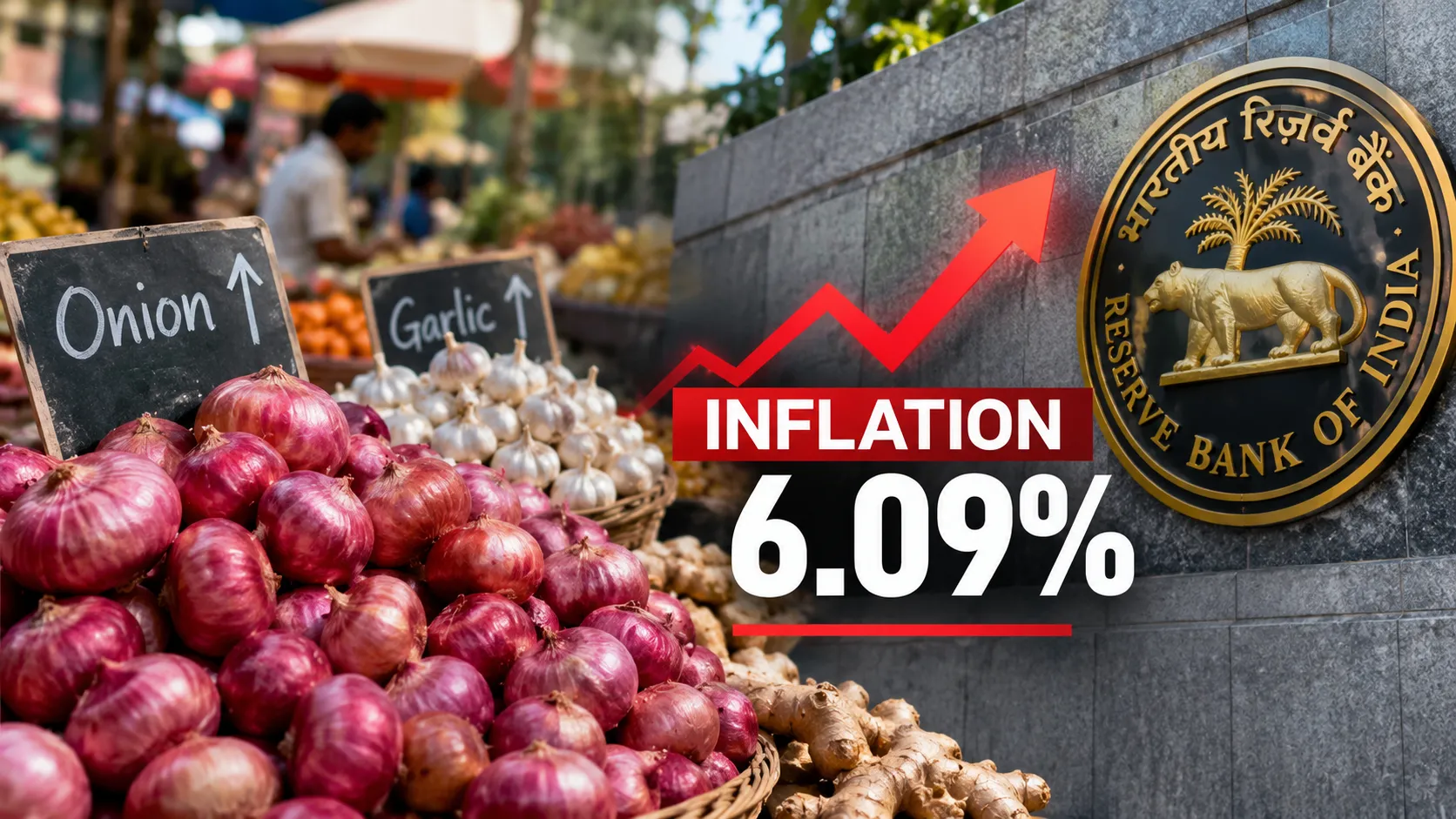
Vegetables were the biggest culprit. Onion prices were 116.22% higher than a year earlier, up from 108.13% in September, according to IndexBox. Garlic prices rose 60.74%, ginger 48.32% and lemons 47.30%.

Not all prices rose. Potato prices fell 14.24% year-on-year, and cauliflower, coconut, brinjal and cabbage were also cheaper than a year ago. Silver jewellery inflation, which had been extremely high, moderated to 52.39% from 87.82%.

By broad category, personal care, social protection and miscellaneous goods recorded the highest inflation, at 10.14%, followed by food and beverages at 8.51% and transport at 5.84%. Health inflation was the lowest at 2.05%, and housing and utilities inflation was 2.90%.

A new base, a familiar problem

The October data use a revised consumer price index with 2024 as its base year, which updates the basket of goods and services to reflect how Indian households spend today. Prices were collected from 1,407 urban markets, including online markets, and 1,465 villages, according to the release.

Despite the methodological update, the core problem is familiar: India's inflation remains highly sensitive to food prices, which can swing sharply because of weather, supply disruptions and hoarding.

Oil and the rupee add pressure

Imported inflation is also a concern. Brent crude has traded above $90 a barrel in recent weeks amid conflict in the Middle East, and the rupee has weakened to around 94 to the US dollar. India imports more than 85% of its crude oil, so higher oil prices and a weaker currency raise the cost of fuel, transport and a wide range of manufactured goods.

Transport inflation of 5.84% partly reflects these pressures. The government has so far shielded consumers from the full impact of higher crude prices at the petrol pump, but that cushion has fiscal costs.

The RBI's dilemma

Economists now expect the RBI to raise its policy repo rate at its monetary policy committee meeting on December 4, according to ETV Bharat. A rate increase would mark a sharp change of direction for a central bank that had been cutting rates as inflation fell to record lows in 2025.

“When onions cost twice what they did a year ago, inflation stops being a statistic and becomes a kitchen-table crisis.”
— TIGI Markets Desk

The RBI faces a difficult trade-off. Raising rates could help anchor inflation expectations and support the rupee, but would increase borrowing costs for businesses and households at a time when the economy is facing global headwinds. Keeping rates on hold risks allowing inflation to become entrenched.

Global conditions add to the complexity. The US Federal Reserve is widely expected to raise rates in December, and the US 10-year Treasury yield is near 5%. Higher US rates tend to draw capital away from emerging markets, putting pressure on currencies such as the rupee.

Market reaction

Indian stocks fell on Friday, November 13, as investors digested the inflation data. The Sensex declined 156.35 points to 81,754.66 and the Nifty 50 fell 86.15 points to 25,213.20, ending a three-day rally, according to ETV Bharat.

Foreign investors, however, continued to buy, purchasing equities worth ₹7,830.60 crore on Thursday. Foreign portfolio investors have bought more than $6 billion of Indian shares in November, according to HDFC Sky, their strongest monthly buying since September 2024.

Bond markets are likely to be more sensitive. Higher inflation and the prospect of rate increases typically push up government bond yields, raising borrowing costs for the government and companies.

d77db481-e2d5-4a6b-b140-b330fcb8530d.png

What it means for households

For Indian families, the data confirm what many have felt at the market. Sharp increases in the prices of staples such as onions and garlic hit household budgets directly, particularly for lower-income families. Higher interest rates, if they come, would raise the cost of home loans, car loans and personal loans.

For savers, rising rates could bring better returns on fixed deposits, but real returns, after adjusting for inflation, may remain modest.

What it means for businesses

Companies face higher input costs, from raw materials to transport, and may have to choose between raising prices and accepting lower margins. Consumer goods companies, which had been hoping for a recovery in rural demand, could see that recovery stall if food inflation squeezes household budgets.

The global Indian angle

For non-resident Indians, a weaker rupee increases the value of money sent home, while higher interest rates in India could make rupee deposits more attractive. Investors in Indian assets will watch whether the RBI acts decisively to defend its inflation target.

Why food prices swing so sharply

Food accounts for a large share of India's consumer price basket, so sudden movements in vegetable prices can move headline inflation by a wide margin within a few months. Onions, tomatoes and potatoes are particularly volatile because they are perishable, grown in concentrated regions and vulnerable to unseasonal rain, heat and transport disruptions.

The government has tools to respond, including export restrictions, releases from buffer stocks and imports, but these take time to work. Monetary policy cannot directly lower food prices, which is why the RBI watches closely whether food inflation spills over into wages and the prices of other goods and services.

What comes next

The RBI's December 4 policy decision is now the key event for Indian markets. The November inflation data are scheduled for release on December 14. Economists will watch vegetable prices, which can fall quickly once new harvests arrive, as well as crude oil and the rupee. If food prices ease, inflation could return within the RBI's band, but the central bank is unlikely to take that chance.

TagsIndia inflationCPIretail inflationReserve Bank of IndiaRBIrepo ratemonetary policyfood inflationonion pricesMoSPIrural inflationurban inflationcrude oilrupeeinterest ratesIndian economybond yieldsSensexhousehold budgetsinvestors

Reader reviews

Sign in to rate and review this article.
Loading reviews…

