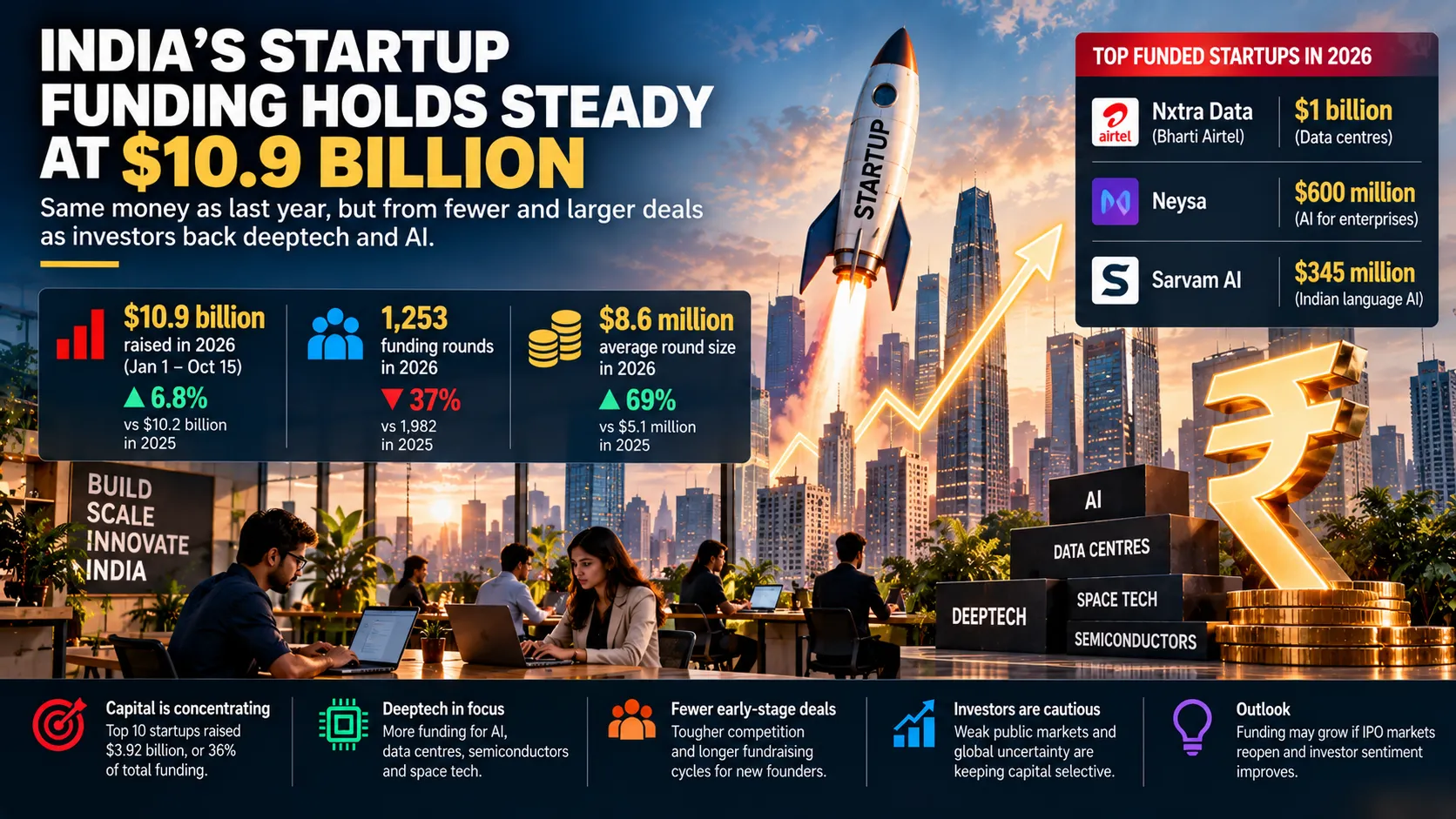
India's startup economy is raising roughly the same amount of money as it did a year ago, but from a very different set of companies. Venture capital funding for Indian startups totalled $10.9 billion between January 1 and October 15, 2026, according to data from market intelligence platform Tracxn reported by Business Standard on October 18. That is 6.8% more than the $10.2 billion raised in the same period of 2025, and slightly above the $10.4 billion recorded in the first ten months of 2024.
The headline stability hides a sharp change underneath. The number of funding rounds fell to 1,253 from 1,982 a year earlier, a drop of almost 37%. Fewer companies are getting funded, but those that do are receiving much larger sums. The average equity round rose to $8.6 million in 2026 from $5.1 million in 2025, an increase of about 69%.
For founders, the message is clear. Capital is available, but it is being rationed. Investors are backing a smaller group of companies, often in capital-intensive sectors such as data centres and artificial intelligence, rather than spreading money across large numbers of early-stage consumer businesses as they did during the 2021 boom.
Ten companies took more than a third of the money
The concentration is striking. The ten largest funded startups together raised about $3.92 billion, or roughly 36% of all venture equity invested in India during the period. Seven of those ten companies have disclosed valuations, which together rose to $10.3 billion in 2026 from $9.3 billion in 2025.
The biggest single deal was a $1 billion investment in Nxtra Data, the data centre business of Bharti Airtel, led by Alpha Wave Global. Data centres have become one of the most sought-after infrastructure assets in India as cloud providers, AI developers and enterprises race to secure computing capacity close to Indian users, and as data localisation rules keep more information onshore.
The second-largest round went to Neysa, a Mumbai-based company that helps enterprises deploy artificial intelligence. Neysa raised $600 million in a Series B round led by private equity giant Blackstone, lifting its valuation from $800 million to $1.4 billion. Sarvam AI, which is building generative AI models designed for Indian languages, raised $255.1 million in a Series B in January and a further $90.4 million in August, a total of $345 million from investors including Nvidia and HCLTech. Sarvam became a unicorn in June at a valuation of $1.5 billion.
Why the money is concentrating
Anjan Ray, investment partner at Navam Capital, offered two explanations for the pattern. The first is that the sources of money behind venture funds have become more cautious. "We hypothesise that VC funding has been relatively flat because their sources of funds" are holding back, he said, pointing to family offices, financial institutions and high-net-worth individuals who have stayed on the sidelines while India's stock market remains subdued.
The link to public markets matters because exits drive the venture cycle. When listed valuations are strong and IPO windows are open, limited partners see returns and recycle capital into new funds. When markets are weak, they become reluctant to commit fresh money. Indian equities have been under pressure in 2026 as foreign portfolio investors pulled out record sums, crude oil prices stayed high and US bond yields rose.
The second explanation is a shift in sector preferences. "Less VC money is going towards consumertech and finance startups, and more towards deeptech," Ray said. Deeptech businesses, from semiconductors and space technology to advanced AI, require far more capital per company and longer time horizons. Ray noted that such companies may need up to a decade before investors can exit. That naturally produces larger rounds and fewer deals.
The change marks a break from the model that dominated Indian venture capital for most of the last decade, when consumer internet, e-commerce, food delivery and fintech absorbed the bulk of investment. Many of those companies have since gone public or matured, while newer opportunities increasingly lie in infrastructure and technology that compete globally.
The deeptech pivot meets India's R&D gap
The shift towards deeptech aligns with a broader push by government and investors to build Indian capabilities in strategic technologies. Policymakers have launched programmes to support semiconductor manufacturing, space startups and AI computing, and venture firms have started dedicated funds for hard technology.
Yet the scale of the challenge remains large. India spends only about 0.65% of GDP on research and development, according to Peak XV Partners managing director Rajan Anandan, compared with around 3.5% in the United States and 2.5% in China. Deeptech companies typically depend on a strong base of public research, university talent and patient capital, all areas where India is still catching up.
Larger rounds also carry risks. When capital concentrates in a few companies, valuations can run ahead of fundamentals, and the failure of a single heavily funded business can weigh on investor sentiment across a sector. Some investors also worry that the decline in deal count is starving early-stage founders of the seed and Series A money they need to reach the scale at which large investors become interested.
What the decline in deal count means for founders
For early-stage founders, the fall in deal volume is the most important number in the data. Fewer rounds mean more competition for each cheque, longer fundraising cycles and tougher terms. Investors are demanding clearer paths to revenue and profitability, and many are concentrating on follow-on investments in their existing portfolio companies rather than taking new bets.
That has accelerated a shift in founder behaviour that has been visible since the funding slowdown of 2022 and 2023. Startups are spending more cautiously, prioritising unit economics and, in many cases, considering profitability a prerequisite for raising money rather than a distant goal. Consumer brands such as The Pant Project, which raised ₹109 crore on October 19, have shown that companies with strong revenue growth can still attract capital, but the bar is higher than it was a few years ago.
There are also bright spots for the ecosystem as a whole. India's IPO market has given investors a route to exit in 2026, with several new-age companies listing or preparing to list. Jio Platforms' record initial public offering, which opens on October 21, is expected to draw global attention to Indian technology assets. A string of successful listings could reassure limited partners and encourage them to commit more capital to Indian venture funds.
The outlook for the rest of 2026
With about ten weeks left in the year, India is on course to finish 2026 with venture funding broadly in line with or slightly above the previous two years. That would mark a period of stability after the extreme swings of the pandemic boom and the funding winter that followed.
Whether funding grows in 2027 will depend largely on public markets and global interest rates. A recovery in Indian equities, a return of foreign portfolio investment and a reopening of the IPO pipeline would give venture funds the exits they need to raise new capital. Conversely, if high oil prices and global market volatility persist, investors may remain selective.
For now, the Tracxn data paints a picture of an ecosystem that has matured rather than shrunk. Capital is flowing to fewer companies, larger cheques and harder technologies. For investors, that means bigger bets on the businesses they believe can build lasting infrastructure for India and the world. For founders outside that circle, it means the competition for capital has rarely been tougher.