IndiaMART, India's largest online business-to-business marketplace, has reported steady growth in quarterly profit and revenue, but signs of slowing momentum in its core business have kept investors cautious.
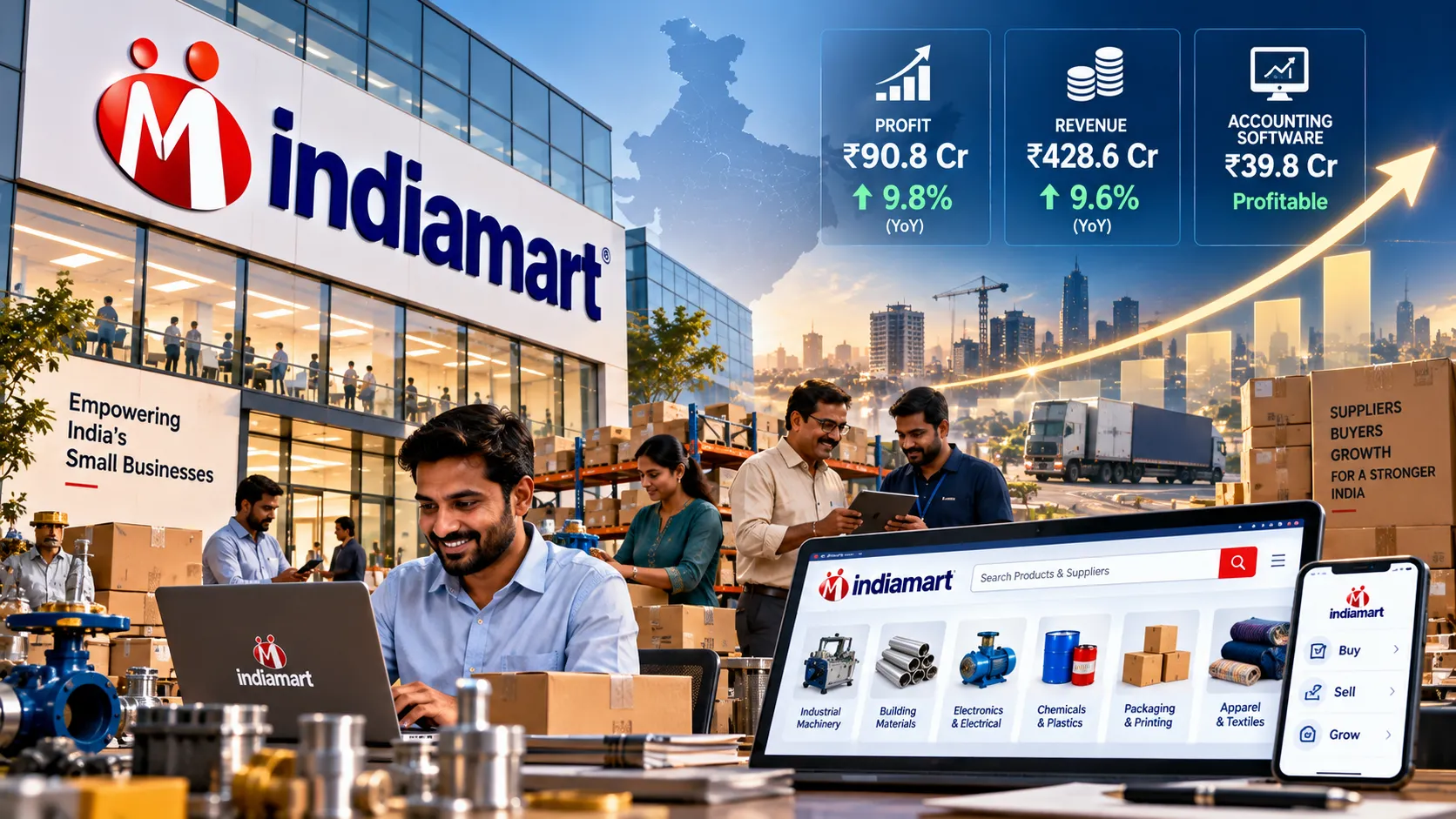
The Noida-based company reported consolidated net profit of ₹90.8 crore for the July-September quarter, up 9.8% from ₹82.7 crore a year earlier, according to the Free Press Journal on Tuesday, October 27. Profit fell 47.3% from ₹172.2 crore in the April-June quarter, which had been boosted by other income.
Revenue from operations rose 9.6% to ₹428.6 crore from ₹391 crore a year earlier, and 3.4% from ₹414.4 crore in the previous quarter.
Breaking down the numbers
Revenue from IndiaMART's web and related services, its core marketplace business, rose to ₹388.8 crore from ₹360.3 crore. Revenue from its accounting software business grew to ₹39.8 crore from ₹30.7 crore, and the segment swung to a profit of ₹3.2 crore from a loss of ₹0.5 crore.
Profit before tax rose to ₹129.4 crore from ₹118.6 crore. Basic earnings per share increased to ₹15.09 from ₹13.77.
Other income was negative at ₹7.6 crore, compared with ₹106.7 crore in the June quarter, which explains much of the sequential decline in profit. IndiaMART holds significant cash and investments, and changes in their valuation can cause swings in other income.
For the first half of the financial year, net profit rose 11.3% to ₹263 crore and revenue grew 10.5% to ₹843 crore.
The collections question
A report linked alongside the results said IndiaMART shares fell 13% after the results, citing a decline in collection growth. Collections, the cash IndiaMART receives from customers for subscriptions, are a leading indicator of future revenue, since the company recognises subscription revenue over time.
Slower collection growth suggests that fewer new customers are signing up, existing customers are renewing at lower rates, or customers are opting for cheaper plans. Investors closely watch collections as a signal of the health of IndiaMART's small business customer base. TIGI was unable to independently confirm the share move or the collections data at the time of writing.
How IndiaMART works
IndiaMART connects buyers and sellers of industrial goods, raw materials, machinery and business supplies. Small and medium-sized businesses pay subscription fees to list their products and receive inquiries from potential buyers. The platform has millions of registered suppliers and serves buyers across India.
The company was founded in 1996 by Dinesh Agarwal and Brijesh Agrawal and listed on Indian stock exchanges in 2019. It has been consistently profitable, unlike many Indian internet companies.
The Busy software play
IndiaMART acquired Busy Infotech, an accounting and inventory management software company, in 2022. The accounting software segment's swing to profitability is a positive sign, as IndiaMART seeks to expand its offerings to small businesses beyond lead generation.
Selling software to small businesses can create recurring revenue and deepen relationships with customers, though competition in the segment is intense.
The MSME connection
IndiaMART's performance is closely tied to the health of India's micro, small and medium enterprises, which form the backbone of the economy. MSMEs face challenges from high input costs, access to credit and competition. High oil prices and global uncertainty have added pressure.
When small businesses are under strain, they may cut back on discretionary spending, including subscriptions to online marketplaces. Conversely, when they are growing, they invest in finding new customers.
Competition
IndiaMART faces competition from other B2B platforms, including TradeIndia, Udaan, and newer platforms focused on specific sectors. Large e-commerce companies have also expanded into business-to-business sales. Search engines and social media offer alternative channels for small businesses to find customers.
The company's scale and brand recognition give it advantages, but it must continue to demonstrate value to customers to retain them.
Valuation and expectations
IndiaMART has historically traded at a premium valuation, reflecting its profitability, cash generation and market leadership. Single-digit or low double-digit revenue growth may not satisfy investors who expected faster expansion, which can lead to sharp share price reactions when growth disappoints.
Understanding deferred revenue
IndiaMART collects subscription fees upfront from suppliers, often for annual or multi-year plans, but recognises the revenue gradually over the subscription period. The unrecognised portion is recorded as deferred revenue, which provides visibility into future revenue. When collections grow strongly, deferred revenue rises, supporting future revenue growth; when collections slow, future revenue growth may moderate.
This model gives IndiaMART significant cash generation, since it receives money before delivering the service, and it holds large cash reserves invested in financial instruments. That explains the large swings in other income from quarter to quarter.
The founder-led company
IndiaMART remains led by founder and chief executive Dinesh Agarwal, one of the pioneers of India's internet economy, who started the company in the 1990s when internet usage in India was minimal. The company's longevity and consistent profitability make it unusual among Indian internet companies, many of which have struggled to turn a profit.
The SaaS opportunity for small businesses
India has tens of millions of small businesses, many of which still manage accounts, inventory and invoicing manually. Digitising these processes represents a large opportunity for software providers, particularly as tax and compliance requirements, such as the goods and services tax, push businesses towards digital record-keeping. IndiaMART's Busy software gives it a foothold in this market, and its profitability in the latest quarter suggests the business is reaching scale. Cross-selling software to IndiaMART's large base of marketplace subscribers is a key part of the opportunity.
What comes next
Investors will watch IndiaMART's collections, customer additions and churn rates in the coming quarters for signs of whether growth is stabilising or slowing further. The company's ability to expand its software business and offer new services to small businesses will also be important.
For India's digital economy, IndiaMART remains a bellwether for how small businesses are adopting online tools, and its results provide a window into the health of the MSME sector. Analysts will also watch for any change in IndiaMART's pricing strategy, the mix of subscription plans and the growth of new services such as payments and logistics, which could help the company deepen its relationship with suppliers and buyers. Management's commentary on small-business sentiment will be closely followed as an indicator of the wider economy's health. The results also offer a read on the broader health of India's small business economy.