
TechArtificial Intelligence5 MIN READ

Indian IT Stocks Defy a Market Rout as TCS Jumps 3.5% and the Nifty IT Index Becomes the Only Sector in the Green

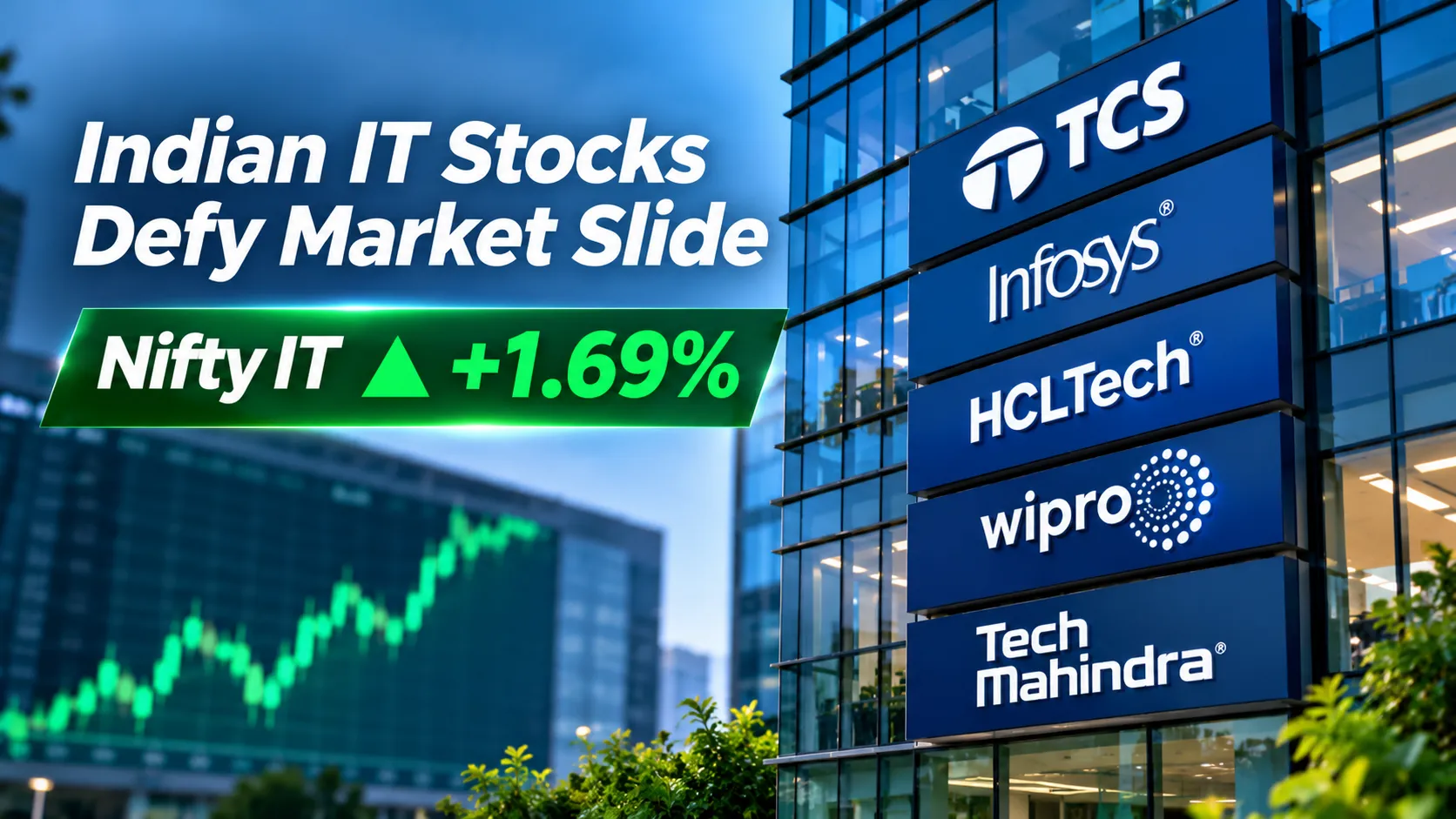
While the Sensex fell nearly 1,500 points on November 23, Indian technology stocks moved the other way. The Nifty IT index rose 1.69%, the only major sectoral gainer, as Tata Consultancy Services climbed 3.53% to ₹2,460 and Tech Mahindra rose 1.79%. The rally suggests investors are beginning to look past fears about artificial intelligence disrupting the outsourcing industry.

By Aravind Kumar · Author24 November 2026New
Indian IT Stocks Defy a Market Rout as TCS Jumps 3.5% and the Nifty IT Index Becomes the Only Sector in the Green

On a day when almost everything on Dalal Street was falling, India's technology companies found buyers.

The Nifty IT index rose 1.69% on Monday, November 23, making it the only major sectoral index to finish in positive territory, according to closing data compiled by Univest. Tata Consultancy Services, India's largest IT services company, climbed 3.53% to ₹2,460 and was the top gainer in the Nifty 50. Tech Mahindra rose 1.79% to ₹1,777.50, and HCLTech also advanced.

The gains came as the Sensex fell 1,483.72 points, or 1.77%, and the Nifty dropped 1.75%, dragged down by heavy selling in banks and metals.

A reversal of fortune

The performance marked a notable change for a sector that has struggled for much of 2026. Indian IT stocks have underperformed the broader market amid concerns that generative artificial intelligence could reduce demand for traditional outsourcing services, as well as slower technology spending by clients in the United States and Europe.

Last week, the Nifty IT index fell for several consecutive sessions as worries about AI disruption and higher US interest rates intensified. Monday's rally suggests that some investors believe the sell-off had gone too far.

Why investors are rotating into IT

Several factors may explain the shift. The first is valuation. After a prolonged period of underperformance, Indian IT stocks trade at lower multiples than in previous years, making them more attractive relative to sectors such as banking, which had rallied strongly in November.

The second is defensiveness. IT companies earn most of their revenue in dollars and other foreign currencies, have strong balance sheets with little debt and pay regular dividends and buybacks. When investors want to reduce risk in the domestic market, IT stocks can serve as a relatively safe haven.

The third is sector rotation. With banks and metals having led the November rally, investors taking profits in those sectors may have redeployed some of the money into IT, which had lagged.

The AI debate

The central question facing the industry is how artificial intelligence will affect its business model. Indian IT companies have traditionally earned revenue based on the number of people working on client projects. AI tools that can write code, test software and automate business processes could reduce the number of people needed for many tasks.

However, AI also creates new opportunities. Large enterprises need help implementing AI, integrating it with existing systems, managing data, ensuring security and complying with regulations. Indian IT companies, with their deep client relationships and large workforces, are well positioned to provide these services.

TCS, Infosys, HCLTech, Wipro and Tech Mahindra have all invested heavily in AI capabilities, training employees and forming partnerships with leading AI companies including OpenAI, Anthropic, Google, Microsoft and Nvidia.

TCS in focus

TCS's gain of more than 3.5% was particularly significant given its size. As one of the most valuable companies in India, its movements have a meaningful impact on the indices. The company has been investing in AI infrastructure and services, including plans for data centre capacity in India, as it seeks to position itself for the next phase of technology spending.

Investors will watch the company's upcoming deal announcements and management commentary for evidence that AI is adding to revenue rather than replacing it.

“After months of being sold on AI fears, Indian IT is starting to look like a place to hide rather than a place to run from.”
— TIGI Tech Desk

The global connection

The performance of Indian IT stocks is closely linked to developments in the US technology sector. Last week's sell-off in US tech, triggered by turmoil at Nvidia and concerns about data centre spending, weighed on sentiment towards technology globally.

Later on Monday, after Indian markets had closed, Wall Street staged a powerful rebound as Nvidia reinstated Jensen Huang as chief executive, with the Nasdaq surging 6.5%. If that recovery holds, it could support further gains in Indian IT stocks when trading resumes on Wednesday, November 25, after the Guru Nanak Jayanti holiday.

744306d8-8cff-484e-8d14-f5e034db747c.png

The currency factor

A weaker rupee typically benefits Indian IT companies, because they earn revenue in foreign currencies but pay most of their costs in rupees. Currency movements can therefore influence margins and earnings. Companies generally hedge a significant portion of their currency exposure, limiting the immediate impact, but over time a weaker rupee supports profitability.

The hiring picture

Indian IT companies have slowed hiring significantly over the past few years, particularly for entry-level roles. The industry is shifting its hiring towards skills in AI, data, cloud and cybersecurity, and investing in retraining existing staff. How quickly demand recovers will have major implications for employment in India's technology hubs, including Bengaluru, Hyderabad, Pune and Chennai.

Analysts remain divided

Not all analysts are convinced that the sector has turned a corner. Some caution that one day of outperformance does not signal a sustained recovery, and that the industry still faces structural challenges from AI and pricing pressure. Others argue that the worst of the AI fears is priced in and that the sector offers value for long-term investors.

The next round of quarterly results in January will provide more evidence of demand trends, deal wins and the impact of AI on revenue.

What it means for the diaspora

Many members of the Indian diaspora work in technology roles in the United States and other countries, often for clients or partners of Indian IT companies. The industry's health affects career opportunities on both sides, as well as investment portfolios that often include significant holdings of Indian IT stocks.

What brokerages are saying

Several brokerages have argued in recent months that Indian IT valuations have become more reasonable after a prolonged period of underperformance. Some have highlighted the sector's strong cash generation, high dividend yields and buyback programmes as sources of support for share prices even if revenue growth remains modest.

Others remain cautious, arguing that pricing pressure from clients seeking AI-driven productivity gains could weigh on revenue growth for several years, and that investors should wait for clearer evidence of a recovery in demand before increasing exposure to the sector.

Rupee and results

Market participants will also track the rupee, US bond yields and client commentary in the coming weeks, all of which will shape whether the sector's rebound proves durable.

What comes next

Investors will watch whether the rotation into IT continues when markets reopen, how the sector responds to the rebound in US technology stocks, and whether companies announce large AI-related deals. The December Federal Reserve meeting will also be important, as US interest rates influence client spending and the outlook for the sector.

TagsNifty ITTCSTata Consultancy ServicesTech MahindraHCLTechInfosysIndian IT stocksartificial intelligenceAI disruptionIT servicessector rotationSensexNiftyvaluationsUS technology spendingrupeeoutsourcinggenerative AIinvestorsIndian tech

Reader reviews

Sign in to rate and review this article.
Loading reviews…