
FundingMarket Data Women6 MIN READ

Indian IT Stocks Stage Their Strongest Weekly Rally in 18 Years as Nifty Logs Best Week in Six Months

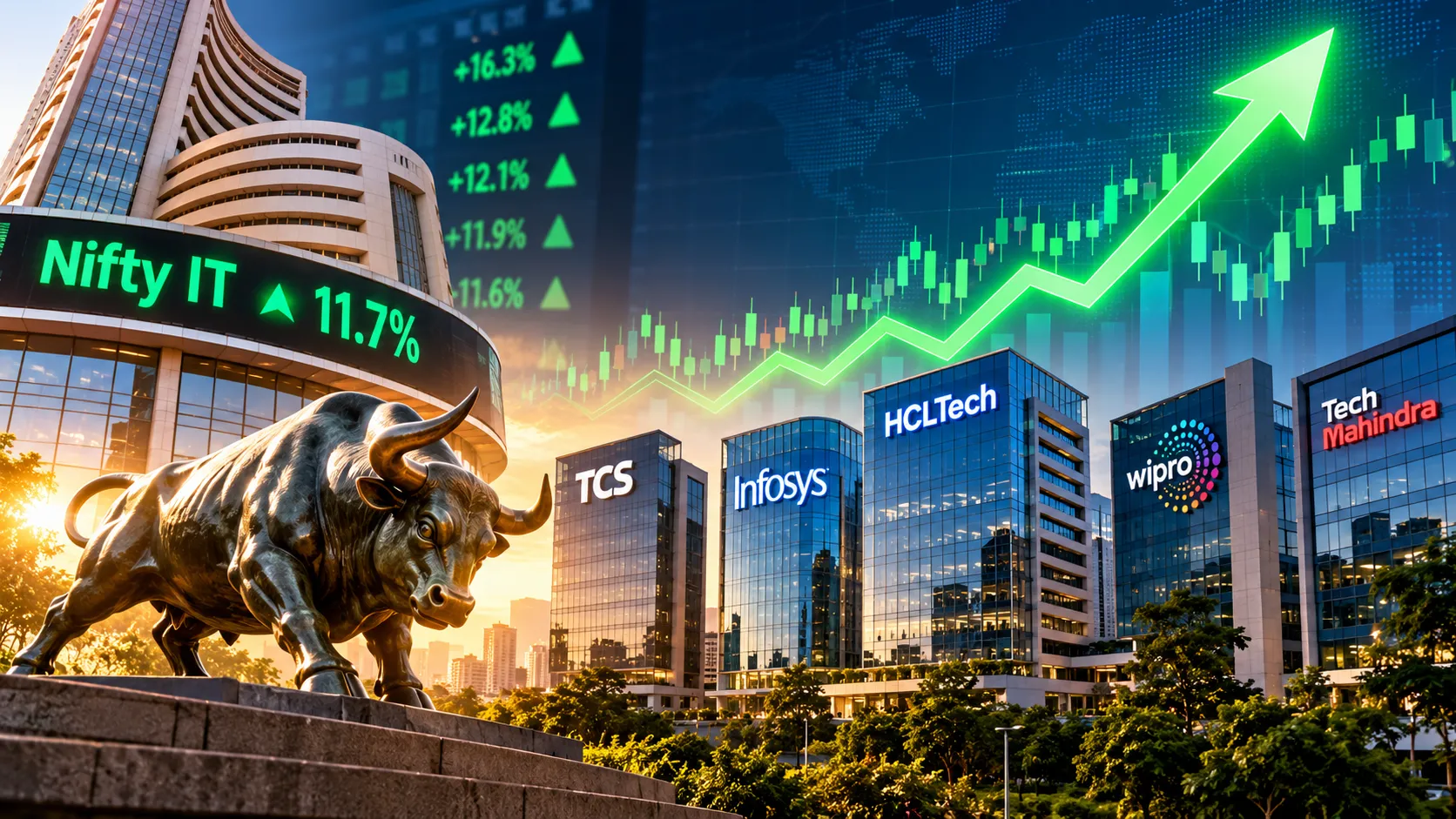
The Nifty IT index jumped 11.7% this week, its biggest weekly gain since 2008, as strong September-quarter results from HCLTech, Tech Mahindra and Wipro and a global selloff in AI and chip stocks pulled investors back into India's beaten-down software exporters.

By Shaym Kumar · Author16 October 2026New
Indian IT Stocks Stage Their Strongest Weekly Rally in 18 Years as Nifty Logs Best Week in Six Months

Indian information technology stocks staged their strongest weekly rally in 18 years, as robust quarterly earnings and a sharp selloff in global artificial intelligence and semiconductor shares prompted investors to return to a sector that had been one of the market's worst performers this year.

The Nifty IT index rose 11.7 per cent over the five sessions to 16 October, its biggest weekly gain since 2008. The surge added roughly ₹2.6 lakh crore to the market value of IT stocks, according to The Economic Times, and made IT the best-performing sector of the week by a wide margin.

The rally helped India's benchmark indices post their best week in six months. The Nifty 50 rose 148.80 points, or 0.65 per cent, on Friday to close at 23,146.15, taking its weekly gain to nearly 3 per cent, its biggest weekly advance in 27 weeks. The Sensex rose 413.66 points, or 0.56 per cent, to 74,729.27, after jumping more than 1,500 points on Thursday.

A Broad-Based Surge Across the Sector

The gains were spread across the sector's largest companies. Tech Mahindra led with a weekly rise of more than 16 per cent, while Wipro gained about 13 per cent and Tata Consultancy Services, Infosys and HCLTech each rose about 12 per cent, according to The Economic Times.

On Friday alone, the Nifty IT index rose 3.92 per cent and was again the top-performing sectoral index. Tech Mahindra jumped about 8 per cent after reporting a 32.7 per cent rise in September-quarter consolidated net profit to ₹1,585.6 crore, with revenue up 15.6 per cent to ₹16,180.2 crore. Wipro gained more than 5 per cent after its quarterly revenue beat expectations and management signalled that previously delayed large contracts could support growth over the next few quarters.

Not every stock joined the rally. Persistent Systems fell more than 3 per cent on Friday after brokerages flagged margin pressure from higher amortisation costs in the September quarter.
9dc5c93b-8e1c-4723-884f-4d9c688c2298.png

Earnings Beat Gloomy Expectations

The catalyst was a set of second-quarter results that proved better than investors had feared after a year of weak sentiment.

HCLTech set the tone. The company reported a 21.2 per cent year-on-year rise in net profit to ₹5,132 crore, beating analysts' estimates, and raised its fiscal 2027 revenue growth guidance to 2.5–4 per cent in constant currency, from 1–4 per cent. Its revenue from advanced AI services rose 78 per cent year on year to $219 million, and it added 6,450 employees, its largest quarterly headcount addition in 16 quarters, according to CNBC-TV18.

TCS, the sector's largest company, earlier reported a 15 per cent rise in consolidated net profit to ₹13,884 crore, with annualised AI revenue above $3 billion and deal wins of $9.6 billion, even as constant-currency revenue growth was a modest 0.5 per cent from the previous quarter.

Tech Mahindra chief executive Mohit Joshi pointed to sustained deal momentum, noting "deal wins exceeding USD 1+ billion in each of the last four quarters", with new contract value of $1.023 billion in the September quarter.

The AI Selloff That Helped India

The rally was also fuelled by events far from Bengaluru and Mumbai. Global AI and semiconductor stocks fell sharply this week amid concerns over the financing of AI infrastructure, rising competition, renewed fears of interest rate increases and questions about whether massive AI investment will generate adequate returns.

A MSCI index of global chip stocks fell 7.4 per cent over the week, putting Indian IT on course for its biggest weekly outperformance against the gauge since 2004, according to a report published by ThePrint. South Korea's technology-heavy market fell more than 6 per cent on Tuesday alone.

For much of the past two years, investors had treated Indian IT services companies as potential losers from the AI boom, fearing that generative AI would automate much of the coding, testing and maintenance work that underpins their business models. Money flowed instead to chipmakers and AI infrastructure companies. As doubts about those trades grew this week, some of that capital rotated back into Indian software exporters.


“If the correction in semiconductors gains momentum, as it has this week, foreign investors will start looking at Indian IT stocks.”
— Rajat Agarwal, Asia Strategist, Societe Generale

"If the correction in semiconductors gains momentum, as it has this week, foreign investors will start looking at Indian IT stocks," said Rajat Agarwal, Asia strategist at Societe Generale.

Accenture Changes the Narrative

Sentiment was further lifted by Accenture, the global consulting and IT services giant whose results and outlook are closely watched as a guide to demand for Indian IT companies. At its investor day, Accenture outlined plans to move closer to $100 billion in annual revenue and said it expects higher revenue growth and profit margins through 2029.

Chief executive Julie Sweet pushed back against fears that AI will erode demand for consulting and technology services. "The opportunity is bigger than ever before," she said, arguing that new demand created by AI "will far exceed the demand that's being replaced."

From Worst to Best

The scale of the rebound reflects how far the sector had fallen. Even after this week's surge, the Nifty IT index remains down about 16 to 17 per cent for the year and is still on course for its worst annual performance since 2022, according to Reuters and ThePrint. Before the rally began, Wipro was down 34 per cent for the year, Infosys 31 per cent and TCS 26 per cent, according to CNBC-TV18.

Those declines left valuations at multi-year lows. The Nifty IT index traded at less than 17 times one-year forward earnings, nearly two standard deviations below its five-year average, making software stocks the cheapest since the pandemic year of 2020. Low valuations meant that results which were merely better than feared triggered sharp short-covering and portfolio repositioning.

Will the Rally Last?

Analysts are divided on whether the surge marks a lasting turnaround or a relief rally.

Morgan Stanley analysts led by Gaurav Rateria said: "Although valuations appear reasonable now, on a relative and absolute basis, the sector lacks near-term catalysts." A survey of chief information officers points to stable growth in technology spending in 2027, which Morgan Stanley said suggests steady to decelerating revenue growth for Indian IT firms.

Gaurav Garg, head of research at Lemonn Markets Desk, cautioned that after such a sharp advance, "some profit-booking and volatility cannot be ruled out." Axis Securities said the pace of global AI adoption over the next two to three years remains a key concern for earnings growth.

Others see a structural opportunity. Sumanta Khan, an equity fund manager at Edelweiss Asset Management, argued that history shows technology transitions are typically followed by longer periods of growth: "while early stages of transition did witness a slowdown, it was immediately followed by a longer period of growth."

What Comes Next

The next major test comes on 23 October, when Infosys, the sector's bellwether, reports its September-quarter results. Analysts expect modest revenue growth of about 1.8 per cent, and investors will look closely at its guidance and commentary on AI-driven demand.

Beyond the IT sector, the week's gains were concentrated in large-capitalisation stocks. The Nifty Midcap 100 and Smallcap 100 indices ended Friday marginally lower, metal and auto stocks attracted buying, and the Nifty Media index hit a record high. Banks were under pressure ahead of results from HDFC Bank, Axis Bank and Kotak Mahindra Bank, while InterGlobe Aviation, Reliance Industries and Asian Paints were among the laggards.

For India's IT industry, which employs millions of people and accounts for a significant share of the country's exports, the week offered a reminder that the AI narrative can cut both ways. Whether this rally becomes the start of a sustained recovery will depend on whether companies can show, quarter after quarter, that AI is expanding their business rather than shrinking it.

TagsNifty ITIndian IT StocksSensexNifty 50TCSInfosysHCLTechWiproTech MahindraQ2 FY27Stock MarketAI SelloffSemiconductorsFIIMarket DataAccenture

Reader reviews

Sign in to rate and review this article.
Loading reviews…
