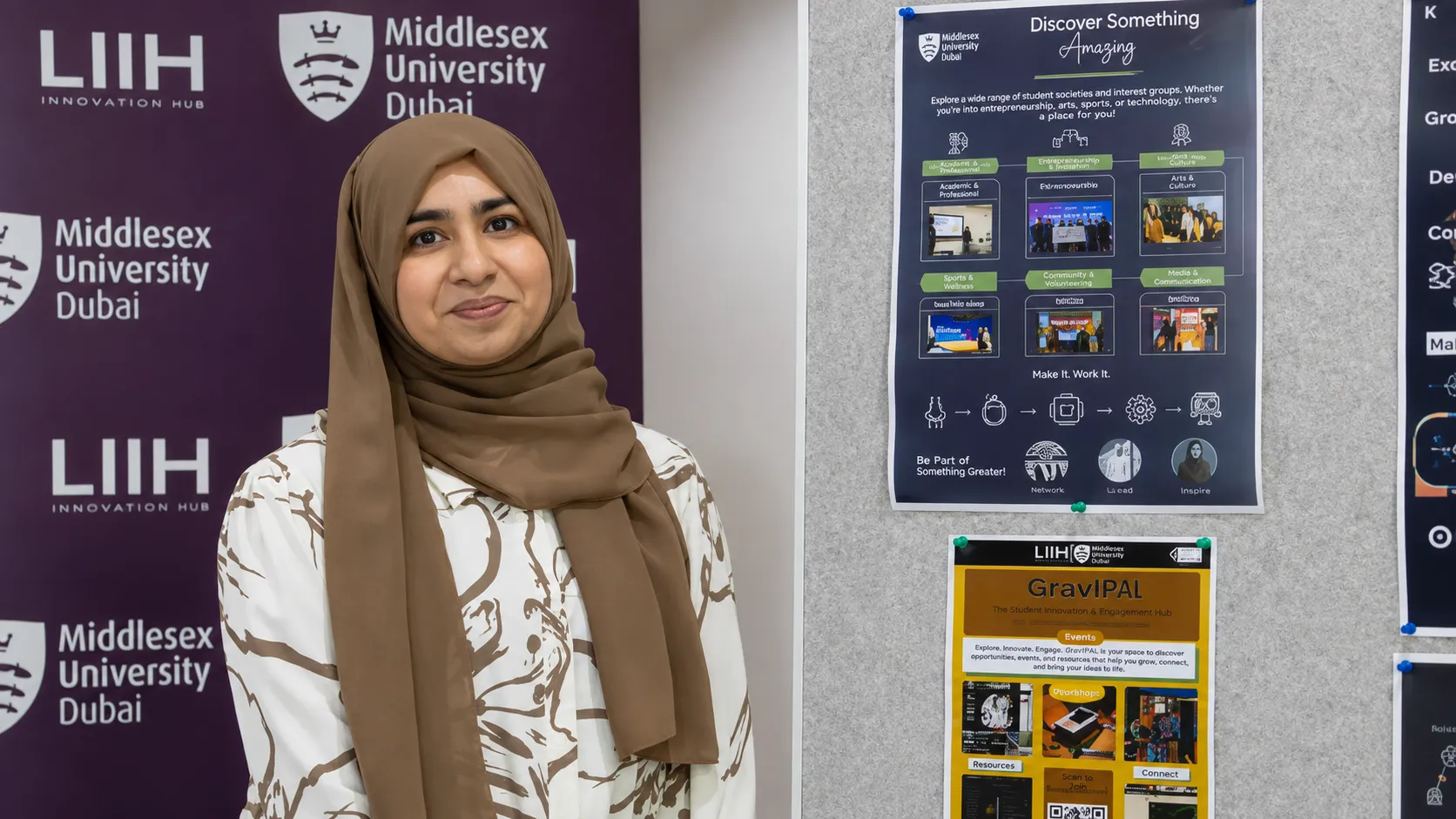
A young engineer from Dubai's Indian community has been chosen to represent the United Arab Emirates at one of the more unusual entries on this year's international space calendar. Shafaq Mandha, a graduate of the Class of 2026 in Computer Systems Engineering (BEng) from Middlesex University Dubai, has been selected for ORBITA-26, an international satellite mission organised by Lab of Future in collaboration with the Future of Education in Russia. The programme will see Mandha travel to Moscow to take part in the mission's satellite build-and-launch activities — a rare, hands-on opportunity for an early-career engineer to work directly on a functioning space payload rather than a classroom simulation.
For the UAE's Indian diaspora, now numbering in the millions and increasingly represented across the emirate's professional and technical classes, Mandha's selection carries a symbolic weight beyond the individual achievement. It signals the extent to which second-generation, Gulf-raised Indian talent — educated locally, trained on international curricula, and fluent in the UAE's own ambitions in advanced technology and space — is beginning to compete for, and win, opportunities on genuinely global platforms.
Mandha's own trajectory reflects a distinctly Gulf-Indian story. Her family traces its roots to the western Indian state of Gujarat, but she was born and raised entirely in the UAE, moving through a schooling pathway that is itself emblematic of the emirate's dense, multilayered international education sector. She began at Leaders Private School in Sharjah before transferring to Westminster School Sharjah for her GCSEs, completing Grade 6 through Grade 12 there. She then went on to Cambridge International School Dubai for her AS and A-Levels, before enrolling at Middlesex University Dubai, where she completed an International Foundation Programme ahead of her bachelor's degree in Computer Systems Engineering.
That progression — private school, British curriculum, and a UK-affiliated university campus, all without leaving the UAE — illustrates how thoroughly the Gulf's international education infrastructure now allows diaspora families to build globally competitive academic profiles without the cost, visa complexity, or family separation that overseas study traditionally required. It is a pathway that a growing number of Indian families in the UAE are choosing deliberately, viewing local British- and American-curriculum institutions as a credible, often more affordable, alternative to sending children abroad for their entire education.
Selection for ORBITA-26 was not a casual process. According to details of the programme, Mandha underwent months of specialist training before being confirmed for the mission, working through the technical and procedural preparation required to contribute meaningfully to a satellite build rather than simply observing one. That training took place at Lab of Future's Space Science, Tech and Research Lab in Dubai, beginning in July 2026 — placing the UAE, and specifically its Indian-origin engineering talent pool, directly inside the preparatory pipeline for an internationally organised space mission rather than treating the country merely as a source of applicants trained elsewhere.
The structure of ORBITA-26 itself is notable: an international collaboration between Lab of Future and Russia's Future of Education initiative, designed to give students from multiple countries direct, applied experience in satellite engineering ahead of an actual launch in Moscow. For a university-level engineering programme, this kind of applied placement is difficult to replicate in a standard curriculum — it compresses years of theoretical study into a compressed, high-stakes practical exercise, with the added weight of representing a national delegation rather than participating as an individual hobbyist.
Middlesex University Dubai's role in producing a graduate capable of competing for, and securing, a place on such a mission speaks to the broader maturation of the UAE's branch-campus university sector. Once viewed primarily as a convenient, geographically proximate alternative to studying in the UK, institutions like Middlesex Dubai are increasingly producing graduates who go on to compete on entirely international stages — not merely regional ones. For the UAE's Indian community specifically, whose economic footprint in the Emirates has historically been concentrated in trade, retail, healthcare, and construction, stories like Mandha's point to a generational shift already under way: a move toward advanced technical and scientific fields, including space engineering, artificial intelligence, and applied research, disciplines the UAE itself has explicitly prioritised as it pursues its own national space ambitions.
That alignment — between an ambitious host nation's strategic technology goals and the aspirations of its long-settled, increasingly locally rooted Indian diaspora — is likely to produce more stories like this one in the years ahead, as the UAE continues to invest heavily in space, deep tech, and advanced manufacturing sectors that reward exactly the kind of technical training Mandha has pursued.
As Mandha prepares for her training culmination and eventual travel to Moscow for the mission's satellite launch, her selection stands as a small but telling data point in a much larger story: that the UAE's Indian diaspora, once defined largely by first-generation migrant labour and entrepreneurship, is now producing a second generation fluent in the frontier disciplines — space engineering among them — that will shape the next phase of the region's technological ambitions.