India's startup funding market slowed sharply in October, with the total amount raised falling by nearly half from the previous month and no company securing a mega-round of more than $100 million.
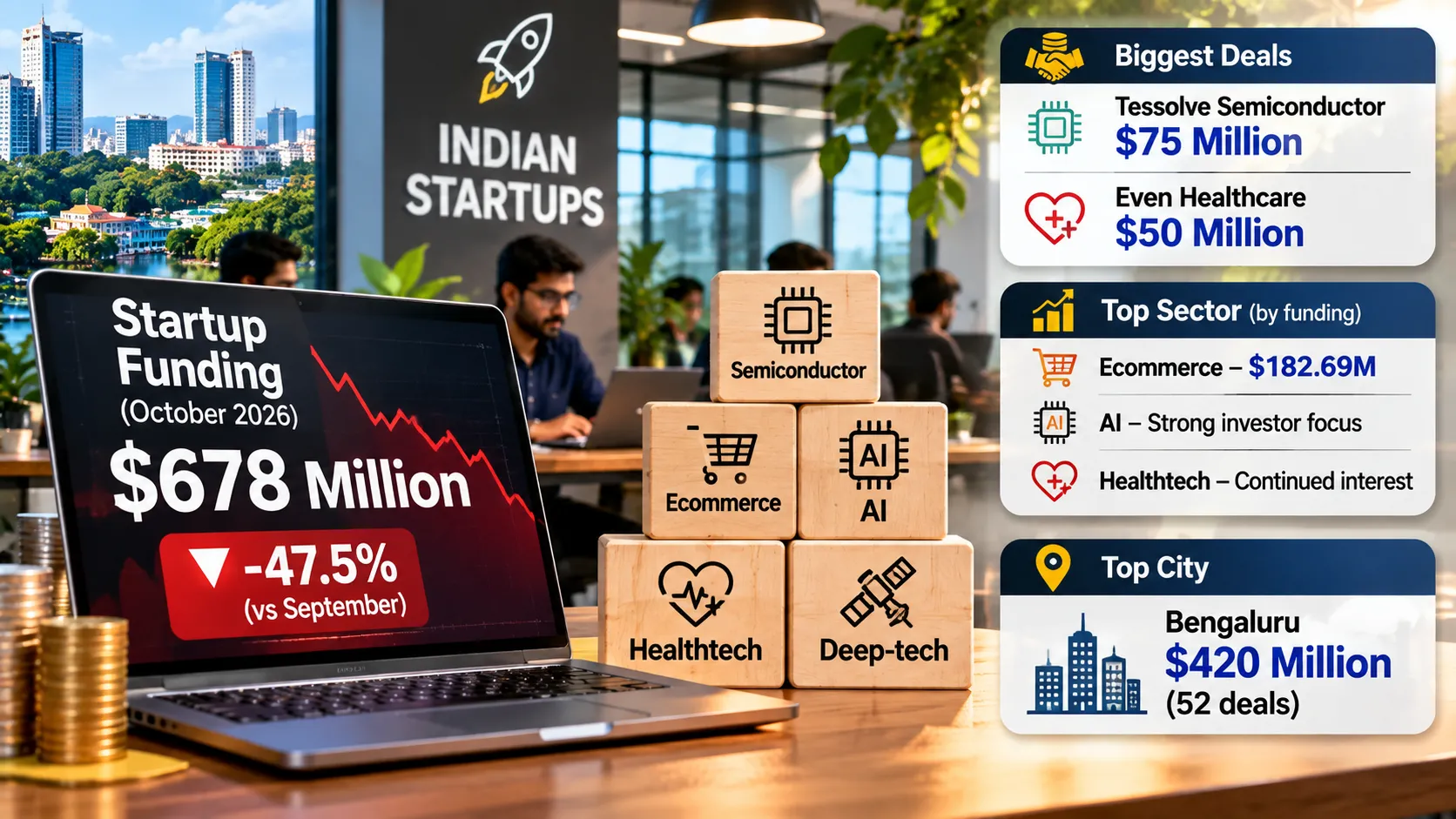
Indian startups raised about $678 million in October 2026, down 47.5% from September, according to data reported by NewsBytes on Monday, November 2. Growth-stage startups raised $414.6 million, while early-stage startups raised $263 million.
The biggest deals
The largest round of the month was a $75 million investment in Tessolve Semiconductor, followed by a $50 million round for Even Healthcare, according to the report. No deal exceeded $100 million.
Tessolve, based in Bengaluru, provides semiconductor engineering services, including chip design support, testing and validation, to global semiconductor companies. Its funding reflects growing investor interest in India's semiconductor ecosystem, supported by the government's India Semiconductor Mission and the expansion of global chip companies' design and testing operations in India.
Even Healthcare is building a healthcare membership model that combines insurance-like coverage with its own network of hospitals and doctors, aiming to make quality healthcare more affordable and accessible for Indian families.
Sector trends
Ecommerce led sectors with $182.69 million in funding, followed by artificial intelligence and healthtech, according to the report. Consumer brands selling online, including food, nutrition, personal care and fashion companies, continued to attract investors, reflecting the growth of digital commerce and quick commerce in India.
AI startups have been a growing focus, with investors backing companies building AI infrastructure, applications and tools for Indian and global markets. Healthtech startups, spanning diagnostics, preventive care and hospital networks, also remained popular.
Bengaluru dominates
Bengaluru led all cities with $420 million raised across 52 deals, ahead of Delhi-NCR and Mumbai, according to the report. Bengaluru's share, well over half the national total, reinforces its position as India's leading startup hub, with a dense concentration of technology talent, experienced founders and investors.
Why funding fell
Monthly funding totals can swing sharply depending on whether large rounds close in a given month. September's total was boosted by larger deals, making October's decline appear steeper. Even so, the absence of any $100 million-plus round in October reflects the selectiveness of investors at the growth stage.
Investors have become more cautious since the boom of 2021 and 2022, when Indian startups raised record sums at high valuations. Many of those companies subsequently struggled to grow into their valuations, leading to down rounds, layoffs and closures. Investors now place greater emphasis on profitability, unit economics and clear paths to public listing.
Weekly patterns
Weekly data published at the end of October showed a similar pattern. Indian startups raised $130.2 million across 32 deals between October 26 and 30, down 29.2% from the previous week even though the number of deals nearly doubled, according to Inc42. Investors are writing more, smaller cheques to early-stage companies, while large growth rounds remain scarce.
The public market factor
Public markets have become an increasingly important source of capital and exits for Indian startups. Companies such as Meesho, Pine Labs, Shadowfax and Ather Energy have listed in recent years, and Jio Platforms' record listing in October boosted sentiment. A healthy IPO market encourages venture investors by providing exits, but volatility in public markets, particularly among smaller companies, can make late-stage investors more cautious.


