
FundingMarket Data Women5 MIN READ

Indians Sent $20.09 Billion Abroad in the First Eight Months of 2026 as Overseas Investments Surge 86%

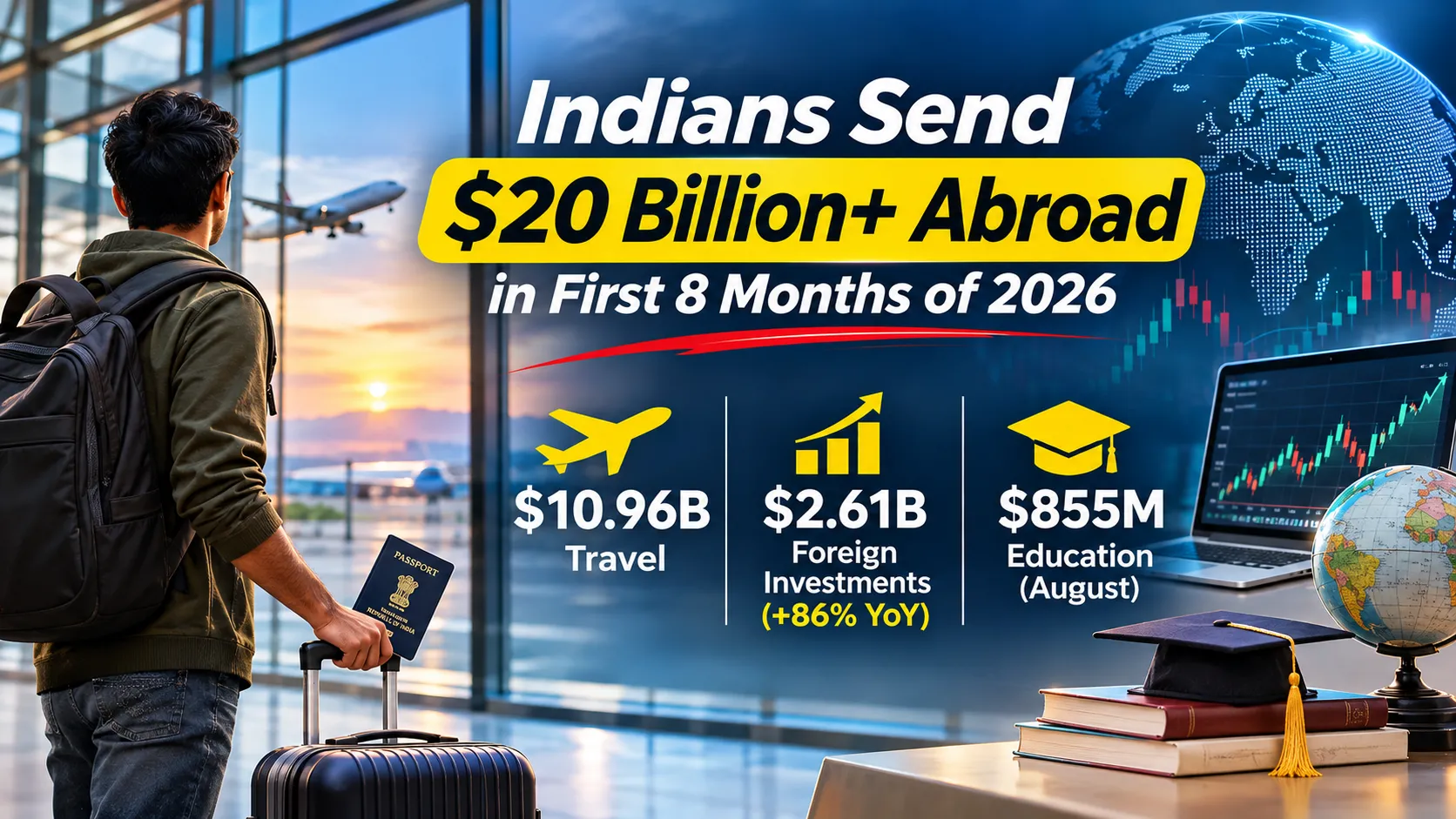
Outward remittances by Indian residents under the Reserve Bank of India's Liberalised Remittance Scheme reached $20.09 billion in January-August 2026, up 5.3% from $19.08 billion a year earlier, according to RBI data reported on November 2. Travel remained the largest category at $10.96 billion, while investments in foreign stocks and debt jumped about 86% to $2.61 billion.

By Shaym Kumar · Author3 November 2026New
Indians Sent $20.09 Billion Abroad in the First Eight Months of 2026 as Overseas Investments Surge 86%

Indian residents sent more than $20 billion abroad in the first eight months of 2026, with spending on international travel continuing to dominate outflows and investments in foreign stocks and bonds growing at the fastest pace of any category.

Outward remittances under the Reserve Bank of India's Liberalised Remittance Scheme (LRS) totalled $20.09 billion between January and August 2026, up 5.26% from $19.08 billion in the same period of 2025, according to RBI data reported on Monday, November 2, by the Indian Express and other outlets. The increase amounts to nearly $1 billion.

In August alone, LRS outflows were $2.74 billion.

Travel dominates

Overseas travel remained by far the largest category, accounting for $10.96 billion in the first eight months, up from $10.67 billion a year earlier, an increase of about 2.7%. The travel category includes holidays, business trips, pilgrimages, medical travel and travel related to education. In August, travel spending was $1.63 billion, nearly 60% of the month's total outflows.

Indians have become one of the world's fastest-growing groups of international travellers, driven by rising incomes, more flight connections and easier visa access to many destinations. Popular destinations include the United Arab Emirates, Thailand, Singapore, Vietnam, Europe and the United States.
274418df-1f27-4600-9e34-0a538256be4a.png

Investments jump

The fastest-growing category was investment in foreign equity and debt, which rose to $2.61 billion from $1.40 billion a year earlier, an increase of about 86%, according to the data.

The surge reflects the growing interest of Indian investors in diversifying their portfolios beyond domestic markets, particularly into US technology stocks. A number of platforms now allow Indians to buy shares listed in the United States and other markets, and fintech companies are building new infrastructure to make the process easier. On November 2, payments company Razorpay said it had received a final licence from the International Financial Services Centres Authority to move money into and out of India through GIFT City, including for global investing.

For the financial year 2025-26, Indian residents invested $2.65 billion in overseas stocks and debt, up 56%, according to RBI data cited by Indian Startup News.

Education spending

Remittances for education-related travel, covering tuition and hostel costs, rose from $450.16 million in March to $855.52 million in August, according to the data, reflecting the seasonal pattern of fee payments ahead of the academic year in Western countries.

However, overall education spending abroad has been under pressure. In FY26, overseas education spending fell about 20.9% to $2.31 billion, according to RBI data, as tighter visa rules and policy changes in major destinations such as Canada, the United States, the United Kingdom and Australia made it harder for Indian students to study abroad. Some students have turned to alternative destinations, including Germany, Ireland, France and other European countries.

What the LRS allows

The LRS, introduced by the RBI in 2004 with an initial limit of $25,000 per financial year, now allows resident individuals, including minors, to send up to $250,000 abroad each financial year for permitted current and capital account purposes. These include education, travel, investments, gifts, medical treatment and maintenance of relatives living abroad.

The data covers only transactions under the LRS. As reports noted, it "should not be interpreted as a measure of all money transferred from India to other countries," since corporate transactions and other channels are not included.


“Indian households are no longer just travelling the world; they are increasingly investing in it.”
— TIGI Markets Desk

The tax dimension

The government imposes tax collected at source (TCS) on many LRS remittances, with rates varying by purpose and threshold. The TCS is not an additional tax, as it can be adjusted against a taxpayer's final income tax liability, but it serves as a deterrent and improves the tax authorities' ability to track large overseas transactions. Changes to TCS rules in recent years have affected the timing and volume of remittances, particularly for travel and investments.

Implications for the rupee

Outward remittances add to demand for foreign currency, which can put pressure on the rupee. The rupee has weakened significantly this year, trading near record lows against the dollar amid high oil prices and foreign portfolio outflows. While LRS flows are modest compared with India's overall trade and capital flows, their steady growth is a factor in the country's balance of payments.

India is also the world's largest recipient of inward remittances, receiving far more money from Indians working abroad than residents send out. Inward remittances, which exceeded $135 billion in FY25 according to RBI data, play a crucial role in supporting the current account and the rupee.

A changing household balance sheet

The growth of overseas investment reflects a broader shift in Indian household finances. Indian households have traditionally kept most of their savings in bank deposits, gold and real estate. In recent years, they have moved increasingly into equities, through direct investment and mutual funds, as financial literacy and access to investment platforms have improved.

Global investing is the next step in this evolution. Financial advisers often recommend that investors diversify across countries to reduce risk, and many Indian investors have been attracted by the strong performance of US technology companies. However, overseas investing also brings currency risk, higher costs and tax complications.

What it means for the diaspora

The data also reflects the deepening connections between India and the global Indian diaspora. Remittances for the maintenance of relatives and gifts form part of LRS flows, supporting family members studying or living abroad. As more Indian families have members overseas, financial flows in both directions are likely to continue to grow.

Who is sending money

The growth in outward remittances reflects the rising affluence of India's urban middle and upper-middle classes, who increasingly travel abroad, send children overseas for education and invest in foreign assets. The trend is concentrated among higher-income households, since the LRS limit of $250,000 a year is far above what most Indian families could send.

Wealth managers and private banks have expanded their offerings of global investment products for wealthy Indian clients, while fintech platforms have made smaller-ticket overseas investing accessible to a broader group of investors.

What comes next

LRS outflows are likely to continue rising, driven by travel and investment, although policy changes, currency movements and global economic conditions could affect the pace. Investors and policymakers will watch whether investment flows sustain their rapid growth, and whether new infrastructure such as GIFT City-based payment services makes it easier and cheaper for Indians to invest abroad.

For the RBI, which manages the rupee and India's foreign exchange reserves, the steady growth of outward flows is one of many factors to monitor as it balances openness to global markets with financial stability.

TagsLiberalised Remittance SchemeLRSoutward remittancesRBIoverseas investmentforeign stocksinternational traveloverseas educationtax collected at sourceTCSrupeeIndian diasporaglobal investingGIFT CityIndian economyforexNRIhousehold financewealth managementinvestors

Reader reviews

Sign in to rate and review this article.
Loading reviews…
