Indonesia's stock market suffered a second day of heavy losses on Monday, October 19, as investors rushed to sell after global index provider MSCI warned it was considering removing the country from its widely tracked emerging-markets benchmark.
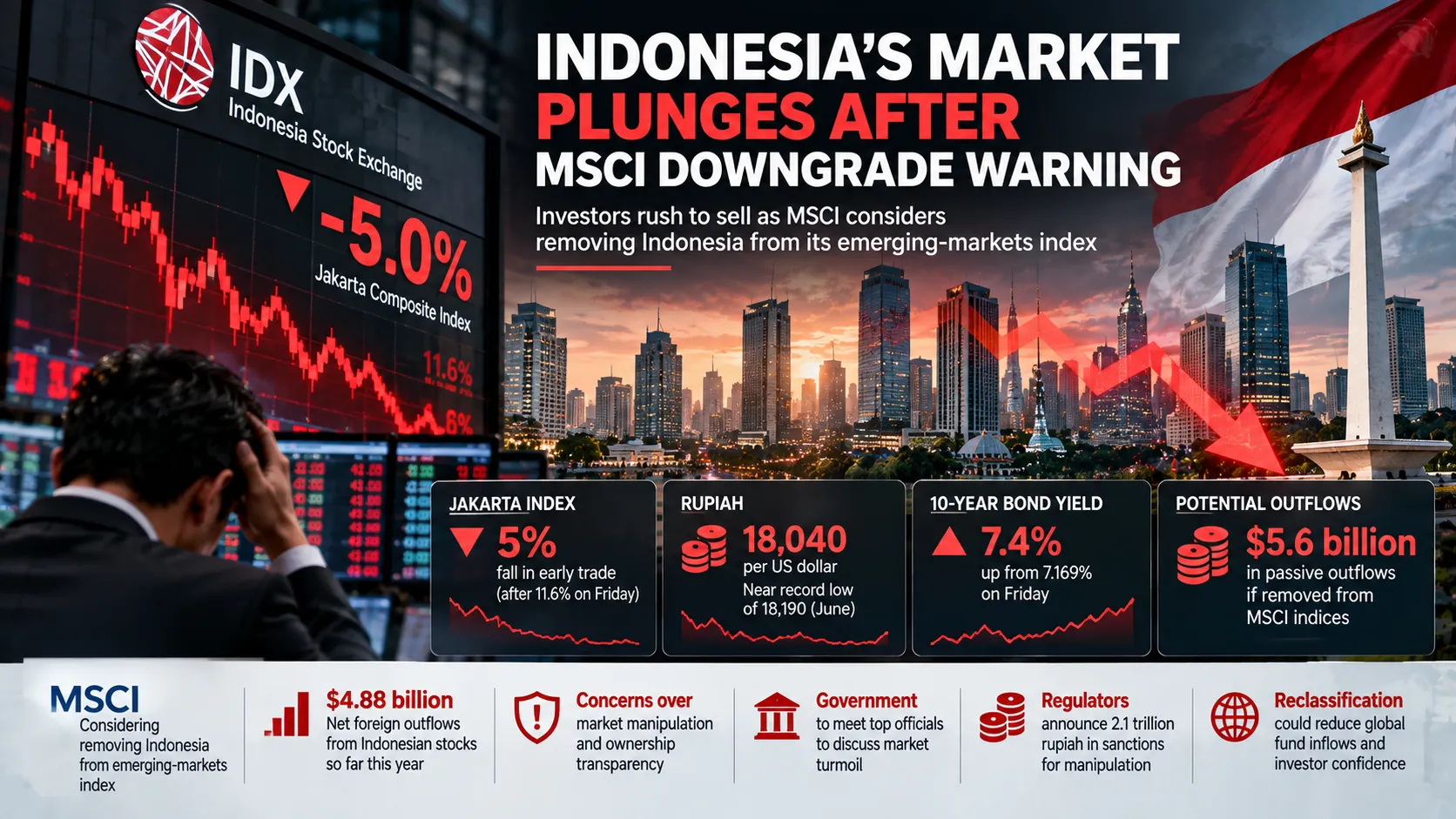
The main Jakarta index fell more than 5% in early trade, according to Reuters, following an 11.6% plunge on Friday. The two-day rout pushed the market to a six-year low. In an attempt to slow the selling, the Indonesia Stock Exchange halved its daily down limit to 7%.
The rupiah weakened to 18,040 per US dollar, close to the record low of 18,190 reached in June, while the yield on Indonesia's 10-year government bond rose to 7.4% from 7.169% on Friday. The Indonesia Stock Exchange said the MSCI announcement "was unexpected to us, causing a market panic."
What MSCI said
MSCI said it was considering reclassifying Indonesia from "emerging markets" to "standalone" status. A standalone classification would put Indonesia outside MSCI's main indices, in the same group as markets such as Lebanon and Zimbabwe.
The index provider first raised concerns in January about market manipulation and transparency of share ownership, and at that time threatened to downgrade Indonesia to "frontier" status. On Friday, MSCI said progress on addressing opacity in ownership and trading behaviour had been insufficient, so even a frontier downgrade would not reflect the severity of the issues.
The warning is a serious blow for Southeast Asia's largest economy. Being part of MSCI's emerging-markets index brings automatic investment from passive funds that track it, as well as attention from active fund managers who benchmark their performance against it.
Billions at stake
Goldman Sachs estimates that full removal from MSCI's indices could trigger about $5.6 billion in passive outflows. Active funds benchmarked to the indices hold more than $8 billion in Indonesian assets, although any selling by those funds would be discretionary.
Foreign investors had already been retreating. They have net sold $4.88 billion of Indonesian stocks so far this year, putting 2026 on track for the largest annual outflow in at least 16 years. Earlier this year, both Moody's and Fitch lowered their outlooks on Indonesia's sovereign credit rating to negative.
S&P Global Ratings said it expects additional capital outflows, but not on a scale that would materially raise Indonesia's financing costs. It nonetheless flagged the risk to investor confidence. Goldman Sachs said "the burden of proof has shifted" and that avoiding reclassification would require evidence of consistently implemented reforms.
The government responds
President Prabowo Subianto was expected to meet top financial officials, including executives from Indonesia's sovereign wealth fund Danantara and members of the Financial System Stability Committee, to discuss the market turmoil. Exchange officials were also scheduled to meet MSCI executives.
Regulators have already taken some steps. They announced sanctions totalling 2.1 trillion rupiah, or about $116.4 million, against parties linked to alleged manipulation in the shares of three companies. An analyst at Aletheia Capital described the fines as a positive move but said more direct action against well-known market players was needed.
Bank Indonesia's policy decision this week will be closely watched. The central bank is widely expected to hold interest rates, although some analysts have raised the possibility of a hike to defend the rupiah and stem the sell-off in government bonds.
Why governance matters to global investors
Indonesia's predicament highlights how much weight global investors place on market integrity. Index providers such as MSCI assess not only the size and liquidity of a market but also how easily foreign investors can access it, how transparent ownership structures are and whether trading is fair.
Concerns in Indonesia have centred on concentrated ownership, where a small group of shareholders controls a large portion of a company's shares, and on unusual trading patterns that can make prices volatile and hard to justify. When the free float, the portion of shares available to ordinary investors, is small, prices can be moved more easily, and index funds may struggle to buy and sell without distorting the market.
For investors, a reclassification would mean Indonesia drops out of the portfolios of many large global funds. That could reduce liquidity, raise companies' cost of capital and make it harder for Indonesian firms to raise money through share sales.
Lessons for India and other emerging markets
Indonesia's turmoil offers a reminder for other emerging markets, including India, of how closely global investors watch governance standards. India has worked in recent years to tighten disclosure rules, strengthen oversight of related-party transactions and crack down on market manipulation, and the Securities and Exchange Board of India has pushed for greater transparency in foreign portfolio investor ownership.
India itself has benefited from index changes. Its weighting in MSCI's emerging-markets index rose sharply in recent years as its market grew and as China's share fell. A significant reduction in Indonesia's weight, or its removal altogether, could lead to a modest reallocation of passive money towards other markets in the index, including India.
How index reclassification works
MSCI's market classification framework assesses countries on criteria including economic development, the size and liquidity of their markets, and the ease of access for international investors. Changes are typically announced after consultation with investors and implemented with a lead time, giving markets a chance to adjust.
Upgrades can bring large inflows. When markets such as Saudi Arabia, China's domestic A-shares and Kuwait were added to or given greater weight in emerging-market indices in recent years, passive and active funds bought billions of dollars of shares. Downgrades work in reverse, forcing index-tracking funds to sell. The prospect of such a move can trigger selling well before any formal decision, as investors try to get ahead of forced flows, which helps explain the speed of Indonesia's sell-off.
What comes next
MSCI's decision is not yet final. The coming weeks will test whether Indonesian authorities can convince the index provider that reforms are real and lasting. Measures could include stricter disclosure of ultimate beneficial ownership, tougher enforcement against manipulation and rules to increase free float.
For now, the sell-off has exposed how quickly confidence can evaporate when governance concerns collide with the mechanics of global index investing. Indonesia, with its young population, abundant natural resources and ambitions to become a high-income economy, has much to gain from deep and trusted capital markets. Restoring that trust has suddenly become one of its most urgent economic priorities.