Infosys, India's second-largest information technology services company, lowered its revenue growth forecast for the year on Friday, October 23, a sign that the artificial intelligence revolution is reshaping demand for the outsourcing industry in ways that are not yet translating into faster growth.
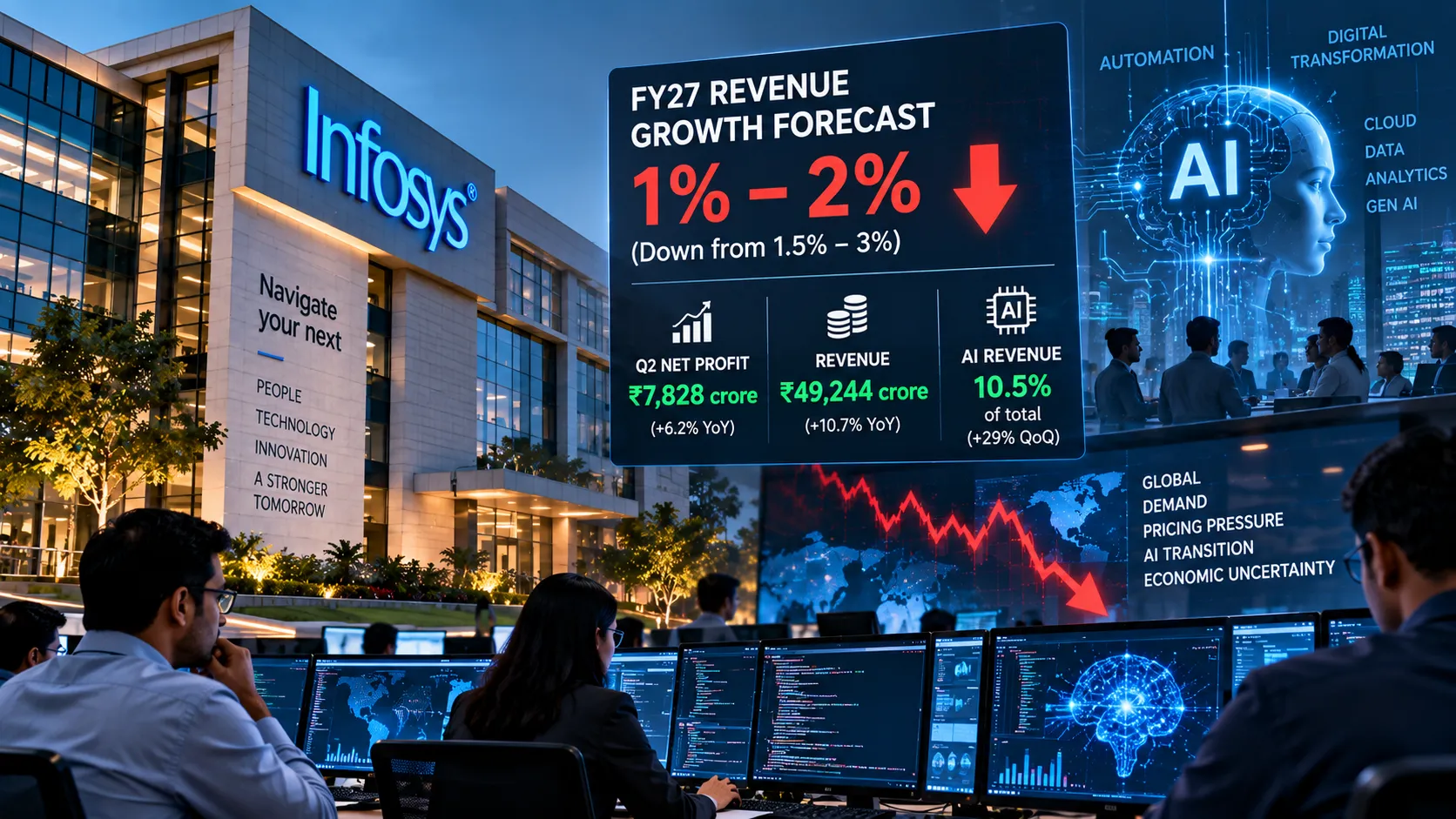
The Bengaluru-based company now expects revenue to grow 1% to 2% in constant currency terms in fiscal 2027, down from the 1.5% to 3% range it set three months earlier, Business Standard reported.
Net profit for the July-September quarter rose 6.2% to ₹7,828 crore, below the ₹7,904 crore that analysts surveyed by Bloomberg had expected. Revenue grew 10.7% to ₹49,244 crore, slightly ahead of the ₹49,108 crore consensus estimate. Operating margin was nearly flat at 21.1%.
A soft quarter
Chief executive Salil Parekh was candid about the challenges. "It was a soft quarter for us. The volumes were softer and in AI we are also seeing compression," he said.
The "compression" he referred to is one of the central dynamics in Indian IT services today. As clients adopt AI tools for coding, testing and operations, work that once required large teams can be done with fewer people, reducing the revenue from traditional contracts. At the same time, AI is creating new work, from building AI applications to modernising data systems, but that new revenue has so far only partly offset the decline.
In dollar terms, revenue grew 1.3% sequentially, and 1.5% in constant currency, compared with 0.6% for rival Wipro.
Chief financial officer Jayesh Sanghrajka warned of further pressure ahead. "The second half will be impacted from wage hikes and the continued intensity on pricing," he said.
AI revenue grows
There were encouraging signs in AI. Revenue from AI-related work rose to 10.5% of the total, up from 8.2% in the previous quarter, and grew 29% sequentially. Parekh pointed to a $300 billion market opportunity in AI services.
Infosys has invested heavily in AI capabilities, including its Topaz suite of AI services, partnerships with major AI model developers and training for its workforce. The company argues that its ability to help clients deploy AI across their businesses will become a major growth driver.
Large-deal wins were strong. The total contract value of large deals signed in the quarter reached $5.2 billion, including one deal worth more than $2 billion. Revenue from those deals is expected to begin flowing from April.
A mixed picture by sector and region
Performance varied widely across industries. Revenue from financial services, Infosys's largest vertical, grew 2.1%, and energy, utilities and resources rose 7.3%. But retail declined 7.7% and hi-tech fell 17.3%.
By geography, North America, the company's largest market, declined 1.5%, while Europe grew 4.6%.
Headcount and talent
Infosys added 4,480 employees during the quarter, bringing its total headcount to 332,542 at the end of September. It hired 8,000 freshers. Voluntary attrition was 12.7%.
Across the sector, IT companies added 16,055 employees in the first half of the fiscal year, Business Standard reported separately, though hiring remains well below the levels of the post-pandemic boom and experts warn that AI-driven change and weak demand could weigh on jobs.
Market reaction
Investors reacted negatively. Infosys's US-listed shares fell about 6.4% in pre-market trading in New York after the results.
"The weaker growth outlook is likely to remain the key focus for investors," said Manav Medewala of Mirae Asset Sharekhan.
The guidance cut comes after a strong rally in Indian IT stocks earlier in October, when investors rotated back into the sector on hopes that the worst was over. The Nifty IT index hit an eight-month high on October 21, helped by strong results from companies such as L&T Technology Services.
The industry backdrop
Indian IT services companies face a complex environment. Clients in the United States and Europe are cautious about discretionary technology spending amid economic uncertainty, high interest rates and geopolitical risks. At the same time, they are prioritising AI investments, sometimes at the expense of traditional IT projects.
Mid-sized IT companies have been growing faster than their larger peers. Coforge, for example, reported a 56.5% jump in quarterly profit on Friday, citing AI-led deal execution. Their agility in winning deals and adapting to AI has helped them gain market share.
What it means for India
The IT services industry is one of India's largest employers of graduates and its biggest source of services exports. Slower growth at major companies has implications for hiring, salaries and the broader economy, particularly in cities such as Bengaluru, Hyderabad, Pune and Chennai.
The industry's ability to reinvent itself around AI will determine whether it can continue to be an engine of employment and foreign exchange earnings. Companies are retraining staff, building AI platforms and seeking new kinds of contracts, such as outcome-based pricing.
How Indian IT is adapting
The industry is responding to AI on several fronts. Companies are training hundreds of thousands of employees in AI tools, building proprietary platforms that combine AI models with their domain knowledge, and forming partnerships with leading AI developers. They are also experimenting with new pricing models, such as charging for outcomes rather than hours, which could allow them to capture some of the productivity gains AI delivers.
Clients increasingly want vendors to commit to productivity improvements in contract renewals, passing on the benefits of automation. That dynamic puts pressure on revenue from existing contracts, even as new AI projects emerge. Analysts expect the transition to take several years, with uneven effects across companies depending on their client mix, service lines and ability to win AI-led transformation programmes.
The question for investors is how quickly AI revenue can grow to offset declines elsewhere. At 10.5% of revenue and rising, AI is already material for Infosys, but the company's overall growth shows that the offset is not yet complete.
What comes next
Infosys will focus on converting its large deal pipeline into revenue and expanding its AI business. Investors will watch whether the large deals signed this quarter deliver the expected boost from April, and whether pricing pressure eases.
For the broader industry, Infosys's guidance cut is a reminder that the transition to AI will be uneven. Companies that adapt fastest are likely to emerge stronger, but the path will involve pressure on traditional revenue along the way.