Infosys, India's second-largest information technology services company, has lowered its growth forecast for the year, a sign that artificial intelligence is beginning to squeeze revenue for the outsourcing industry even as it creates new opportunities.
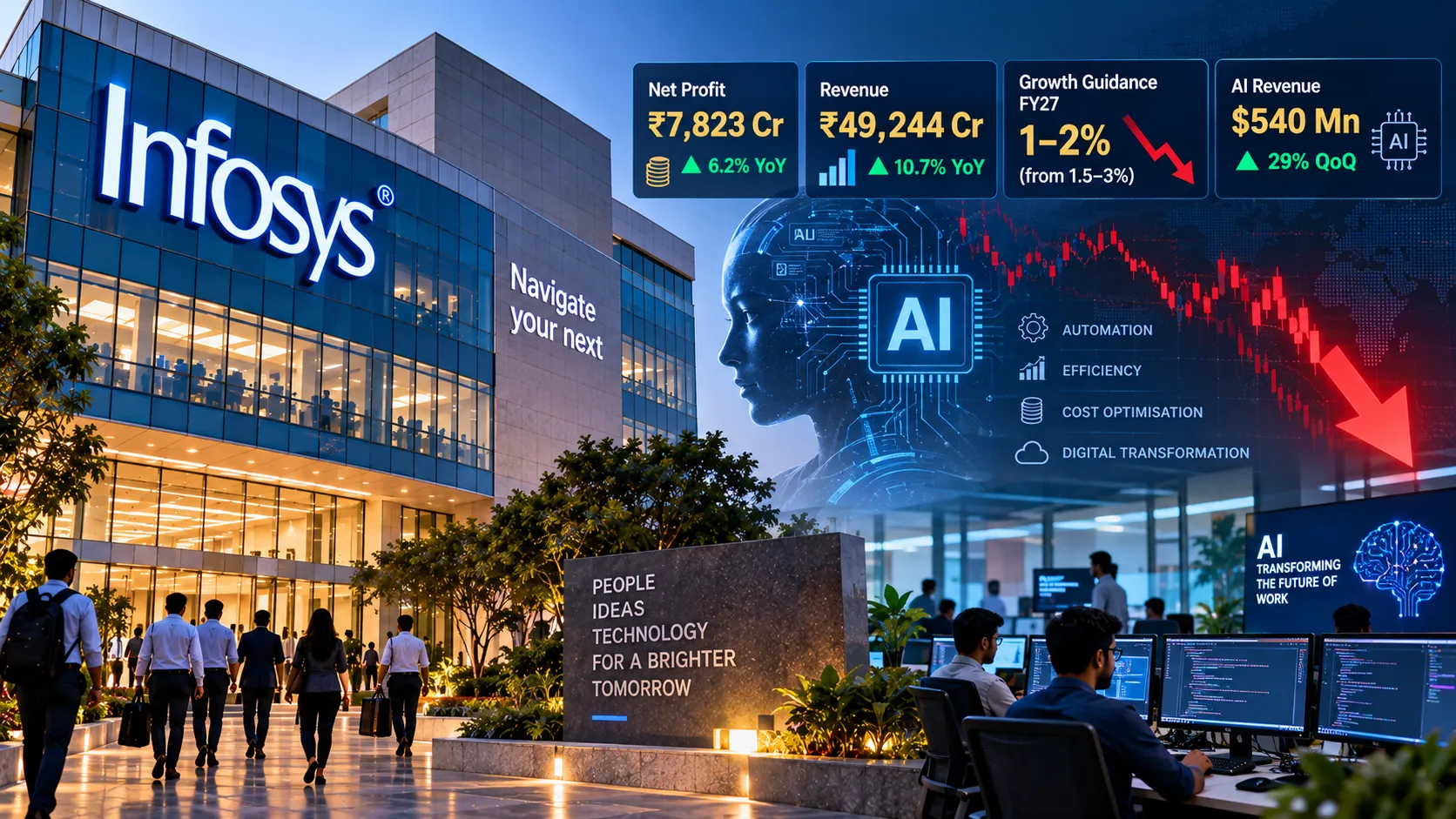
The Bengaluru-based company reported consolidated net profit of ₹7,823 crore for the July-September quarter, up 6.2% from ₹7,364 crore a year earlier and almost unchanged from ₹7,769 crore in the June quarter. Revenue from operations rose 10.7% to ₹49,244 crore from ₹44,490 crore, and the operating margin was about 21%.
But the headline numbers were overshadowed by the company's outlook. Infosys cut its revenue growth guidance for the financial year ending March 2027 to 1-2% in constant currency terms, from 1.5-3% previously. It cited pricing pressure, intense competition and client demands for higher productivity.
Infosys shares fell in early trade on Monday, October 26, and the Nifty IT index dropped 1.20%, making technology the weakest sector on a down day for Indian markets.
Deal wins remain strong
The guidance cut came despite healthy deal activity. Infosys won large contracts worth $5.2 billion, about ₹49,000 crore, during the quarter, including a single deal worth more than $2 billion spread over seven years.
Large deal wins are a key indicator of future revenue, but they take time to convert into sales. Many of the contracts signed in recent quarters involve consolidating vendors, renewing existing work at lower prices or delivering efficiency gains, which means they may not add as much new revenue as their headline value suggests.
AI revenue grows
Revenue from artificial intelligence services reached $540 million in the quarter, up 29% from the previous quarter. Infosys has been building AI capabilities through its Topaz platform and partnerships with leading model developers, and it is helping clients deploy AI agents and automate processes.
The growth in AI revenue is encouraging, but it remains a small share of total revenue. The challenge for Infosys and its peers is that AI is also reducing demand for some traditional services, such as application maintenance, testing and customer support, as clients use the technology to do more with fewer people.
The productivity squeeze
Client demands for productivity are at the heart of the guidance cut. As AI tools make software development and maintenance more efficient, clients expect service providers to pass on those savings through lower prices or more work for the same cost. That compresses revenue growth even when the volume of work is stable.
Competition has also intensified. Indian IT companies compete not only with each other but with global firms such as Accenture and Capgemini, and increasingly with technology vendors that offer AI-powered automation directly. In a market where clients are cautious about spending, price competition has become fierce.
A tough environment for Indian IT
Infosys's results reflect broader challenges for India's IT industry, which employs millions of people and is one of the country's largest sources of export earnings. Clients in the United States and Europe, the main markets, have been cautious about discretionary technology spending amid economic uncertainty, high energy prices and rapid technological change.
Not all companies are struggling equally. Mid-sized firm Coforge reported a 56.5% jump in quarterly profit to ₹588 crore, helped by a full quarter of contribution from its $2.35 billion acquisition of Encora, and raised its margin guidance. Hardware and AI infrastructure company Netweb Technologies reported a 61.5% sequential jump in revenue as demand for AI systems surged.
The contrast suggests that companies with focused strategies in fast-growing areas, or that have made acquisitions to add capabilities, are faring better than the largest diversified players.
What it means for employees
Slower growth has implications for hiring. Indian IT companies have been cautious about adding staff over the past two years, and many have focused on retraining existing employees in AI skills rather than expanding headcount. The guidance cut suggests hiring will remain subdued.
The industry's traditional model, which relied on adding large numbers of engineers to grow revenue, is being reshaped as AI allows companies to deliver more with fewer people. That shift poses challenges for the millions of graduates who look to IT services as a path to well-paid employment.
Market reaction
The guidance cut added to pressure on Indian equities, which have been weighed down by high oil prices and foreign selling. IT stocks are a large component of the benchmark indices and a major holding for foreign investors, so weakness in the sector has an outsized effect on market sentiment.
Analysts will be revising their earnings estimates for Infosys and the sector after the results. The key question is whether the guidance cut reflects temporary caution or a structural slowdown in demand for traditional IT services.
The strategic response
Infosys and its peers are responding by investing heavily in AI capabilities, forming partnerships with model developers and cloud providers, and reorganising their offerings around outcomes rather than headcount. Several companies have begun pricing more contracts based on results delivered rather than hours worked, a shift that could protect margins even as revenue per project falls.
Training is another priority. Indian IT companies have said they are retraining large parts of their workforce in AI tools, aiming to ensure employees can work alongside automated systems and take on higher-value tasks.
Peers under the same pressure
Infosys is not alone. Large Indian IT companies have all reported subdued growth over the past two years, with clients shifting budgets towards AI projects and away from traditional maintenance work. Tata Consultancy Services, Wipro and HCLTech have each spoken about pricing pressure and cautious client spending, and investors will compare their commentary closely with Infosys's revised outlook.
What comes next
Investors will watch Infosys's deal pipeline and AI revenue in coming quarters for signs that new opportunities can offset pressure on traditional services. The company's ability to convert its large deal wins into revenue growth will be crucial.
For the broader IT industry, the next few quarters will test whether AI ultimately expands the market for technology services, as companies hope, or shrinks it by automating work that was once outsourced. The answer will shape one of India's most important export industries for years to come, and will influence how investors value the sector on Dalal Street.