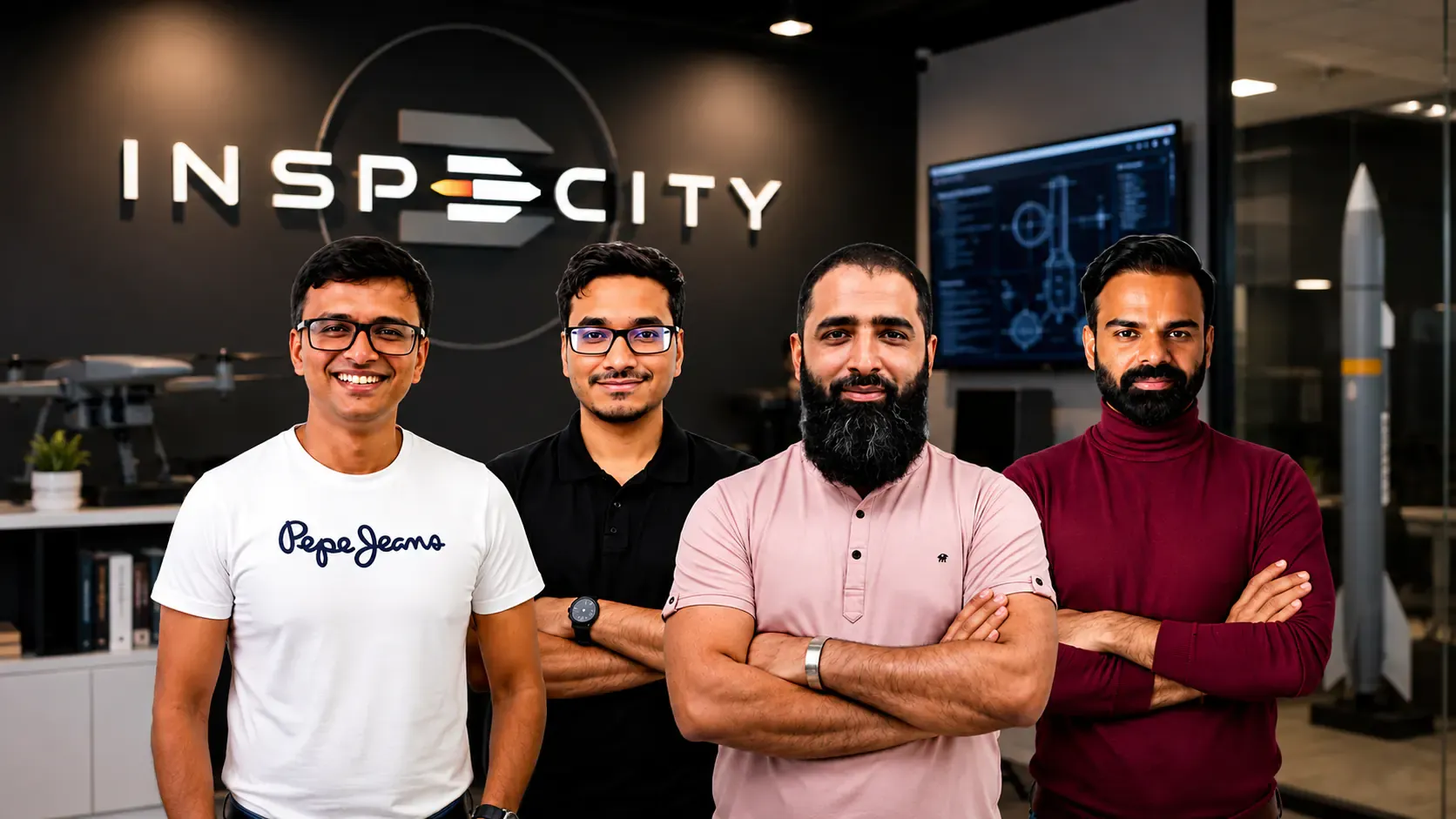
Most satellites do not fail because their electronics break down. They fail because their propellant runs out, leaving fully functional solar panels and payloads to be pushed into graveyard orbits simply because there is no way to refuel them in space. InspeCity, a Thane-based space-technology startup incubated at IIT Bombay, has raised ₹100 crore — roughly $10.5 million — in a pre-Series A round to build the infrastructure that could change that calculus.
The round was co-led by deep-tech specialist Speciale Invest and prominent public-markets investor Ashish Kacholia, with additional participation from Antler Elevate, Antler India, angel investor Manish Gandhi and Shastra VC. The fresh capital builds on InspeCity's earlier fundraising history, which included a $5.6 million seed round and a $1.5 million pre-seed round, bringing the company's total disclosed funding to a scale that positions it among the more capitalised space-tech startups to emerge from India's academic incubator ecosystem.
Founded in 2022 by Arindrajit Chowdhury, InspeCity is developing in-space servicing, assembly and manufacturing technologies designed to extend the operational lifespan of satellites and address the growing problem of orbital debris. As satellite constellations multiply — driven by broadband mega-constellations, earth observation fleets and defence applications — the economics of replacing rather than repairing spacecraft are coming under increasing strain, both financially and in terms of orbital sustainability.
The company's near-term roadmap is ambitious: over the next 12 to 18 months, InspeCity plans to execute four in-orbit missions intended to validate its propulsion, sensing, robotics and docking capabilities in sequence. Each successful milestone would de-risk the technology further for commercial satellite operators who remain understandably cautious about entrusting expensive, mission-critical assets to unproven robotic servicing platforms.
In-orbit servicing sits at the intersection of commercial opportunity and strategic necessity. Governments increasingly classify satellite infrastructure as critical national assets, and the ability to inspect, repair or refuel spacecraft after launch carries implications well beyond cost savings for private operators — it touches directly on questions of space sovereignty and debris mitigation that are becoming more urgent as low Earth orbit grows more congested.
For India's space-tech sector, which has expanded rapidly since the opening of the space economy to private players, InspeCity's raise reinforces a broader trend: domestic startups are increasingly targeting technically ambitious, capital-intensive frontier categories rather than confining themselves to satellite launch services alone. Whether InspeCity's docking and servicing technology can be proven reliably in orbit — and commercialised at a price point satellite operators are willing to pay — will determine whether this pre-Series A becomes the first chapter in a much larger growth story.
The global in-orbit servicing market remains in its early commercial stages, with only a handful of companies worldwide — predominantly in the United States and Europe — having successfully demonstrated docking and servicing capability with operational spacecraft. InspeCity's entry into this select group, backed by a fresh pre-Series A round, positions the company among a small cohort of global challengers attempting to prove that robotic in-space servicing can move from technology demonstration to a genuinely scalable commercial service.
India's space economy has undergone a marked transformation since the government opened the sector to private participation, with the Indian Space Research Organisation increasingly positioning itself as an enabler and customer for private space companies rather than the sole operator of the country's space programme. That policy shift has catalysed a wave of startup activity across launch vehicles, satellite manufacturing and, now, servicing infrastructure, with founders like Chowdhury benefiting from both government support programmes and a growing pool of specialised early-stage investors willing to underwrite the sector's long development timelines.

Speciale Invest's involvement as co-lead investor is notable given the firm's established track record backing India's deep-tech and space-tech startups specifically, lending additional credibility to InspeCity's technical roadmap among investors who may lack the specialised knowledge to independently evaluate orbital mechanics and robotic servicing claims. Ashish Kacholia's participation, meanwhile, brings the perspective of one of India's most closely watched public-markets investors, whose early-stage bets are often interpreted by the broader investment community as signals worth monitoring.
The four planned in-orbit missions over the next 12 to 18 months represent a compressed and ambitious validation timeline for technology this complex. Each mission carries meaningful execution risk — orbital robotics remains one of the most technically demanding disciplines in aerospace engineering, where failure in even a single subsystem during a live mission can set a company's credibility back by years, given the difficulty and expense of securing additional flight opportunities to attempt validation again.
Should InspeCity successfully demonstrate its propulsion, sensing, robotics and docking capabilities across these missions, the company would be well positioned to pursue larger institutional funding rounds from investors more accustomed to backing later-stage, de-risked space infrastructure businesses. Until then, the ₹100 crore raised in this round will need to stretch across mission hardware, launch costs and the specialised engineering talent required to execute a genuinely novel technical roadmap in one of aerospace's most unforgiving operating environments.
The strategic dimension of orbital debris mitigation is likely to grow more, not less, prominent in the years ahead, as international regulatory bodies and satellite operators alike confront the mounting cost of an increasingly congested low Earth orbit. Companies capable of demonstrating credible, repeatable in-orbit servicing capability may eventually find themselves not just serving individual satellite operators on a commercial basis but participating in broader, potentially government-backed debris remediation efforts — a market opportunity that remains speculative today but could meaningfully expand InspeCity's addressable market well beyond commercial satellite life extension alone.
Chowdhury's engineering team will also need to navigate the practical realities of testing and iterating on hardware that, once launched, cannot be physically retrieved and modified in the way ground-based technology can. That constraint places a premium on exhaustive pre-launch validation, redundant subsystem design and conservative mission sequencing — engineering disciplines more commonly associated with established aerospace primes than with early-stage venture-backed startups, underscoring the unusually high execution bar InspeCity has set for itself with this ambitious four-mission roadmap.
Manish Gandhi and Shastra VC's participation alongside Antler's twin India and Elevate programmes rounds out a syndicate that spans both operator-angel expertise and institutional deep-tech investing infrastructure, a combination that founders in capital-intensive, technically complex categories often cite as more valuable than capital alone when navigating the earliest, highest-risk stages of hardware validation.


