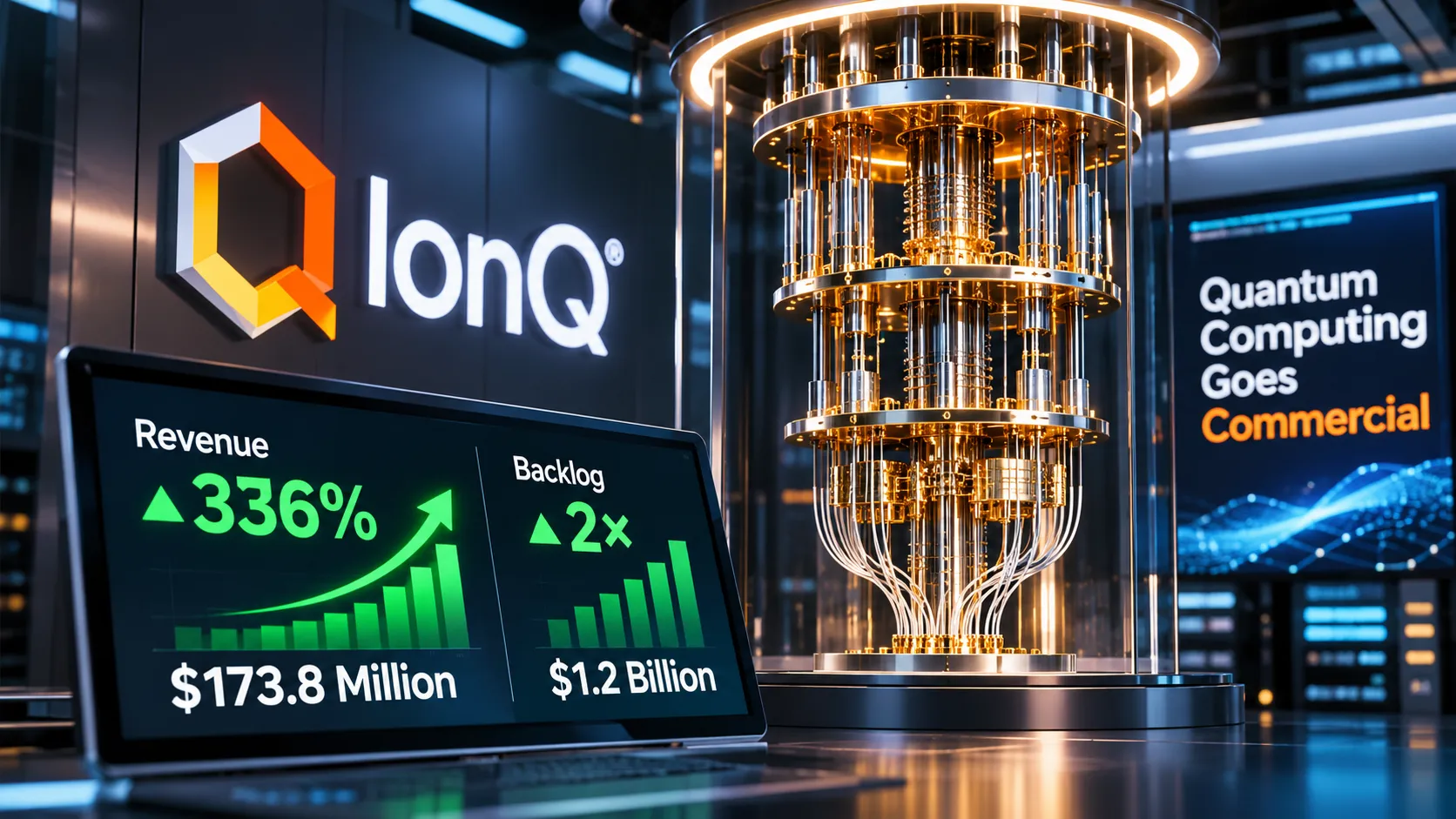
IonQ, one of the most prominent publicly traded quantum computing companies, reported a more than fourfold increase in revenue and raised its full-year forecast, in the latest sign that quantum technology is beginning to generate meaningful commercial revenue.
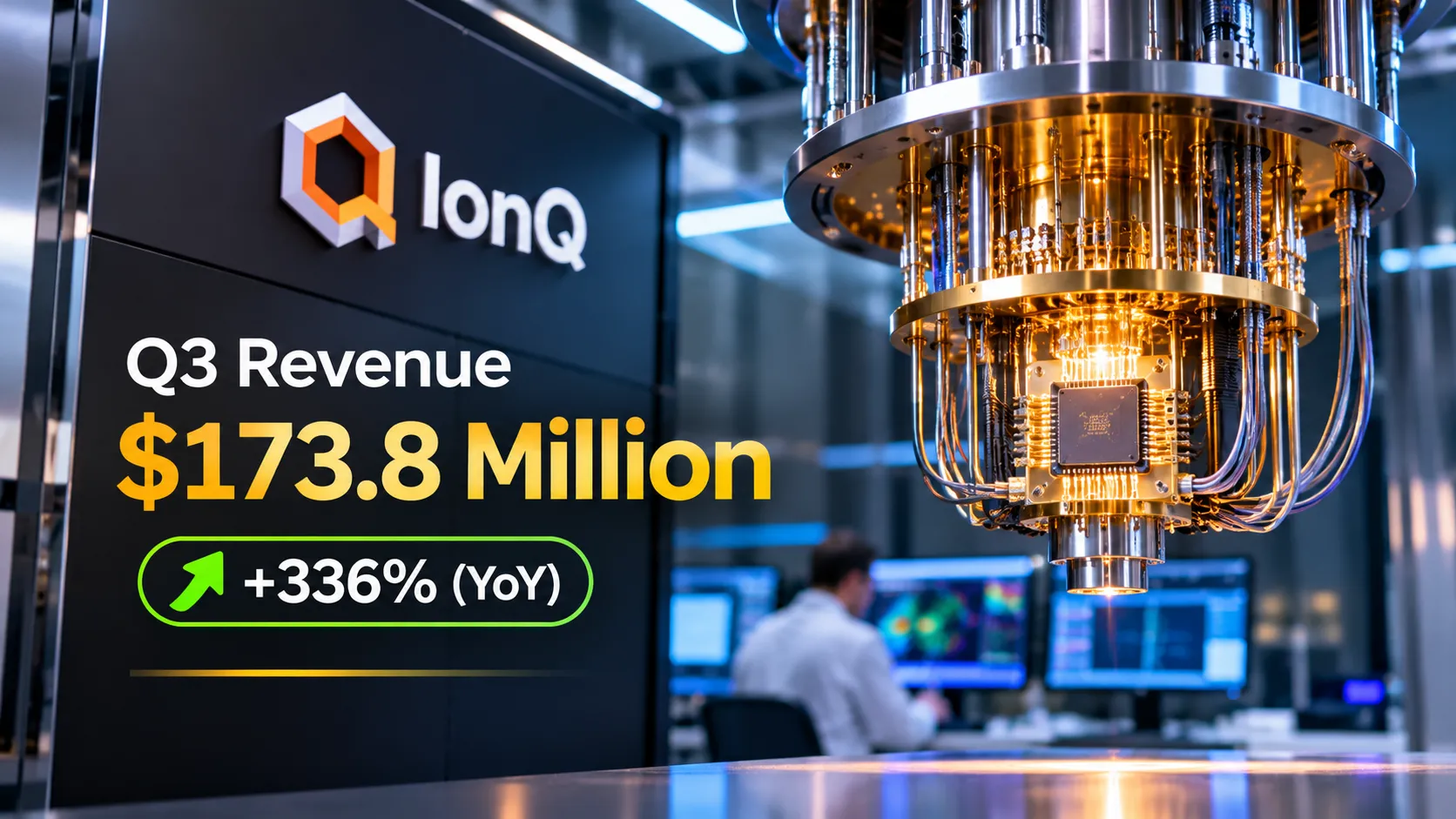
The Maryland-based company reported revenue of $173.8 million for the third quarter, up 336% from a year earlier and its sixth consecutive record quarter, according to The Quantum Insider, citing results announced on November 5. It raised its 2026 revenue forecast to $505 million to $515 million.
IonQ's shares rose 4.92% in after-hours trading, according to StockTitan, on a day when the Nasdaq fell 5.5%.
Where the revenue comes from
A significant share of the growth came from acquisitions. Revenue from IonQ's platform business, which includes quantum computers, networking and related services, rose 127% to $90.3 million, driven by global deployments of its Tempo quantum systems, according to The Quantum Insider. Revenue from SkyWater Foundry Services, a semiconductor manufacturing business IonQ acquired, was $83.5 million.
Analysts at FourWeekMBA noted that about 48% of revenue came from SkyWater, meaning that organic quantum revenue, while growing strongly, accounts for just over half of the total. IonQ expects its quantum computing revenue to grow 110% for the year.
A growing backlog
Remaining performance obligations, a measure of contracted future revenue, more than doubled to $1.2 billion, according to The Quantum Insider. "Our Remaining Performance Obligations more than doubled to $1.2 billion," said Inder Singh, IonQ's chief operating officer and chief financial officer. About two-thirds of new contract dollars signed by the platform business were for quantum computing.
Profit on paper, loss in practice
IonQ reported net income attributable to the company of $564 million, or $1.42 per share, but this was largely the result of a non-cash change in the valuation of warrants, not operating performance, according to The Quantum Insider. On an adjusted basis, IonQ reported an adjusted EBITDA loss of $133.6 million and an adjusted loss of $0.29 per share, reflecting heavy investment in research and development.
The company had $1.7 billion in cash and investments at the end of September, and $3.7 billion on a pro forma basis including a $2 billion equity offering that closed on October 16.
DARPA milestone
IonQ advanced to Stage C of the Quantum Benchmarking Initiative run by DARPA, the US Defense Advanced Research Projects Agency, with potential programme value of up to $300 million, according to The Quantum Insider. The initiative aims to determine whether any approach can achieve a utility-scale quantum computer by 2033. Chief executive Niccolo de Masi described IonQ as "the only trapped-ion company to advance to DARPA Stage C."
IonQ also won a $28 million contract under DARPA's It's About Time programme for 25 optical atomic clocks, with a $30 million option for 100 more.
Superion 256
IonQ's next-generation system, the Superion 256, has attracted significant orders. Nvidia selected it to be the first on-premise quantum computer at its Accelerated Quantum Research Center, according to The Quantum Insider. IonQ also signed a $33 million contract with SDT for a Superion 256 system and a quantum memory platform, and a $25 million contract with Florida International University. BigGo Finance reported that the Superion 256 had sold out for 2027.
Other agreements include an $8.2 million contract with Congruity360 for post-quantum cryptography and quantum key distribution, $7.5 million of follow-on funding from the Air Force Research Laboratory for quantum networking and a memorandum of understanding with Northrop Grumman.
What quantum computing promises
Quantum computers use the principles of quantum mechanics to perform certain calculations that would be impractical for classical computers. Potential applications include drug discovery, materials science, financial modelling, logistics optimisation and cryptography. However, today's quantum computers remain limited by errors and the number of qubits, the basic units of quantum information, and practical, large-scale applications are still years away.
IonQ uses trapped-ion technology, in which individual charged atoms are held in place by electromagnetic fields and manipulated with lasers. Competitors pursue other approaches, including superconducting qubits, used by IBM and Google, and neutral atoms.
Building a quantum conglomerate
Under de Masi, IonQ has pursued an aggressive acquisition strategy, buying companies in quantum networking, sensing, security and manufacturing. The acquisition of SkyWater, a US semiconductor foundry, gives IonQ control over chip manufacturing capacity, which it can use for its own quantum chips while serving external customers such as D-Wave and Qolab. It also acquired Elisity, a security company.
The investment debate
Quantum computing stocks have been highly volatile, rising sharply on enthusiasm about the technology and falling on doubts about how soon it will generate profits. IonQ's growing revenue and backlog provide some support for its valuation, but its continued losses and reliance on acquisitions for revenue growth remain points of debate.
The India angle
India has launched a National Quantum Mission with a budget of about ₹6,000 crore to develop quantum computing, communication and sensing capabilities. Indian startups and research institutions are working on quantum technologies, and the global growth of companies such as IonQ highlights the commercial potential of the field. Indian engineers and researchers also form an important part of the global quantum workforce.
Revenue quality
Investors and analysts have debated the quality of IonQ's revenue growth. The acquisition of SkyWater added a large, relatively low-margin manufacturing business that accounts for nearly half of revenue. Supporters argue that controlling chip manufacturing capacity is strategically important for building quantum computers at scale, while sceptics prefer to focus on the growth of the core quantum business, which rose 127% in the quarter.
IonQ's raised full-year guidance covers the whole business, including the foundry, which makes it important for investors to track the performance of each segment separately.
Quantum and AI
IonQ has positioned quantum computing as complementary to AI, with its Superion 256 system to be installed at Nvidia's Accelerated Quantum Research Center. Hybrid systems that combine classical AI computing with quantum processors are seen as a promising path to practical applications, and partnerships with AI leaders could help quantum companies find early commercial uses.
What comes next
Investors will watch IonQ's progress in delivering Superion 256 systems, its performance in the DARPA initiative and the growth of its organic quantum revenue. With a $1.2 billion backlog and a raised forecast, IonQ is positioning itself as a leader in the emerging commercial quantum industry.