India's largest initial public offering ended on a resounding note on Friday, October 23, as institutional investors at home and abroad poured bids into Jio Platforms, the digital and telecom arm of Reliance Industries.
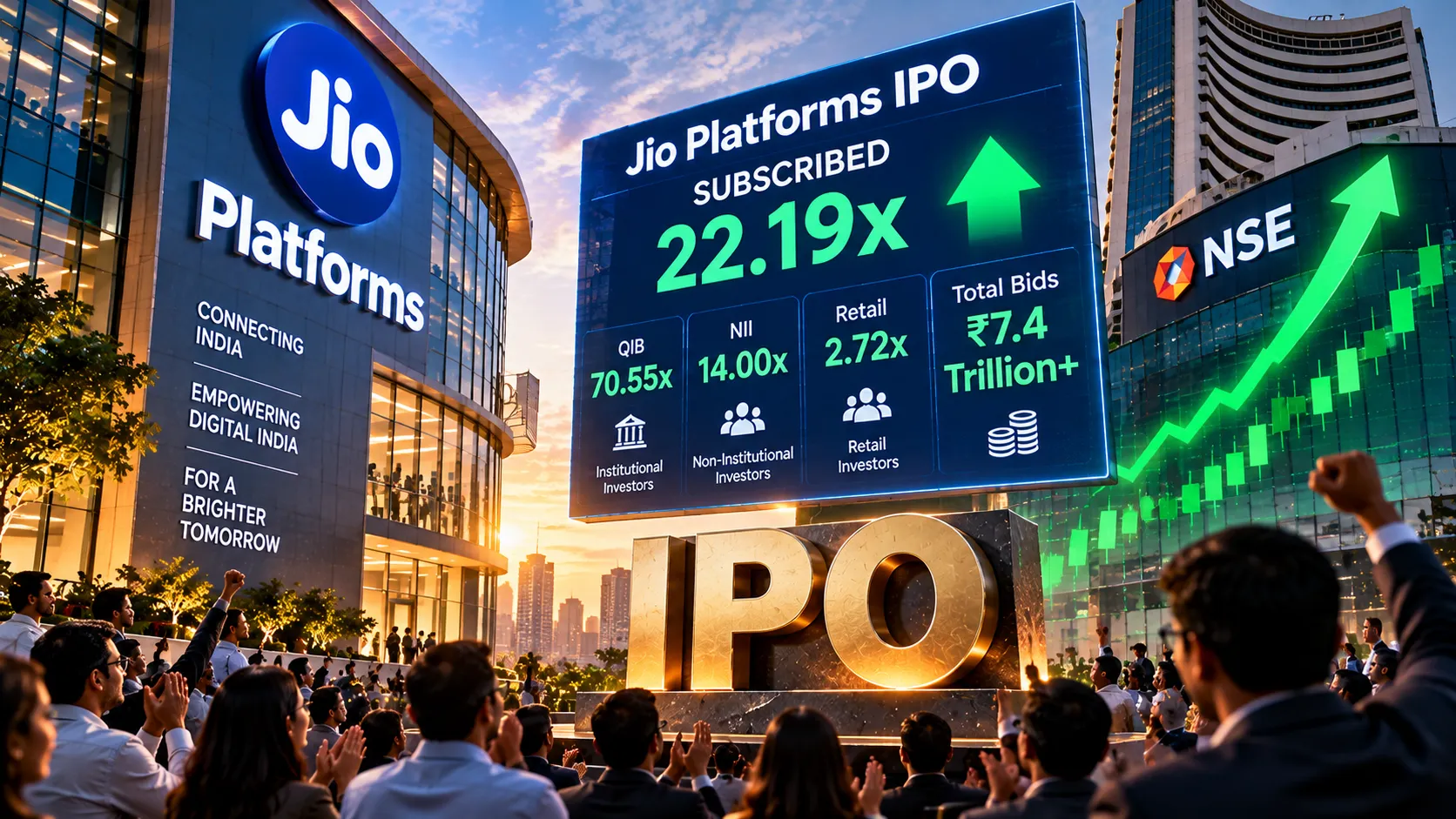
The ₹30,213 crore IPO was subscribed 22.19 times overall by the close of bidding, Business Standard reported, citing exchange data. Qualified institutional buyers bid for 70.55 times the shares reserved for them, placing orders for about 3,457.6 million shares against 49 million on offer.
Including the anchor book, total demand exceeded ₹7.4 trillion from about 13.9 million applications. Bids in the public offering alone, excluding anchor investors, exceeded ₹4.9 trillion.
How each category fared
Non-institutional investors, typically wealthy individuals and corporates, subscribed 14 times their portion, up from 5.28 times a day earlier. Within that category, bids of more than ₹10 lakh were subscribed 15.89 times, and bids of ₹2 lakh to ₹10 lakh 10.22 times.
Retail investors subscribed 2.72 times, bidding for 231.2 million shares against 85 million reserved, worth more than ₹25,867 crore. The employee portion was subscribed 2.93 times, and the portion reserved for Reliance Industries shareholders 7.60 times.
Among institutions, foreign portfolio investors bid for 1,239.3 million shares, domestic financial institutions for 1,525 million and mutual funds for 357.1 million.
The terms of the offer
The IPO comprised a fresh issue of 270 million shares at a price band with an upper end of ₹1,119 per share. Of the issue, ₹2,500 crore was reserved for Reliance Industries shareholders and ₹500 crore for employees, who received a 5% discount. Nineteen banks managed the offering.
At the upper end of the price band, Jio Platforms is valued at about ₹10.3 trillion, roughly $109 billion. That would make it larger at listing than Facebook was at its 2012 IPO, when it was valued at about $104 billion, and would rank it seventh among listed telecom companies globally by market value.
The shares are scheduled to list on October 28.
Why institutions piled in
Analysts said institutional demand was stronger than expected. "Jio Platforms IPO demand was much better than anticipated, especially the institutional subscription," said independent market analyst Ambareesh Baliga. He added that the valuation had "left something on the table" for investors who receive allotments, suggesting room for gains after listing.
Several factors underpin institutional appetite. Jio is India's largest telecom operator by subscribers, with a dominant position in mobile data. It has expanded into home broadband, enterprise services, digital platforms and satellite internet, and is positioning itself as a technology company rather than a pure telecom operator, as executive Akash Ambani argued ahead of the IPO.
India's telecom sector has also become more profitable after years of price wars. Consolidation has left three private operators, and tariff increases have lifted revenue per user. Investors see further scope for tariff increases, growth in data consumption and new revenue from enterprise and digital services.
Retail demand more measured
Retail investors were more cautious, with subscriptions of 2.72 times, solid but modest compared with the institutional frenzy. Geetanjali Kedia of S P Tulsian Investment Advisory Services noted that "IPOs generally see subscription on day 3," as many investors wait until the final day to bid.


