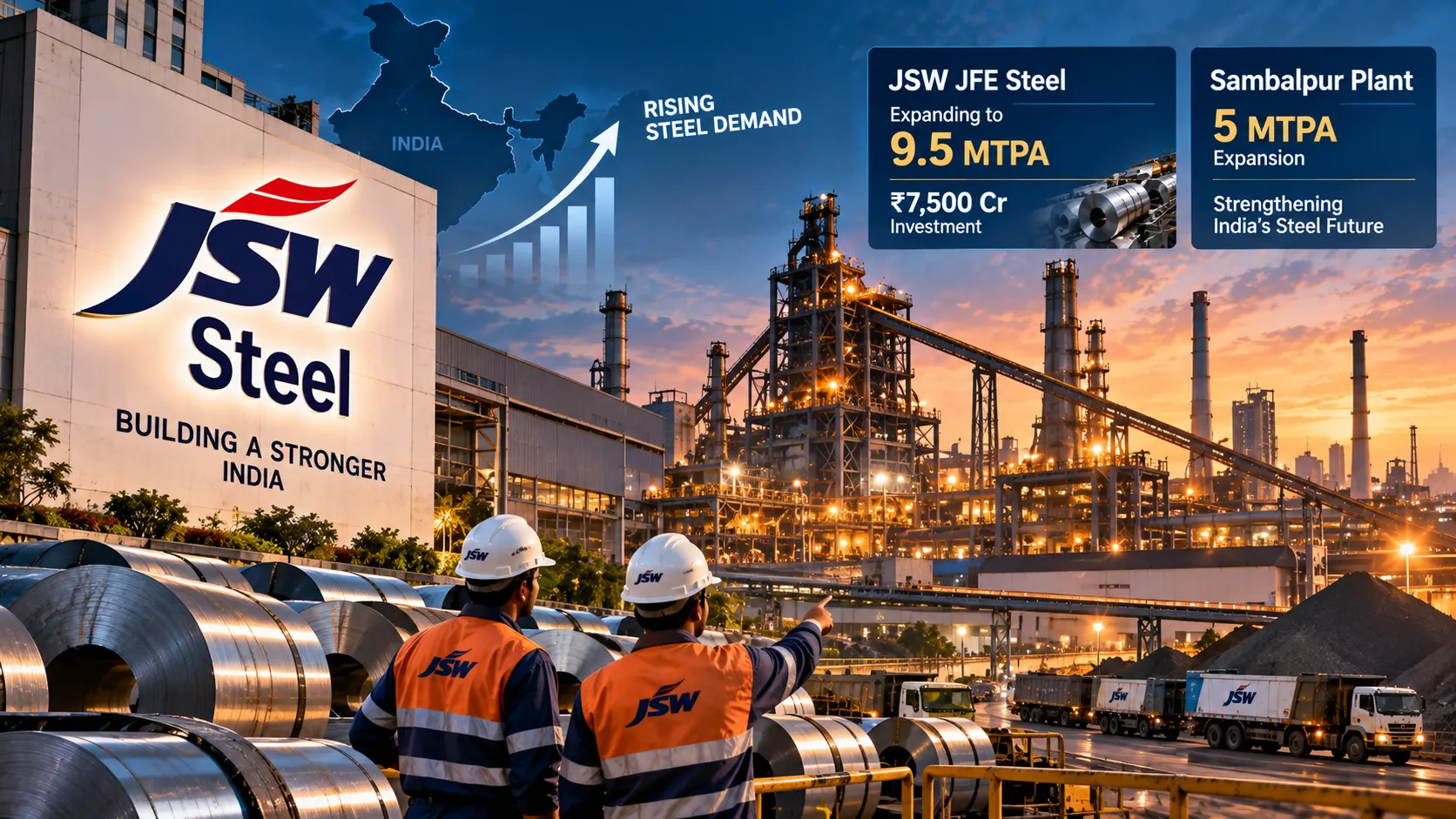
JSW Steel, India's largest steelmaker by capacity, is pressing ahead with ambitious expansion plans, betting that the country's demand for steel will keep growing strongly despite global economic uncertainty.
The company's joint venture with Japan's JFE Steel, JSW JFE Steel, will expand capacity to 9.5 million tonnes at an estimated investment of ₹7,500 crore, according to market reports on Monday, October 26. Separately, JSW Steel's board approved a 5 million tonnes per annum (MTPA) expansion at its plant in Sambalpur, Odisha.
JSW Steel shares were among the top gainers on the Sensex in early trade on Monday, rising even as the broader market fell.
The JFE partnership
JFE Steel, one of Japan's largest steelmakers, has been a strategic partner of JSW Steel for years, holding a stake in the company and collaborating on technology. The two companies formed joint ventures to produce specialised steel products in India, including cold-rolled grain-oriented electrical steel, a high-value product used in transformers and electric motors.
Electrical steel is in growing demand as India expands its power grid, adds renewable energy capacity and builds more electric vehicles. Much of India's electrical steel has historically been imported, and domestic production supports the government's goal of reducing imports and strengthening supply chains.
The partnership also reflects Japan's growing investment in India. Japanese companies have expanded their presence in Indian manufacturing, attracted by the size of the market and the opportunity to diversify supply chains.
Sambalpur expansion
The Sambalpur expansion adds to JSW Steel's growing footprint in Odisha, a state rich in iron ore and coal that has become a centre for India's steel industry. Proximity to raw materials reduces costs, and Odisha's ports provide access to export markets and imported coking coal.
The Odisha government has been actively courting steel investment. A large integrated steel plant of 5 million tonnes, estimated at ₹35,000 crore, involving JSW and South Korea's POSCO, is under discussion, according to state officials. The state also secured investment proposals worth ₹53,894 crore at the India Chem 2026 exhibition in Mumbai.
India's steel ambitions
India is the world's second-largest steel producer after China, and its steel demand has been growing faster than that of most major economies, driven by infrastructure spending, construction, automotive production and manufacturing. The government's National Steel Policy targets 300 million tonnes of production capacity by 2030.
JSW Steel, Tata Steel, the state-owned Steel Authority of India, ArcelorMittal Nippon Steel India and other producers have announced major expansion plans to meet that target. JSW Steel, part of the JSW Group led by chairman Sajjan Jindal, has been one of the most aggressive in adding capacity.
Challenges for the industry
The expansion comes despite challenges. Cheap imports, particularly from China, where steel production exceeds domestic demand, have put pressure on prices in India and globally. India imposed a safeguard duty on certain steel imports to protect domestic producers.
High energy costs are another concern. Steel production is energy-intensive, and high oil and coal prices raise costs. Coking coal, a key raw material, is largely imported.
Environmental pressures are also increasing. Steel production is one of the largest sources of industrial carbon emissions, and Indian producers face pressure from customers, investors and regulations such as the European Union's carbon border adjustment mechanism to reduce emissions. JSW Steel has committed to reducing its carbon intensity and is investing in renewable energy and cleaner production technologies.