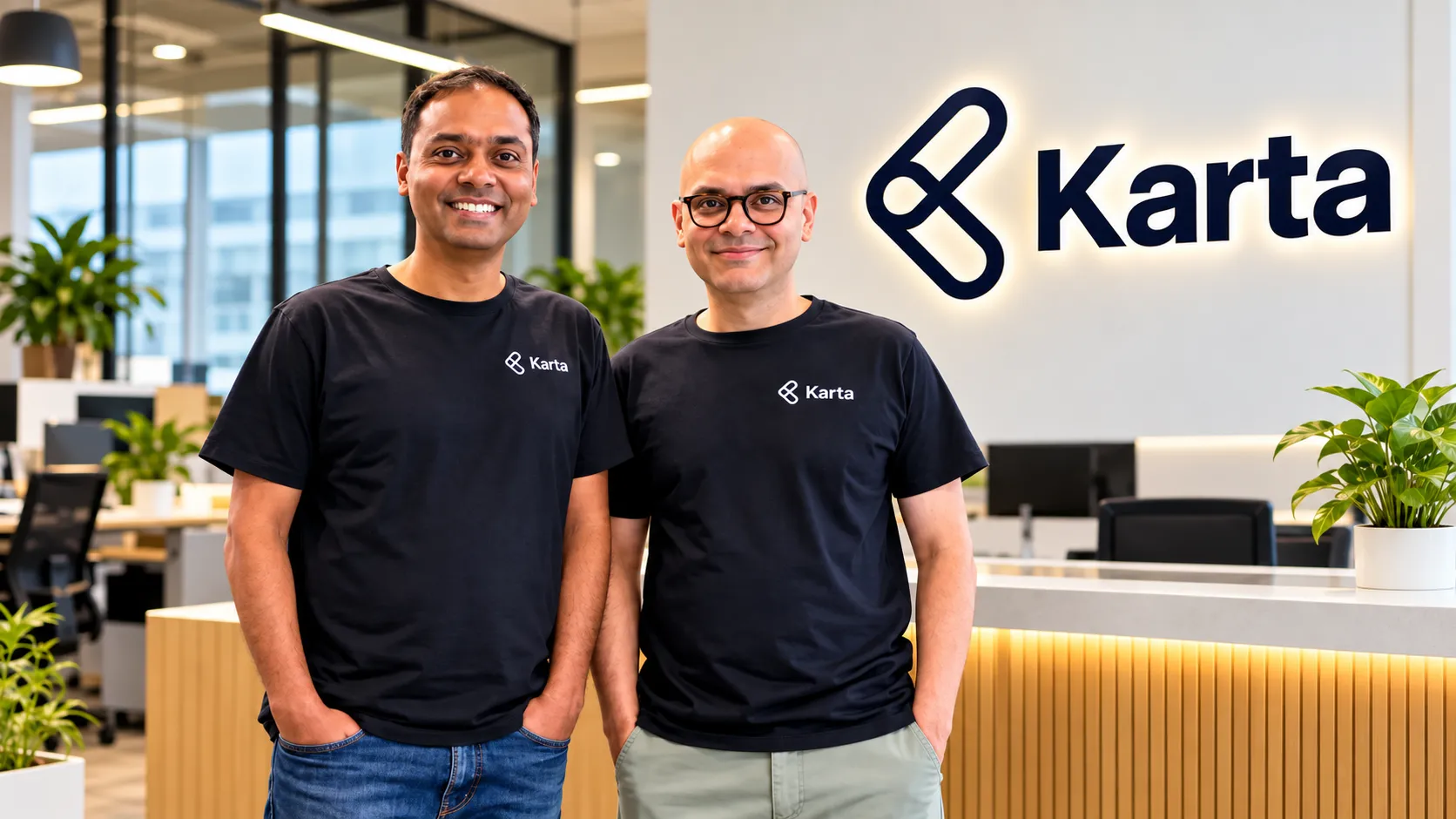
Karta AI, a Bengaluru-based startup that builds voice artificial intelligence agents for financial institutions, has raised $3 million in a seed funding round, as investors bet that AI will transform how Indian banks and lenders handle the millions of customer calls they receive every month.
The round, reported on Thursday, October 22, was led by PeerCapital and Cedar Hill Capital, with participation from Wyser VC, CDM Capital and Seedstars, according to Entrackr.
Karta AI said it would use the funds to strengthen end-to-end automation and multilingual capabilities, expand deployments with financial institutions, and scale its engineering and go-to-market teams.
What Karta AI does
Founded in 2024 by Vijaypal Singh and Abhishek Kushwaha, Karta AI focuses on inbound customer operations in banking, financial services and insurance, commonly known as BFSI. Its voice AI agents answer calls from customers of banks, lenders, fintechs and insurers, integrating with enterprise systems to resolve queries and carry out tasks.
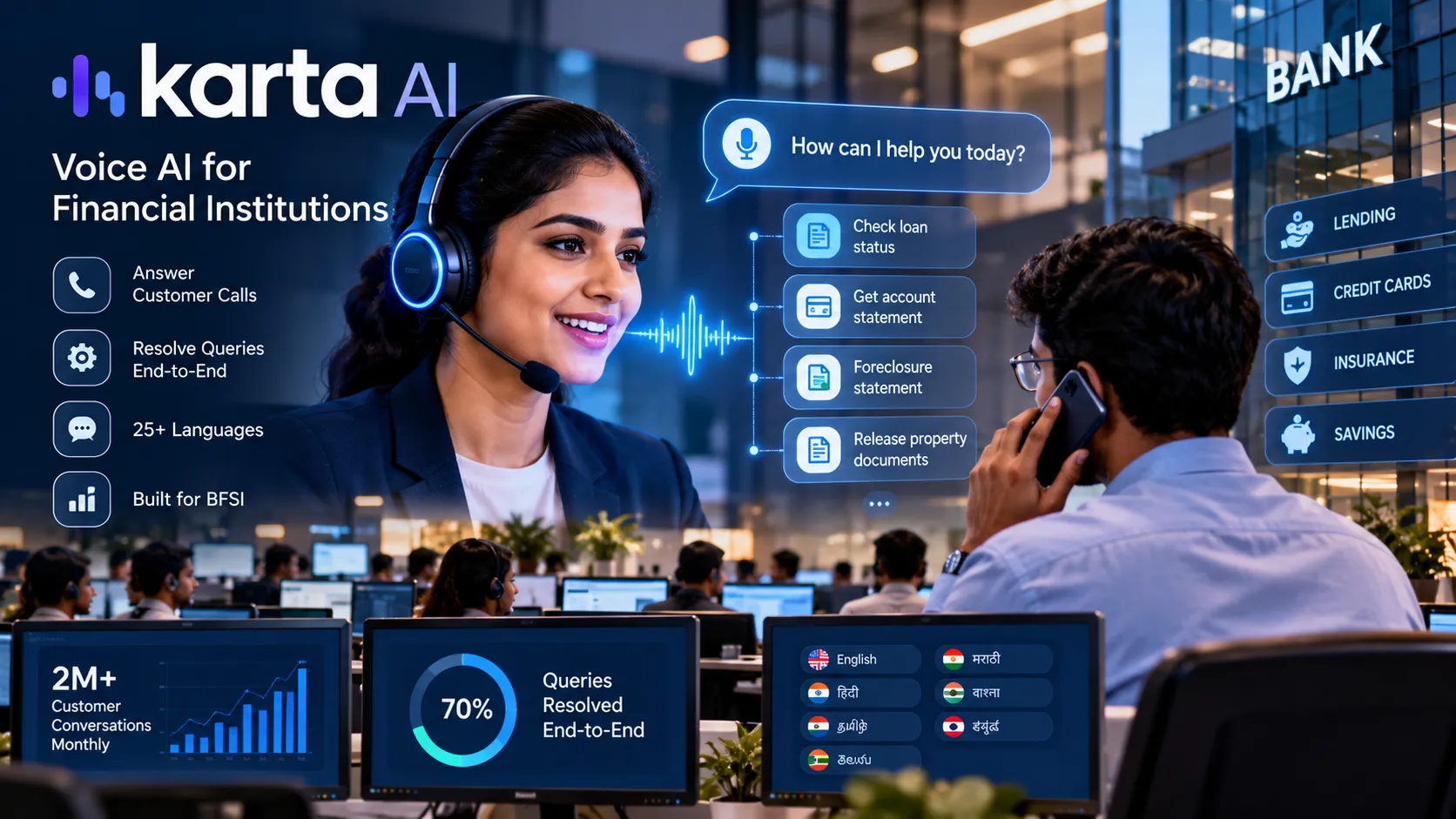
Typical use cases include checking loan disbursal status, providing account statements, issuing foreclosure statements and handling requests for the release of property documents. The agents handle calls "without human intervention, unless escalation is required," according to the company.
Unlike conventional voice bots, which are typically designed to address one specific query, Karta AI says its agents can handle multiple customer requests within a single conversation. A "predictive context engine" draws on past interactions handled by both human agents and AI to improve resolution and decision-making.
Early traction
The company says it is live with financial institutions and handles around 2 million customer conversations a month across more than 25 languages. It claims its inbound servicing agent resolves around 70% of borrower queries end to end, up from zero before deployment.
Karta AI has not disclosed its clients, revenue or valuation. The figures are company claims and have not been independently verified.
Multilingual capability is particularly important in India, where customers often prefer to speak in their native languages. Banks and lenders serving customers in smaller towns and rural areas need to handle conversations in Hindi, Tamil, Telugu, Marathi, Bengali, Kannada and many other languages, which has traditionally required large, multilingual contact centre teams.
Why banks want voice AI
Financial institutions in India handle enormous volumes of customer calls. The expansion of digital lending, the growth of credit cards and personal loans, and the spread of insurance have all increased the number of customers who need help with routine requests.
Contact centres are expensive to run, and staff turnover is high. Many queries are repetitive and could, in principle, be resolved automatically if systems can understand customers accurately and access the right information. Voice AI promises to cut costs, reduce waiting times and make support available around the clock.
Advances in large language models and speech technology have made voice agents far more capable than earlier interactive voice response systems, which forced callers through rigid menus. Modern AI agents can understand natural speech, handle interruptions and respond conversationally.
A crowded field
Karta AI is entering a competitive market. Several Indian startups are building voice AI for financial services and other sectors. Desible.ai raised a ₹32 crore seed-plus round led by Prime Venture Partners, Navana.ai raised a ₹40 crore Series A led by Ronnie Screwvala, and Rezolv raised a $12.5 million Series A led by Norwest, according to Entrackr. Arrowhead and Gnani.ai are among other players offering multilingual voice AI.
Global technology companies, including major cloud providers and contact centre software firms, also offer AI tools for customer service, and banks may choose to build some capabilities in-house.
To stand out, Karta AI is emphasising deep specialisation in BFSI workflows, integration with enterprise systems and the ability to handle complex, multi-intent conversations.
The regulatory backdrop
Deploying AI in financial services raises regulatory considerations. The Reserve Bank of India has emphasised customer protection, grievance redressal and data security for regulated entities, and lenders using AI must ensure that automated systems treat customers fairly and that complaints can be escalated to humans.
Data privacy is also critical. India's Digital Personal Data Protection Act sets rules for how companies collect and process personal data, and financial institutions must ensure that voice data and customer information handled by AI vendors are protected.
The bigger picture
Voice AI in banking is part of a broader wave of AI adoption in Indian financial services. Banks and fintechs are using AI for credit underwriting, fraud detection, collections and personalised marketing. Customer service is one of the most visible applications, since it directly affects customer experience.
For India's AI startup ecosystem, enterprise-focused companies like Karta AI represent a growing segment. Rather than building foundation models, they apply AI to specific industry problems where they can demonstrate measurable results.
The economics of customer service
Customer service is a significant cost centre for financial institutions. Large banks and lenders employ thousands of agents, either directly or through business process outsourcing companies, to handle calls, emails and chats. India's BPO industry, which serves both domestic and international clients, employs hundreds of thousands of people in customer support roles.
AI voice agents threaten to reshape this industry. If agents can resolve a majority of routine queries, institutions could significantly reduce staffing needs, redeploying human agents to complex cases that require judgment and empathy. That shift has implications for employment in India's BPO sector, which has been a major source of jobs for young graduates.
Proponents argue that AI will augment rather than replace human agents, handling repetitive tasks while freeing people for higher-value work. In practice, the balance will depend on how quickly the technology matures and how institutions choose to deploy it.
What comes next
Karta AI plans to build reusable, industry-specific capabilities and expand into international markets. Its ability to win and retain large financial institution clients, and to prove that its agents can handle sensitive interactions reliably, will determine whether it can scale.
For banks and lenders, the promise is clear: faster service at lower cost. The challenge for startups like Karta AI is to deliver that promise while meeting the high standards of accuracy, security and trust that financial services demand. The startup's progress will also offer a useful indicator of how quickly Indian lenders are willing to hand customer conversations to machines.