FundingMarket Data Women5 MIN READ

Kaynes Technology Shares Crash 15% to a 52-Week Low as Q2 Profit Plunges 62% and Auditor Flags Restatement Concerns

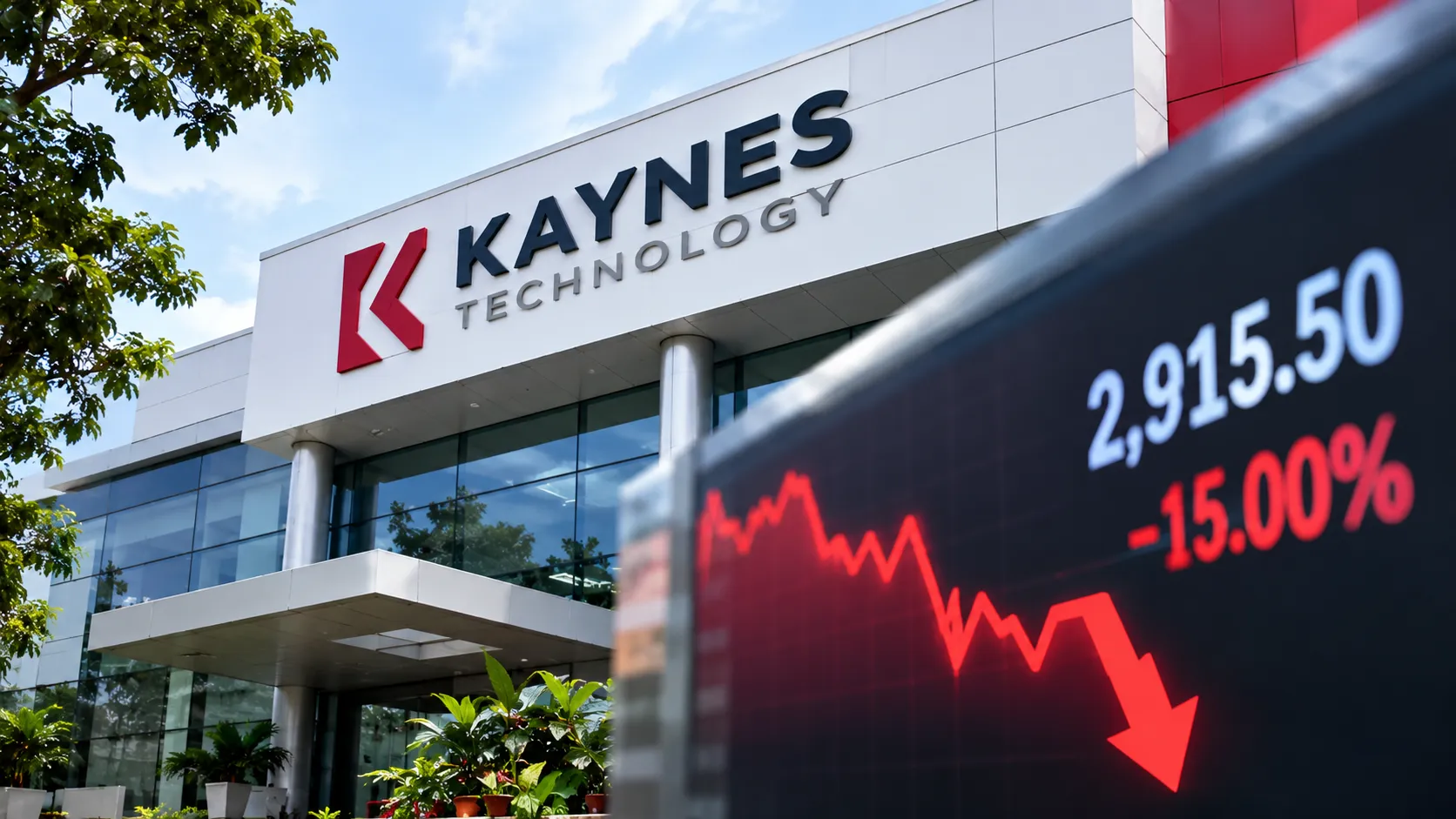
Shares of electronics manufacturer Kaynes Technology fell as much as 15% to a 52-week low of ₹2,915.50 on November 16 after the company reported a 62% fall in September-quarter net profit to about ₹45 crore, weak margins and a qualified auditor review. A restatement of past figures and a plan to sell 49% of its semiconductor unit added to investor concern.

By Shaym Kumar · Author16 November 2026New
Kaynes Technology Shares Crash 15% to a 52-Week Low as Q2 Profit Plunges 62% and Auditor Flags Restatement Concerns

One of the market's most celebrated bets on India's electronics manufacturing ambitions suffered a sharp loss of confidence on Monday.

Shares of Kaynes Technology India fell as much as 15% to a 52-week low of ₹2,915.50 on the National Stock Exchange on November 16, according to Business Standard, after the Mysuru-based company reported weak results for the September quarter and its auditor raised questions about its accounts.

Kaynes reported consolidated net profit of about ₹45 crore for the July-September quarter, the second quarter of the 2026-27 financial year, down about 62% from a year earlier, according to reports carried by IANS on November 15. CNBC-TV18 put the decline at 66%, reflecting differences in how the comparison was calculated. Either way, it was the company's weakest profit performance in years.

A miss on every line

The results fell short of expectations across most measures, according to CNBC-TV18. Revenue rose just 4% year on year to ₹952 crore, a multi-quarter low and below analysts' estimates. The EBITDA margin, a measure of operating profitability, fell 320 basis points to 13.2%, compared with a poll estimate of 14.7%. Gross margin narrowed by 140 basis points.

A sharp fall in other income also weighed on the bottom line. For the first half of the financial year, revenue grew 18%, while the margin fell 200 basis points to 14.1%.

The slowdown marks a striking change for a company that had delivered rapid growth since its stock market debut in 2022, becoming a favourite of investors seeking exposure to India's push to manufacture more electronics locally.

The auditor's qualification

More troubling for investors than the earnings miss were questions over the company's accounts. The auditor's limited review of the quarterly consolidated results carried a qualified conclusion, mainly relating to Kaynes's investment in its associate company Mixx Technologies Inc, according to brokerage Equirus, as cited by CNBC-TV18. Kaynes recognised its share of the associate's losses at ₹6 crore for the quarter and ₹10.4 crore for the first half.

The company is also restating earlier figures to correct errors. According to Equirus, the corrections include premature recognition of revenue, excess overheads capitalised into inventory, and inadequate provisions for slow-moving inventory and doubtful receivables. Bill discounting and supplier finance arrangements have also been reclassified as borrowings on the balance sheet.

Equirus said the corrections raise concerns about the quality and reliability of historical reporting, although the company is taking steps to fix them.

What brokers are saying

Brokerages turned cautious. JPMorgan has a neutral rating with a target price of ₹3,150, according to CNBC-TV18. It attributed the earnings miss to a lower contribution from the smart meter business as management works to reduce working capital, and said automotive and railway revenues grew strongly while industrial, medical and Internet of Things segments were weaker.

JPMorgan said investors would want answers on three issues: the reasons for the restatement, the rationale for selling a 49% stake in Kaynes Semicon, and a solution for the smart meter business. CLSA, which has a hold rating and a target of ₹3,580, said the EBITDA miss signals a ramp-down of the smart metering division.

Of the 24 analysts covering the stock, seven rate it a buy, eight a hold and nine a sell, according to CNBC-TV18. The shares had closed 1.5% lower at ₹3,430 on Friday and were already down 13% this year before Monday's fall.

The semiconductor question

The proposed sale of 49% of Kaynes Semicon is significant because the semiconductor unit has been central to the company's growth story. Kaynes Semicon is building an outsourced semiconductor assembly and test facility in Gujarat under the government's India Semiconductor Mission, and has attracted attention as one of the country's early entrants into chip packaging.

“In markets, trust in the numbers is worth as much as the numbers themselves.”
— TIGI Markets Desk

Bringing in a partner could reduce the capital burden on Kaynes and share the risks of a technically demanding business. But investors will want to understand the valuation, the identity of any partner and how much of the semiconductor upside Kaynes will keep. The company has also announced a joint venture with Japan's Toyokawa, according to Zee Business.

Working capital and cash flow

Concerns about cash flow have followed Kaynes for some time. Electronics manufacturing services companies often carry large inventories and receivables, because they buy components in advance and are paid by customers after delivery. Rapid growth can consume large amounts of cash, and investors watch closely whether profits translate into cash generation.

The reclassification of bill discounting and supplier finance as borrowings matters here. Such arrangements allow companies to receive cash earlier or pay suppliers later, but they can make a balance sheet look healthier than it is if they are not classified as debt. Moving them into borrowings gives a clearer picture of the company's true leverage.

7683d45d-1928-4b78-9659-cab0c5db9052.png

The smart meter slowdown

India's smart meter programme, which aims to replace hundreds of millions of conventional electricity meters, has been a major source of orders for electronics manufacturers. But the business requires heavy working capital, as payments from power distribution companies can be slow. Kaynes's decision to scale back this division to protect cash flow reflects a trade-off between growth and financial discipline.

Why this matters for India's electronics ambitions

Kaynes has been one of the most visible beneficiaries of India's push to build an electronics manufacturing ecosystem, supported by production-linked incentive schemes and semiconductor subsidies. Investors have rewarded companies in the sector with high valuations, betting on years of rapid growth as global companies diversify supply chains away from China.

The company's troubles are a reminder that high growth must be matched by robust governance and transparent accounting. Questions about financial reporting can quickly erode confidence, particularly in sectors where valuations depend on long-term expectations. Other listed electronics manufacturers are likely to face closer scrutiny of their accounts and cash flows.

The company's semiconductor business is also connected to the wider startup ecosystem. Bharat Semi, a New Delhi chip design startup that announced a $24 million funding round this week, counts Kaynes Semicon among its design wins, illustrating how closely India's young chip companies depend on a handful of manufacturing partners.

Lessons for investors

For investors, the episode underlines the importance of looking beyond headline growth. Auditor observations, related-party transactions, cash flow conversion and the classification of financing arrangements can reveal risks that profit figures do not. Qualified audit opinions and restatements are relatively rare among large listed companies and are generally treated as serious warning signs.

At the same time, restatements can be a sign that a company is cleaning up its reporting. Much will depend on how transparently management explains the issues and whether it can restore confidence over the coming quarters.

What comes next

Investors will focus on the company's earnings call and any further disclosures on the restatement, the Kaynes Semicon stake sale and the outlook for the smart meter business. Clear explanations and evidence of improving cash flow could help stabilise the shares. Further surprises, however, could deepen the sell-off in one of India's most closely watched manufacturing stocks.

TagsKaynes TechnologyKaynes SemiconQ2 FY27 resultselectronics manufacturing servicesEMSsmart metersauditor qualificationrestatementMixx TechnologiesJPMorganCLSAEquirussemiconductorsMake in IndiaIndian stocksNSEcorporate governanceOSATIndia Semiconductor Missioninvestors

Reader reviews

Sign in to rate and review this article.
Loading reviews…