
Kenya, long regarded as one of Africa's most dynamic technology hubs, has seen startup funding collapse this year. The decline reflects both broader caution among investors and a series of high-profile failures among Kenyan companies.
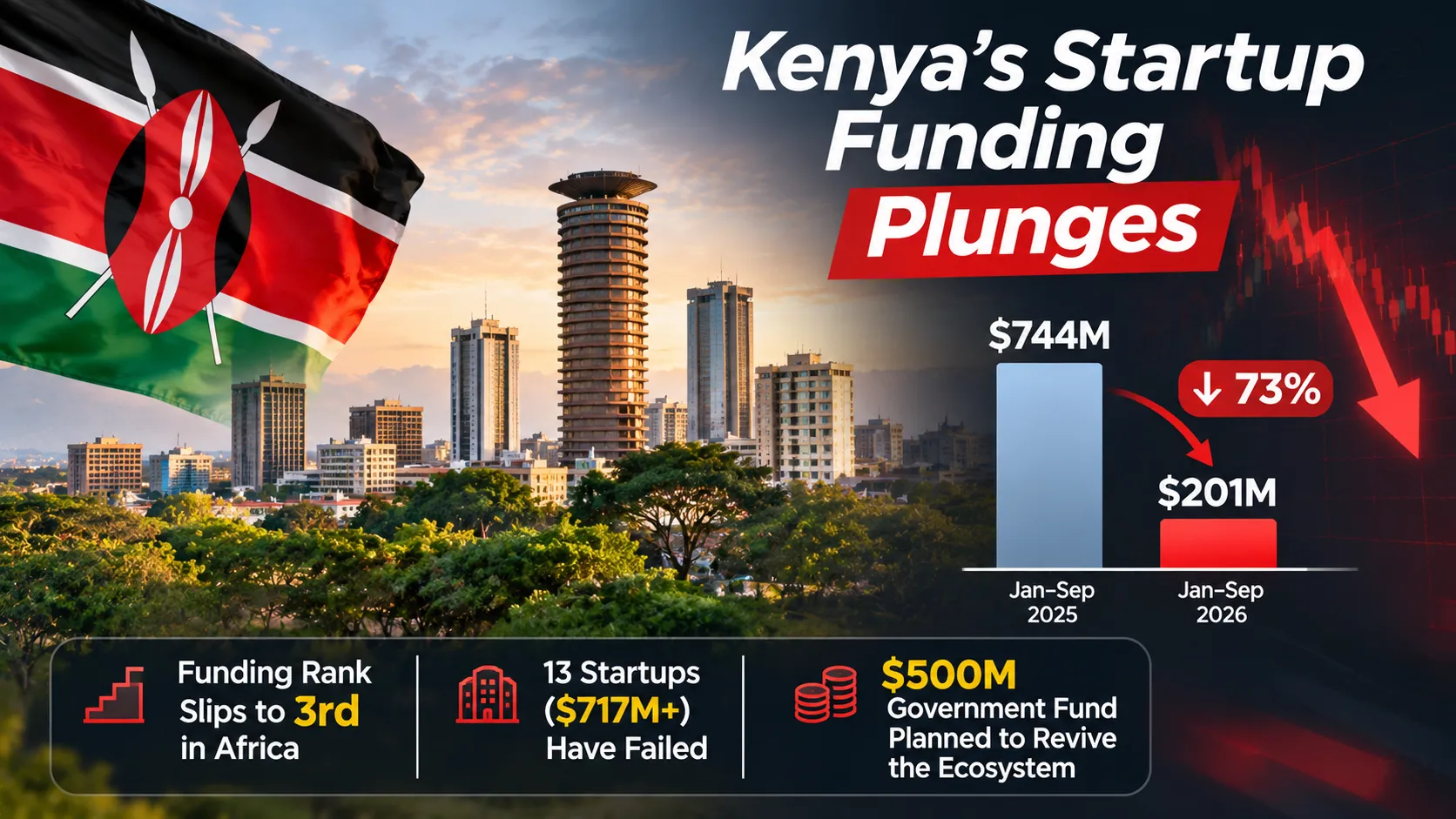
Kenyan startups raised $201 million (about KSh26.1 billion) from January to September 2026, down 73% from $744 million (about KSh96.7 billion) in the same period a year earlier, according to data from Africa: The Big Deal, reported by Kenya Today on November 21.
The number of Kenyan companies securing rounds of $100,000 or more fell 32% to 45.
Kenya slips to third place
The decline pushed Kenya down Africa's funding rankings. Kenya led African startup funding inflows in 2025, but in the first nine months of 2026 it ranked third, behind Nigeria, with $635 million, and Egypt, with $445 million.
Part of Kenya's decline reflects a statistical reclassification. Electric mobility company Spiro, which raised more than $327 million, was reclassified as a pan-African company rather than a Kenyan one, removing its funding from Kenya's totals. Even so, the underlying decline in Kenyan funding is substantial.
A wave of failures
Kenya's startup ecosystem has been shaken by a series of company failures. At least 13 Kenyan companies that collectively raised $717.5 million have entered administration. They include agri-tech platform Twiga Foods, e-commerce company Copia, clean cooking fuel company Koko Networks and buy-now-pay-later provider Lipa Later.
These were among the most prominent and well-funded startups in Kenya. Their collapse has made investors more cautious and raised questions about business models that relied on heavy subsidies, rapid expansion and continuous fundraising.
Twiga Foods, which connected farmers and food vendors through a digital platform, was once one of Kenya's most celebrated startups. Koko Networks, which sold clean cooking fuel through a network of automated dispensers, had attracted significant climate-focused investment. Their difficulties highlight the challenges of building capital-intensive businesses in markets with low consumer incomes and limited infrastructure.
Africa-wide trends
Across Africa, startup funding reached $2.16 billion in the first nine months of 2026. The number of investors participating in deals above $100,000 fell 18% to 334, indicating that the pool of active investors has narrowed.
Funding has become increasingly concentrated in large deals. Deals of $10 million or more accounted for 83% of total funding. Early-stage deals between $100,000 and $1 million fell 22% to 171, while deals above $1 million fell 13%.
There was a notable shift in the mix of financing. Equity funding rose 23% to $1.5 billion, while debt funding fell 33% to $669 million.
The domestic capital gap
One of the structural challenges for Kenyan startups is the limited participation of domestic investors. Kenya's pension industry held about KSh2.8 trillion at the end of 2025, but allocated only about 1.07% to private equity, far below the 10% permitted under regulations.
The heavy reliance on foreign venture capital makes African startup ecosystems vulnerable to shifts in global investor sentiment. When global investors become cautious, as they have since the end of the 2021-22 funding boom, African startups can find it difficult to raise money.
Kenya's government has announced plans for a $500 million (about KSh65 billion) fund under the planned Nairobi International Financial Centre, targeting technology, AI and small business firms. Such initiatives aim to increase the role of domestic capital in supporting local startups.
Lessons from Kenya
Kenya's experience offers lessons for startup ecosystems in other emerging markets, including India. During the funding boom, many startups raised large sums to expand rapidly, often prioritising growth over profitability. When funding dried up, companies without sustainable business models struggled to survive.
India went through a similar correction after 2022, with many startups cutting costs, laying off staff or shutting down. However, India's large domestic market, deep pool of domestic investors and active public markets have helped its ecosystem recover more quickly than many others.
The contrast highlights the importance of domestic capital. India's mutual funds, family offices and retail investors have provided significant support to its startups and to IPOs of new-age companies, reducing dependence on foreign investors.
The India-Africa connection
India has deep economic ties with East Africa, including Kenya. Indian companies operate in sectors such as telecom, pharmaceuticals, automobiles and agriculture across the region, and Indian exports to Africa grew 44% in the first half of the current financial year.
The large Indian diaspora in Kenya has a long history in business and trade. Indian investors and entrepreneurs have also been involved in Kenyan technology companies.
Indian technology companies, including fintech and agri-tech firms, have seen Africa as an expansion market, given similarities in challenges such as financial inclusion and smallholder farming. Kenya's funding slump may create opportunities for Indian companies with sustainable models to partner with or acquire struggling African startups.
What comes next
The outlook for Kenyan startups will depend on whether investor confidence can be rebuilt. Companies with strong unit economics, clear paths to profitability and solutions to real market needs are likely to continue attracting capital. Areas such as fintech, clean energy, logistics and AI applications remain promising.
Policy initiatives to mobilise domestic capital, such as the proposed Nairobi International Financial Centre fund, could help. Reforms that encourage pension funds to invest more in private markets would also strengthen the ecosystem.
For The Impactful Global Indian's readers, Kenya's funding slump is a reminder that startup ecosystems are cyclical, and that sustainable growth depends on strong fundamentals and diverse sources of capital.
Debt versus equity
The shift from debt to equity in African startup funding is notable. In previous years, debt financing grew rapidly, particularly for companies with asset-heavy models such as solar home systems, electric vehicles and lending platforms. The 33% drop in debt funding in 2026 may reflect lenders' caution after the collapse of several debt-funded companies, as well as higher global interest rates. For founders, the change means that equity investors are again the main source of growth capital, which can be more expensive in terms of dilution but more forgiving when companies face difficulties. Founders who can show steady revenue and disciplined spending are best placed to benefit when investor confidence returns.