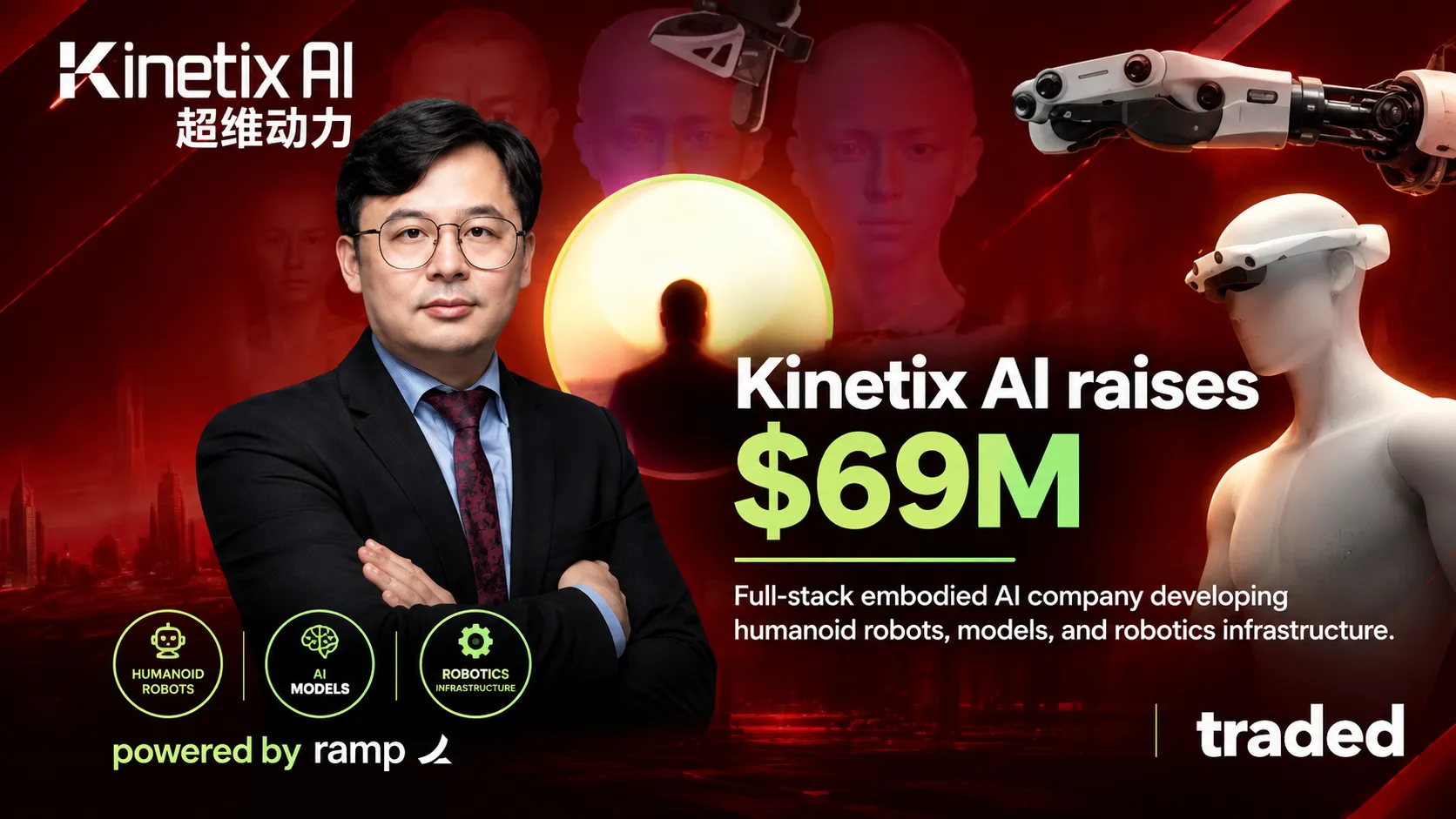
Shenzhen-based Kinetix AI, known in China as Chaowei Dongli, has closed more than RMB500 million — in excess of $70 million — across a series of Angel+ financings, one of the largest early-stage rounds yet disclosed in China's fast-growing embodied artificial intelligence sector. The round was backed by Vertex Ventures, Fangguang Capital, Wanshi Capital and a group of undisclosed institutional investors, according to funding data reviewed by TIGI. Individual closing dates for the tranches have not been made public, but the company confirmed the cumulative total on September 11.
The scale of the raise, at such an early stage, signals how aggressively Chinese venture capital is now chasing physical AI — the branch of artificial intelligence concerned not with generating text or images but with machines that can perceive, move and manipulate the physical world. Kinetix AI is building humanoid robotics platforms designed for industrial and logistics environments, competing in a segment that has become one of the most closely watched corners of China's technology economy over the past eighteen months.
China's push into humanoid robotics has been driven by a combination of state industrial policy, falling component costs and a domestic supply chain that already dominates global production of motors, actuators and precision gearing — the mechanical building blocks of any humanoid machine. Local governments across Guangdong, Zhejiang and Jiangsu provinces have set up dedicated robotics funds in the past two years, and Shenzhen in particular has positioned itself as a hub for hardware-heavy AI ventures that can draw on the city's existing electronics manufacturing base.
For investors, the appeal of embodied AI lies in its perceived durability. Unlike large language models, where competitive advantage can erode quickly as rival labs release comparable systems, humanoid robotics ventures accumulate defensibility through hardware integration, proprietary control software and manufacturing relationships that are far harder to replicate overnight. That thesis has underpinned a string of oversized early rounds across the sector this year, from Beijing to Hangzhou, as venture firms compete for allocation in companies still years away from mass commercial deployment.
Kinetix AI's backers span both financial and strategic investors. Vertex Ventures, the venture arm linked to Singapore's Temasek ecosystem, has been steadily building a portfolio of Asian deep-tech and robotics companies, while Fangguang Capital and Wanshi Capital bring domestic industrial networks that could prove valuable as Kinetix AI moves from prototype to pilot deployment. The company has not disclosed a formal valuation for the round, a common practice among early-stage Chinese hardware startups still finalising governance structures before a larger institutional round.

The broader competitive backdrop is intensifying. Chinese humanoid robotics firms including Unitree and UBTech have drawn outsized public market attention in 2026, with strong investor demand around recent listings underscoring how far the category has moved from research curiosity toward a recognised, if still nascent, commercial sector. Kinetix AI's early-stage raise suggests that the capital pipeline feeding that sector shows no sign of narrowing, even as some investors caution that hardware timelines and unit economics remain considerably less proven than those of software-only AI companies.
What differentiates Kinetix AI within an increasingly crowded field is less clear from public disclosures than the scale of its fundraising. The company has given limited detail on its specific product roadmap, robot form factor or target industries, choosing instead to let the financing figures speak to investor conviction. That reticence is not unusual among early-stage Chinese robotics ventures, many of which prefer to control the narrative around their technology until working units are ready for customer trials.
For the wider embodied-AI investment thesis, the Kinetix AI round adds to a growing body of evidence that venture capital is willing to underwrite substantial bets on physical robotics well before commercial revenue materialises — a pattern reminiscent of the capital intensity seen in autonomous vehicles a decade ago, but compressed into a shorter timeframe. Whether that capital translates into robots capable of reliable, cost-effective work outside curated demonstrations remains the open question that will determine which of this year's crop of humanoid robotics startups survives to a Series B and beyond.