TechFintech5 MIN READ

Kissht Wins Exchange Nod for ₹832 Crore Preferential Issue Backed by Axis, HDFC and Groww Mutual Funds

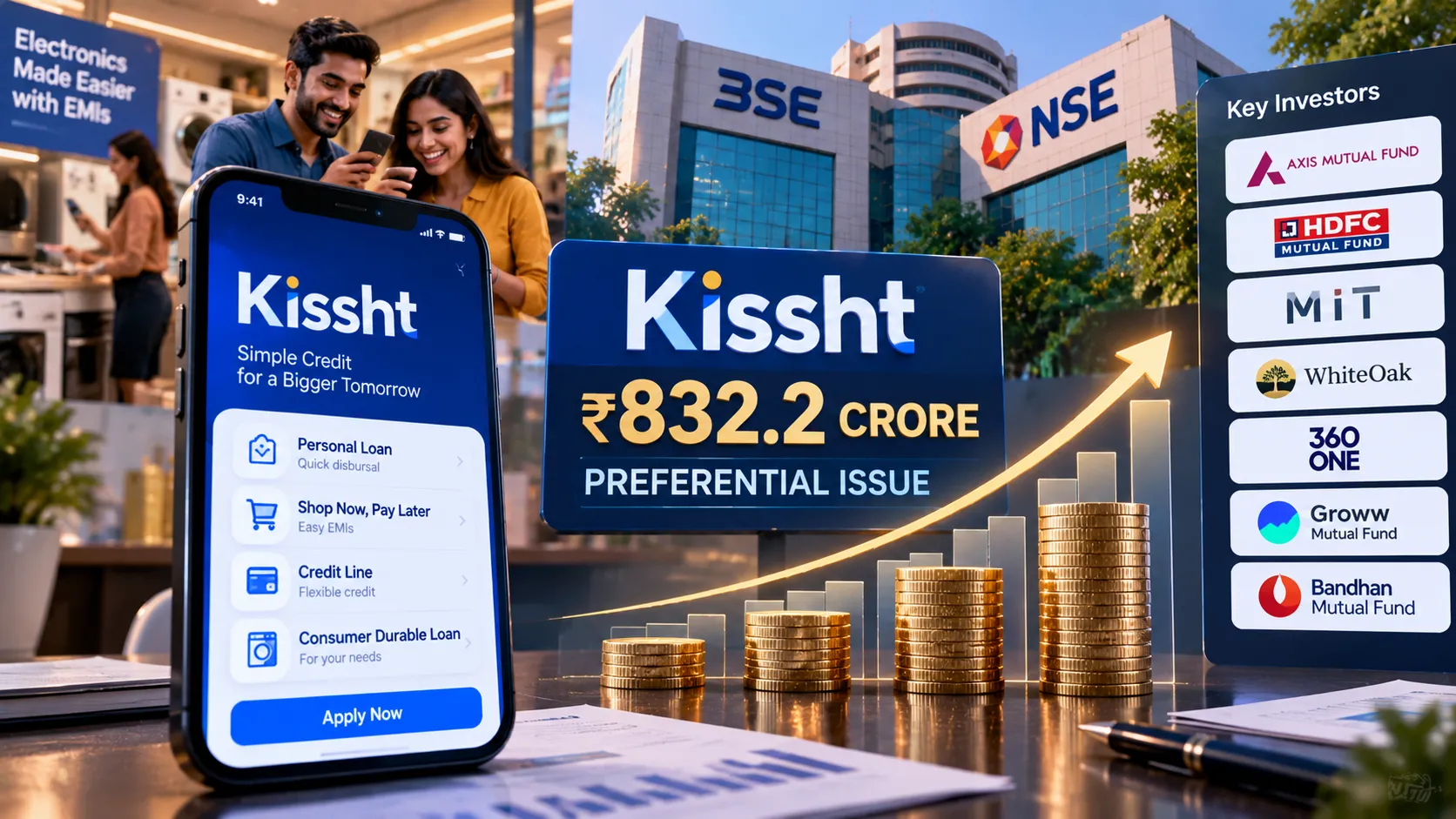
Listed digital lender Kissht, operated by OnEMI Technology Solutions, has received in-principle approval from BSE and NSE for an ₹832.2 crore preferential issue of up to 2.65 crore shares at ₹314.11 each. About 34 investors, including Axis, HDFC, WhiteOak, Bandhan and Groww mutual funds, are expected to participate.

By Aravind Kumar · Author21 October 2026New
Kissht Wins Exchange Nod for ₹832 Crore Preferential Issue Backed by Axis, HDFC and Groww Mutual Funds

Kissht, one of India's best-known digital consumer lenders, is set to raise fresh capital just five months after its stock market debut. OnEMI Technology Solutions, the company that operates Kissht, has received in-principle approvals from BSE and the National Stock Exchange for a preferential issue of shares worth ₹832.2 crore, according to a regulatory filing disclosed on October 20 and reported by Entrackr.

The company plans to issue up to 2.65 crore equity shares at ₹314.11 each, which includes a premium of ₹313.11 per share over their face value. The board approved the fundraise on September 17, and shareholders gave their approval at an extraordinary general meeting on October 14.

About 34 investors are expected to participate in the issue, including Axis Mutual Fund, HDFC Mutual Fund, MIT, WhiteOak, 360 ONE, Groww Mutual Fund and Bandhan Mutual Fund.

Where the money will go

OnEMI plans to direct 75% of the proceeds to its wholly owned subsidiary Si Creva Capital Services, a non-bank financial company, "to support lending operations," with the remaining 25% for general corporate purposes.

For a lender, equity capital is the foundation on which it can borrow and lend. Regulators require non-bank financial companies to maintain minimum capital adequacy ratios, so raising equity allows Kissht to expand its loan book while staying within regulatory limits. Stronger capital also improves a lender's creditworthiness in the eyes of banks and bond investors.

The company said it is targeting multiple credit rating upgrades over the next two years, expecting stronger capitalisation to bring better access to funding, lower borrowing costs and greater lending capacity.

From IPO to preferential issue

OnEMI listed on Indian stock exchanges about five months ago after raising ₹926 crore in its initial public offering, comprising a fresh issue of ₹850 crore and an offer for sale of about ₹76 crore by existing shareholders. Its shares rose nearly 12% on debut, according to market reports.

Returning to the market so soon after an IPO is unusual but not unheard of for fast-growing lenders, whose capital needs rise with their loan books. A preferential issue, in which shares are sold to selected investors rather than to the public, can be completed more quickly than a follow-on public offering and allows the company to bring in institutional investors with long-term horizons.

The participation of large domestic mutual funds suggests institutional confidence in Kissht's growth prospects. Mutual funds have been major buyers of Indian equities in 2026, supported by record inflows from retail investors through systematic investment plans.

Strong growth in the latest quarter

Kissht's recent financial performance has been robust. In the first quarter of FY27, operating revenue rose 45% year on year to ₹670 crore, profit increased 58% to ₹95 crore, and assets under management grew 61% to ₹8,001 crore, according to Entrackr.

Kissht offers personal loans, consumer durable financing and credit lines to customers through its app and partner merchants. Like other digital lenders, it uses technology and data to assess creditworthiness quickly and disburse loans digitally, targeting customers who may be underserved by traditional banks.
a442829f-53e9-4dfb-8a20-87ad0d2e8e4a.png

The regulatory backdrop for digital lending

Digital lending in India has grown rapidly over the past decade, but it has also attracted close regulatory scrutiny. The Reserve Bank of India introduced digital lending guidelines in 2022 to protect borrowers, requiring loans to be disbursed directly to borrowers' bank accounts, mandating transparent disclosure of costs and restricting the role of unregulated lending apps.


“Five months after its IPO, Kissht is going back to investors, a sign that growth in digital lending still runs on fresh capital.”
— TIGI Fintech Desk

In late 2023, the RBI raised risk weights on unsecured consumer loans and on bank lending to non-bank financial companies, increasing the cost of capital for lenders focused on personal loans. Lenders have since tightened underwriting and focused on asset quality, while those with strong capital positions have been better placed to grow.

The sector has also faced challenges from rising defaults among borrowers with multiple loans, prompting lenders and credit bureaus to monitor over-indebtedness more closely.

The fintech listing wave

Kissht is part of a wave of Indian fintech companies that have listed on domestic exchanges, including payments, lending and wealth management platforms. Public markets have given these companies access to capital and liquidity for early investors, but they have also brought greater scrutiny of profitability, asset quality and governance.

Investors have rewarded lenders that combine growth with profitability. Kissht's rising profits and expanding loan book have positioned it among the more successful recent fintech listings.

How preferential issues work

A preferential issue allows a listed company to raise capital by allotting new shares to a select group of investors, rather than offering them to the public or to all existing shareholders. In India, such issues are governed by Securities and Exchange Board of India rules on pricing, disclosure and lock-in periods, and require shareholder approval and in-principle approval from the stock exchanges.

The pricing formula is based on the company's recent trading history, which is designed to protect existing shareholders from excessive dilution at unfairly low prices. Shares allotted to investors are typically subject to a lock-in period, preventing them from being sold immediately.

For companies, preferential issues can be a faster and cheaper way to raise capital than a follow-on public offering. The participation of large mutual funds can also signal institutional confidence in the company's prospects, which can support the share price.

Digital lending's growth story

India's digital lending market has grown rapidly, driven by smartphone penetration, digital payments and data-driven credit assessment. Fintech lenders have extended small-ticket loans to customers who were previously underserved by banks, including young salaried professionals and the self-employed.

What comes next

With exchange approvals in hand, Kissht is expected to complete the allotment of shares to the participating investors. The fresh capital will support further growth in its loan book, and progress on its targeted credit rating upgrades will be watched closely.

For India's digital lending sector, Kissht's fundraise illustrates how capital markets are becoming an increasingly important source of funding for fintech lenders. As long as growth remains strong and asset quality holds, investors appear willing to provide the capital needed to keep expanding. For investors, the participation of three large mutual funds in Kissht's preferential issue signals that institutional appetite for listed digital lenders remains intact, provided growth is matched by disciplined underwriting and asset quality. The company's next few quarterly results will show whether that confidence is justified.

TagsKisshtOnEMI Technology SolutionsSi Creva Capitalpreferential issuefintechdigital lendingNBFCBSENSEAxis Mutual FundHDFC Mutual FundGroww Mutual FundWhiteOak360 ONEBandhan Mutual Fundcredit ratingAUMIPOconsumer creditIndia fintech

Reader reviews

Sign in to rate and review this article.
Loading reviews…
