FundingMarket Data Women5 MIN READ

Korea's "Black Tuesday": Samsung and SK Hynix Plunge as a Chinese Memory Breakthrough Rattles the AI Chip Trade

South Korea's Kospi fell more than 7% intraday on October 13 and triggered a trading curb. SK Hynix dropped 10% and Samsung Electronics 7.4% after China's CXMT reported progress on denser DRAM, raising doubts about how long the AI-driven memory boom can last.

By Aravind Kumar · Author14 October 2026New
Korea's "Black Tuesday": Samsung and SK Hynix Plunge as a Chinese Memory Breakthrough Rattles the AI Chip Trade

South Korea's stock market suffered a steep sell-off on Tuesday, October 13. The country's two semiconductor giants, Samsung Electronics and SK Hynix, plunged as investors reacted to signs that China is closing the technology gap in memory chips, the components at the heart of the artificial intelligence boom.

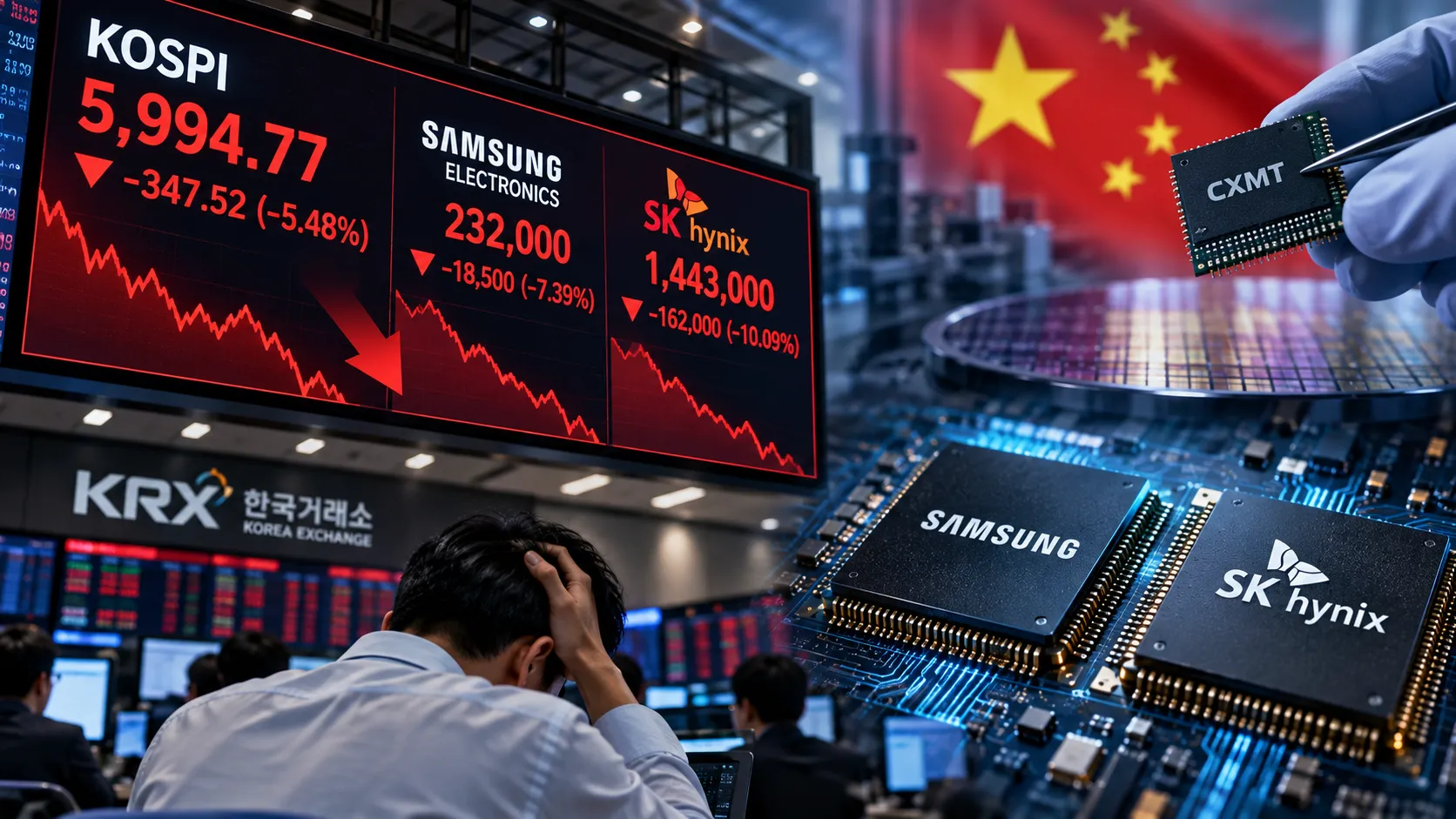
Local media quickly labelled the session "Black Tuesday." The benchmark Kospi index fell more than 7% intraday, breaking below the 6,000-point level, before ending the day down about 5.5%. The sell-off was severe enough for the Korea Exchange to activate a sell-side "sidecar", a mechanism that temporarily halts program selling to slow a disorderly decline. It was the first such curb in nearly two months.

SK Hynix, the world's leading supplier of high-bandwidth memory for AI processors, closed down 10.09% at 1.443 million won, a loss of 162,000 won per share. Samsung Electronics fell 7.39% to 232,000 won. Both stocks had already dropped about 4.5% on Monday, compounding the damage. Because the two companies together account for more than half of the Kospi's weighting, their slide dragged the entire index down with them.

The trigger: China's denser DRAM

The immediate catalyst was news from ChangXin Memory Technologies, or CXMT, China's largest maker of DRAM, the memory used in everything from smartphones to AI servers. CXMT said it had made progress on a denser DRAM design using a so-called 4F² cell layout, which fits more memory into the same area of silicon. The company said it plans to introduce server memory modules based on its technology by the end of the year.

The claims have not been independently verified, and CXMT still needs to improve its manufacturing yields and win qualification from demanding server customers before it can compete at scale in the high end of the market. Samsung and SK Hynix are reportedly developing similar architectures of their own.

For investors who have bid memory stocks to extraordinary heights on the strength of AI demand, the announcement was enough to prompt a rethink. Charu Chanana, a strategist at Saxo, told Reuters that the CXMT news was "a clear trigger for the selloff in memory stocks."

A boom built on scarcity

To understand why the reaction was so violent, it helps to understand how profitable memory has become. AI data centres consume vast quantities of advanced memory, particularly the high-bandwidth memory stacked alongside graphics processors. Supply has struggled to keep up, and prices have soared.

The effect on margins has been dramatic. SK Hynix's gross margin rose from less than 1% in the September quarter of 2023, at the bottom of the last memory downturn, to about 79% in the March quarter of 2026. In the United States, Micron Technology recently reported quarterly revenue of more than $54 billion and full-year fiscal 2026 revenue of $133 billion, up from $37 billion a year earlier.

Profits like these depend on tight supply. Memory has historically been one of the most cyclical industries in technology: shortages drive prices and investment higher until new capacity arrives, prices collapse and margins evaporate. A credible new Chinese competitor in advanced DRAM, backed by state support and able to add capacity aggressively, is exactly the kind of development that could end a cycle early. That is the fear now hanging over the sector.

“A clear trigger for the selloff in memory stocks.”
— Charu Chanana, Strategist, Saxo, on CXMT's DRAM announcement

Ha Seok-keun, chief investment officer at Eugene Asset Management, said uncertainty over how long the memory upcycle will last is weighing on the valuations of Korean chipmakers. Even if earnings keep growing, share prices may stall if investors expect that growth to slow.

dbacd1cc-82db-42ba-a450-2a2da43cc4ec.png

A global chip sell-off

Korea's rout was the sharpest expression of a broader retreat in semiconductor stocks. On Monday, the Philadelphia Semiconductor Index fell 2.7% and Micron dropped about 4%, amid concerns about competition from China, including reports that Huawei is eroding Nvidia's dominance of China's AI-chip market. In early US trading on Tuesday, memory and storage names including Western Digital, Seagate and Sandisk came under heavy pressure again, and Micron fell almost 4%.

Comments from Broadcom's chief executive added to the unease. He warned that some of the capital chasing AI themes ignores business models and profitability, and that such investing has become increasingly akin to betting. Coming from the head of one of the biggest beneficiaries of AI infrastructure spending, the remarks reinforced worries that parts of the AI trade have run ahead of fundamentals.

Fragile foundations in Seoul

Korea's market was particularly vulnerable. The Kospi roughly doubled at one point in the first half of the year, powered by the chip rally, before falling about 22% from its June record high in the second half. Foreign investors have been net sellers of Korean equities this year, with cumulative sales of about $131 billion according to Bloomberg data, as they shift money towards US stocks.

Domestic retail investors had piled into the rally using borrowed money. Margin loans peaked at 38.6 trillion won in June and have since fallen to about 33 trillion won, while cash in brokerage accounts has dropped from nearly 140 trillion won to about 100 trillion won. As prices fell on Tuesday, some leveraged funds were forced to liquidate positions, accelerating the decline. Supportive corporate buying has also faded: Samsung has completed a buyback for employee stock compensation, and SK Hynix's repurchase programme is nearly done.

What comes next

Early trading on Wednesday, October 14, brought some relief. The Kospi rebounded about 1.75% to around 6,140 in the opening session, as bargain hunters returned. Whether that marks a floor or a pause will depend on how the CXMT story develops and on what the major memory makers say about demand and pricing in their upcoming results.

The structural question will not go away quickly. AI demand for memory remains enormous, and the leading Korean and US suppliers retain significant technological and manufacturing advantages. But Tuesday's sell-off showed how much of their valuations rests on the assumption that supply will stay tight for years. Any sign that China can break into advanced memory at scale threatens that assumption.

For India, the episode carried a striking contrast. On the same day, Indian equities rallied, led by a more than 5% gain in IT services stocks, which have little exposure to memory pricing. It was a reminder that, even within the broad label of "technology," the AI boom is creating very different winners and risks across markets.

TagsKospiSamsung ElectronicsSK HynixCXMTmemory chipsDRAMsemiconductorsAIchip stocksMicronBroadcomSouth KoreaChinastock marketselloffHBMtechnology stocksglobal marketsAI bubbleAsia markets

Reader reviews

Sign in to rate and review this article.
Loading reviews…

