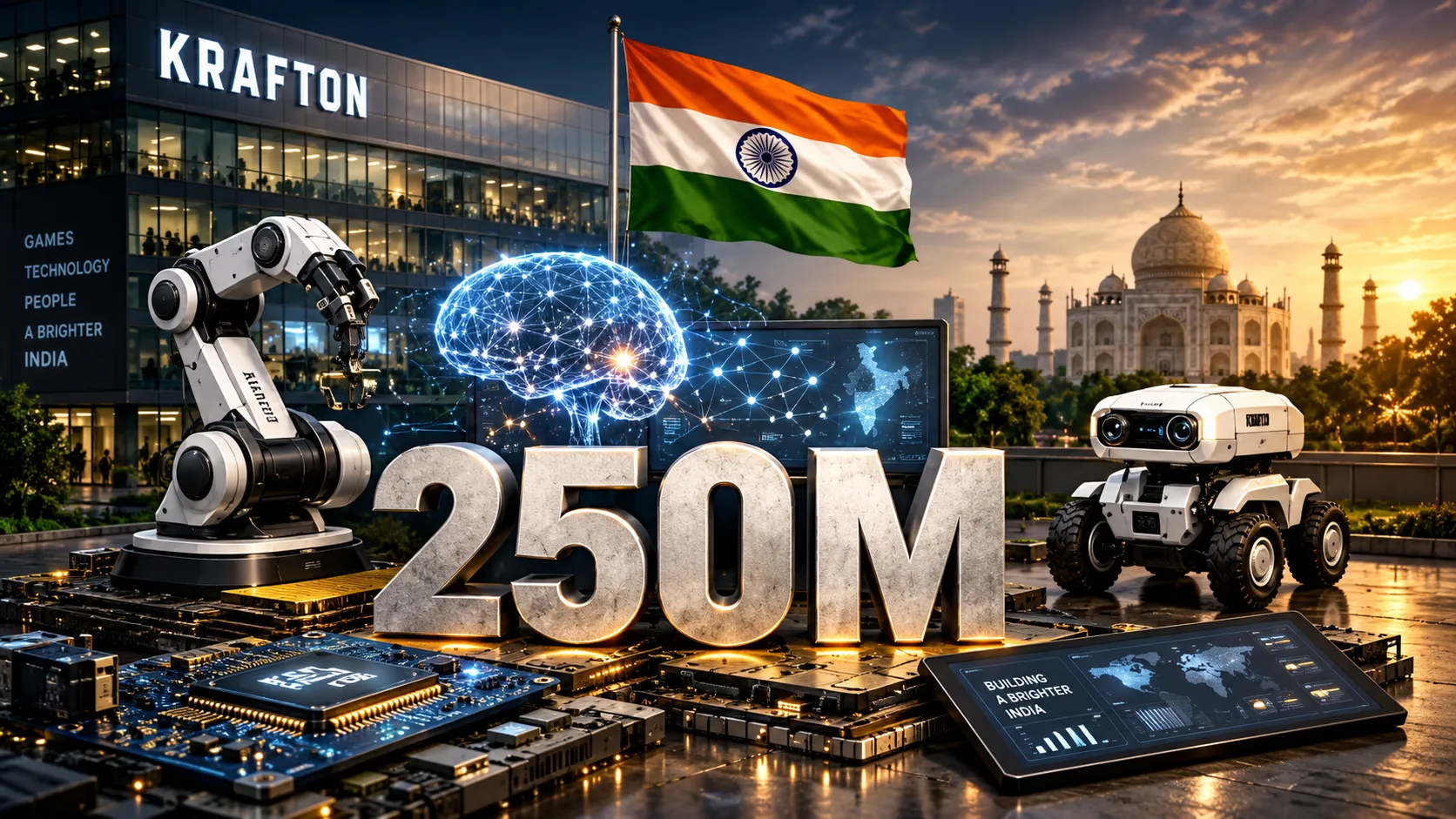
KRAFTON, the South Korean gaming company behind PUBG Mobile and one of the more prolific corporate investors in India's startup ecosystem, has announced plans to invest $250 million in Indian artificial intelligence and deeptech startups. The commitment marks a significant expansion of KRAFTON's India strategy, moving well beyond its original gaming and entertainment focus into frontier technology categories that have become the dominant theme in global venture capital.
The announcement lands at a moment when Indian AI and deeptech startups are increasingly competing for both domestic and international capital, and a large, dedicated commitment from an established corporate investor with deep India experience is likely to be read by the broader startup ecosystem as a strong vote of confidence in the country's technical talent base.
The announcement also reflects a broader recalibration underway among Asian gaming and entertainment conglomerates, several of which have accumulated substantial cash reserves from their core businesses and are now actively seeking diversification opportunities in frontier technology sectors that offer longer-term structural growth potential beyond the more mature and increasingly competitive mobile and console gaming markets.
Venture capital professionals note that dedicated sector-specific commitments of this size from a single strategic investor remain relatively rare within India's funding landscape, where capital deployment has more commonly come through diversified, multi-sector venture funds rather than corporates making explicit, publicly announced commitments to a single technology vertical, making KRAFTON's approach a distinctive template that other global corporates evaluating India-focused technology investment strategies may increasingly look to study and potentially replicate.
KRAFTON has been one of the more active foreign strategic investors in India over the past several years, building a portfolio that spans gaming studios, digital entertainment platforms and consumer technology companies. The pivot toward AI and deeptech reflects a broader recalibration happening across corporate venture arms globally, as gaming and consumer internet companies look to diversify their exposure into categories with longer-term structural growth, even where near-term monetisation remains less certain than in their core businesses.
For India's deeptech founders, who have often struggled to access the scale of capital available to AI startups in the United States or China, a committed $250 million pool from a single strategic investor could meaningfully change the calculus for later-stage fundraising, particularly for companies working on foundational technology layers that require patient, long-duration capital rather than the faster return cycles typical of consumer software.
India's deeptech founders have long pointed to a persistent gap between the country's strong technical talent pipeline, produced by its extensive network of engineering institutions, and the availability of large-scale, patient domestic capital willing to fund the kind of long product development cycles that deeptech and advanced AI research typically require before reaching commercial viability, a gap that committed strategic capital pools of this size could meaningfully help address.
India's engineering education system produces one of the largest annual pools of technically trained graduates globally, yet a persistent share of that talent has historically emigrated to pursue opportunities at better-funded technology companies abroad, a dynamic that dedicated, large-scale domestic capital pools like KRAFTON's commitment are explicitly aimed at helping to reverse by giving ambitious technical founders a credible reason to build and scale within India itself.
The move also reflects India's growing positioning within the global AI supply chain, not merely as a market for AI-enabled consumer products but increasingly as a source of foundational research, applied engineering talent and infrastructure-layer innovation. Government policy initiatives around semiconductor manufacturing, AI compute infrastructure and startup incentives have combined over the past two years to make India a more attractive destination for large, dedicated technology investment pools.

KRAFTON's decision to frame this as a deeptech and AI-specific commitment, rather than a general-purpose India fund, suggests the company sees particular value in sectors such as applied AI, robotics, semiconductor design and advanced materials, areas where India has historically produced strong engineering talent but has lacked the depth of domestic capital required to build globally competitive companies at scale.
The Indian government's own policy push around semiconductor manufacturing incentives, AI compute infrastructure subsidies and startup-friendly regulatory reforms has created a more favourable operating environment for deeptech founders over the past two years, and large strategic capital commitments from established international investors like KRAFTON tend to reinforce that policy momentum by demonstrating tangible market validation of India's positioning as a credible deeptech investment destination.
For India's diaspora investor community, many of whom have built careers within global technology and semiconductor industries, KRAFTON's commitment offers a potential new avenue for co-investment and advisory involvement, particularly for those interested in supporting India's transition from a services-led technology economy toward one increasingly capable of producing globally competitive, IP-driven deeptech companies of its own.
The broader significance of the commitment lies in what it signals about how global corporates are increasingly viewing India: not simply as a large consumer market to be captured through localised products, but as a genuine innovation base capable of producing exportable, IP-driven technology companies. That shift in perception, if it continues, could meaningfully alter the funding dynamics for India's next generation of frontier technology startups.
As with any large capital commitment of this nature, the real measure of impact will come from deployment: how quickly KRAFTON moves to identify and fund specific companies, what check sizes it targets, and whether the commitment translates into durable, multi-round support for portfolio companies as they scale, rather than a headline figure that takes years to fully deploy.
For India's venture ecosystem more broadly, dedicated capital pools of this scale from strategic corporate investors also carry an important signalling function, potentially encouraging other global corporates evaluating India-focused investment strategies to consider similar dedicated commitments, particularly as competition among nations to attract AI and deeptech investment capital continues to intensify across the broader Asia-Pacific region.
Policymakers focused on India's innovation strategy are likely to view the commitment as validation of recent regulatory and incentive reforms aimed at strengthening the country's deeptech ecosystem, even as they continue pushing for complementary measures, including deeper domestic institutional capital participation, that would reduce India's reliance on foreign strategic capital alone to fund its most ambitious frontier technology companies.
The bottom line for TIGI's readers: a $250 million dedicated commitment from a global strategic investor is a meaningful vote of confidence in India's deeptech talent base, and its deployment pace over the coming quarters will be worth watching closely.


