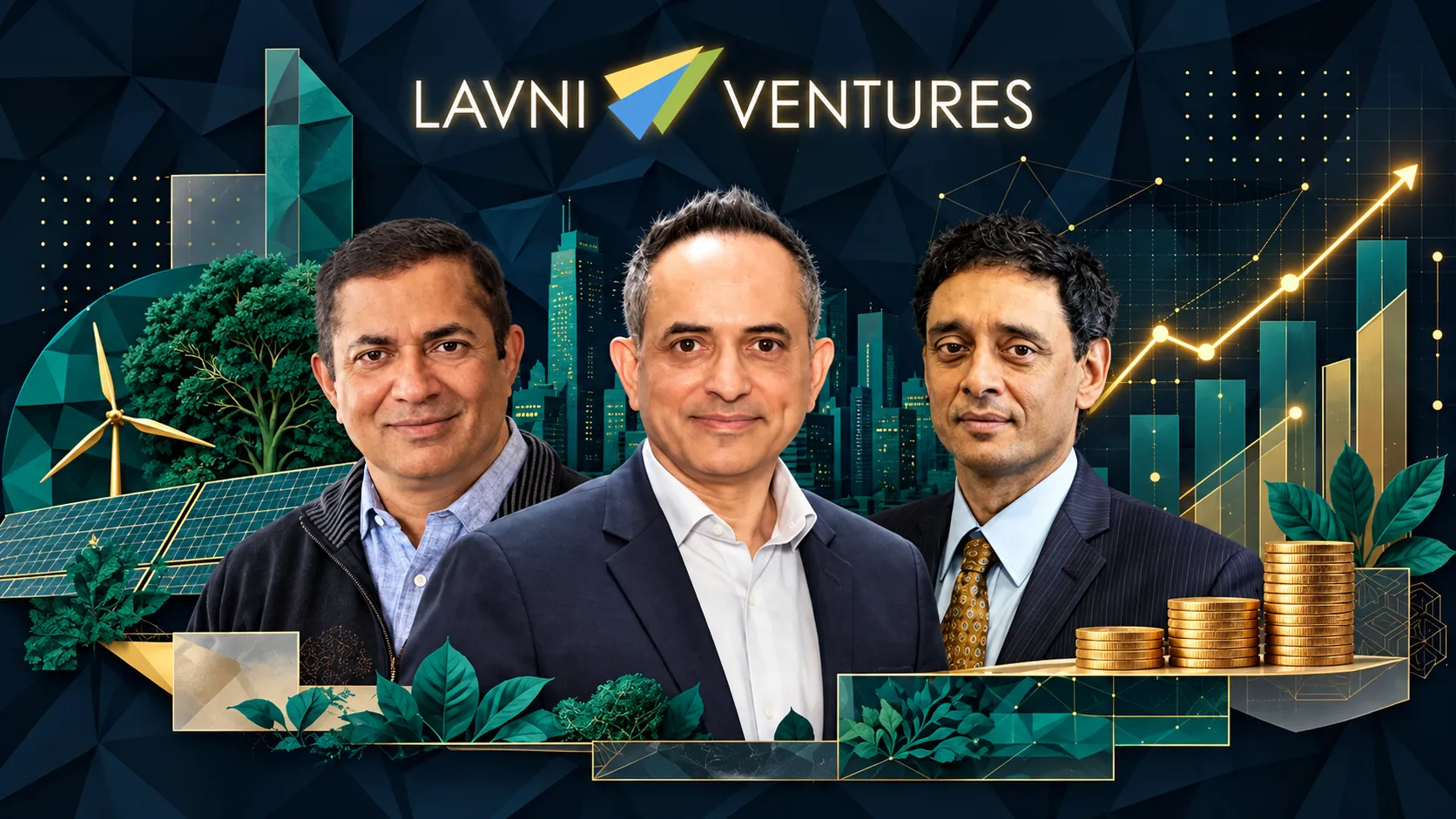
Lavni Ventures, an early-stage venture capital firm focused on deep-tech impact, has closed its second fund at its ₹200 crore target in committed capital, giving it fresh firepower to back Indian startups building foundational technologies in health and climate.
The final close, announced on 22 September 2026, comes roughly a year after the fund's first close in August 2025. The fund also carries a green-shoe option of ₹100 crore, which would allow it to expand to as much as ₹300 crore if investor demand supports it.
Fund II is a scheme of Lavni Ventures Trust, a Category II Alternative Investment Fund registered with the Securities and Exchange Board of India. The firm plans to deploy ₹2 crore to ₹6 crore per seed investment and reserve ₹8 crore to ₹15 crore for follow-on rounds in its best-performing companies.
A thesis built on foundational technology
Founded in 2020, Lavni Ventures has positioned itself at the intersection of two themes that many investors treat separately: deep technology and social or environmental impact. Its second fund focuses specifically on health and climate, sectors where scientific innovation can translate into large-scale benefits but where the path to commercial viability is often long and uncertain.
The firm has already made three investments from Fund II, which offer a useful window into its thesis. Padcare Labs works on recycling sanitary waste, a problem that is both environmentally significant and socially sensitive in India, where disposal systems for menstrual hygiene products remain inadequate in many cities. Monitra Healthcare focuses on remote cardiac monitoring, addressing a large and growing burden of cardiovascular disease with technology that can extend specialist care beyond major hospitals. Vidcare works on at-home diagnostics, an area that gained prominence during the pandemic and continues to expand as patients and health systems seek to reduce the cost and inconvenience of testing.
Each of these companies combines a technical product with a clear public-health or environmental purpose, and each operates in a market where adoption depends on building trust with institutions, clinicians and consumers.
Why impact and deep tech are converging
For much of the past decade, impact investing in India was associated with microfinance, affordable housing and livelihoods. Deep tech, meanwhile, was seen as the domain of specialist funds betting on semiconductors, space and advanced materials. Lavni's model reflects a growing recognition that many of India's most pressing development challenges require genuine technological breakthroughs rather than incremental improvements in service delivery.
Climate adaptation, waste management, affordable diagnostics and chronic disease management are all areas where India's scale magnifies both the problem and the opportunity. A diagnostic device that works reliably in a small-town clinic, or a recycling process that can handle mixed waste economically, can reach tens of millions of people if it succeeds.
Yet these businesses are also difficult to fund. They often require years of research and development, regulatory approvals and pilot deployments before generating meaningful revenue. Many generalist venture funds, which are structured to seek rapid growth and relatively quick exits, are poorly suited to such timelines.
The case for small, focused cheques
Lavni's cheque sizes are modest by the standards of late-stage venture capital, but they are well calibrated for its stage of investing. A seed investment of ₹2 crore to ₹6 crore can fund a deep-tech team through prototype development, early validation and initial customer pilots. The reserved follow-on capital allows the fund to support companies that show promise when they approach larger institutional investors.
This reserve strategy is increasingly important in India's funding environment. Early-stage deep-tech companies frequently struggle to raise their second institutional round, a phase sometimes described as the valley of death. A fund that can continue to support its portfolio through that phase improves the odds of its companies reaching commercial scale.

A broader boost for Indian deep tech
The close comes as India's deep-tech ecosystem attracts more attention from policymakers and investors. The government has announced a series of initiatives aimed at research-led innovation, and several new funds targeting deep technology have launched in recent years. Corporate venture arms and family offices have also shown growing interest in technologies linked to energy transition and healthcare.
Health and climate remain two of the most consequential domains for India. The country faces a rising burden of non-communicable diseases, uneven access to specialist care, rapid urbanisation and significant exposure to climate risks such as heatwaves, flooding and water stress. Technologies that address these challenges have obvious social value, and many also serve large, underpenetrated markets.
The discipline question
Impact-focused investors face a persistent challenge: demonstrating that financial returns and measurable impact can coexist. Limited partners in such funds increasingly expect rigorous reporting on outcomes, from emissions avoided to patients reached, alongside conventional financial metrics. Lavni's ability to show both will influence its capacity to raise future funds and will contribute to the wider credibility of the impact-investing model in India.
Deep-tech investing also carries distinct risks. Technical milestones can slip, regulatory processes can be slower than expected and markets can take longer to adopt new solutions than founders anticipate. The fund's success will depend on selecting teams that combine scientific depth with commercial realism and on providing the patient support needed to bridge the gap between invention and adoption.
What founders should take away
For founders working on health and climate technologies, the close of Lavni's second fund adds another specialised source of early capital to an ecosystem that still has relatively few. Investors who understand the long development cycles of deep tech, and who are comfortable evaluating both impact and commercial potential, can be valuable partners at the earliest stages.
It also signals that the market for impact-oriented deep-tech investing in India is maturing. Hitting a fund target within roughly a year of the first close, with room for a green-shoe, suggests that limited partners are willing to back specialist managers with a clear thesis.
As India seeks to translate its scientific talent into companies that solve real-world problems, funds like Lavni Ventures' second vehicle will play an important role. The coming years will reveal whether its portfolio can turn promising science into scalable businesses, but the fund's close is a vote of confidence in the idea that some of India's most important startups will be those that make its people healthier and its environment more resilient.