China's crowded electric vehicle market produced a clear set of winners in October. Leapmotor extended its run of record months, while Xpeng and smartphone maker Xiaomi each crossed a key milestone. But some of the sector's early stars, including Nio and Li Auto, lost ground.
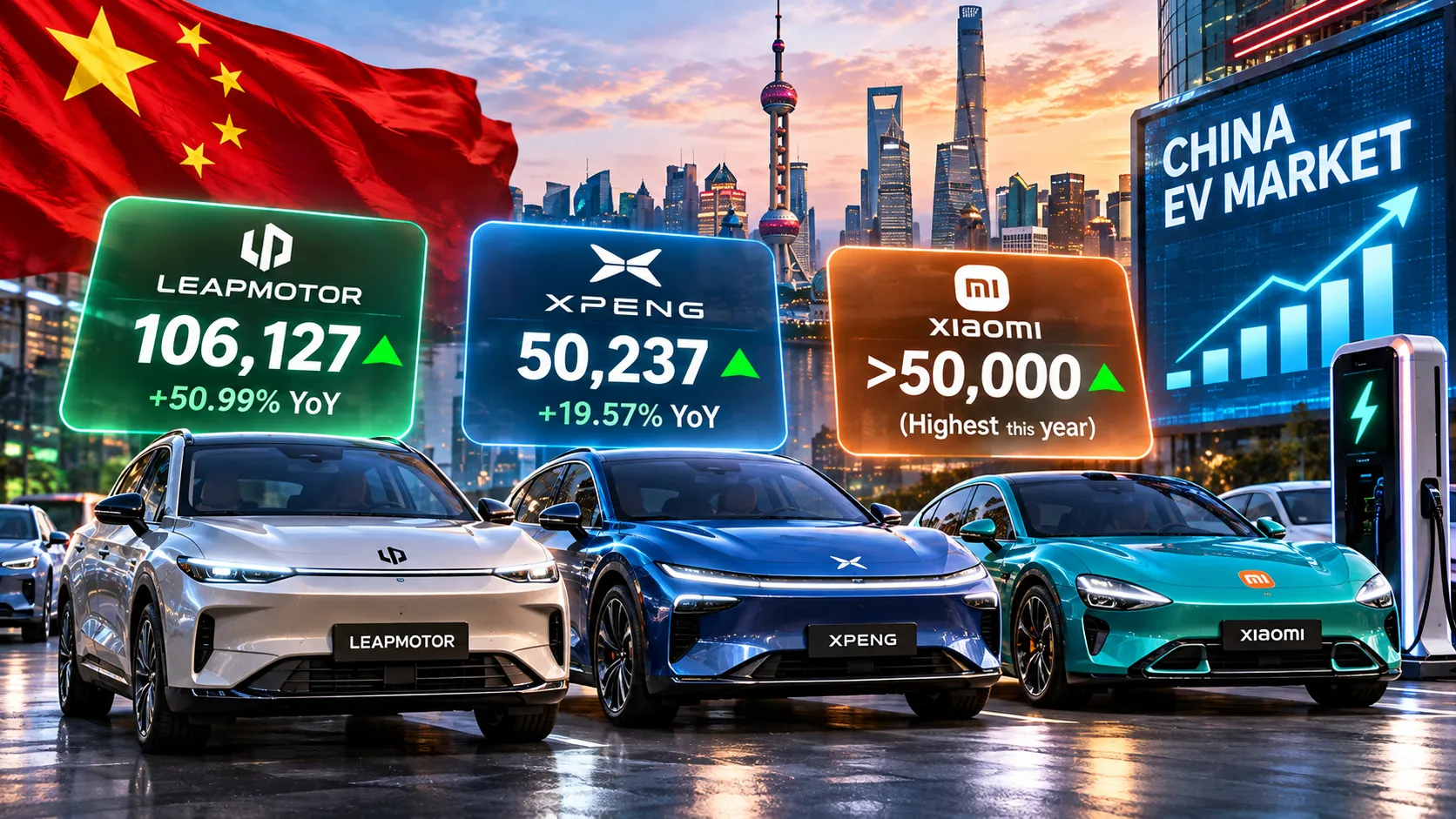
Leapmotor delivered 106,127 vehicles in October 2026, up 50.99% from a year earlier and its fourth consecutive month above 100,000, according to CnEVPost's roundup of deliveries published on Sunday, November 1.
Xpeng delivered 50,237 vehicles, its first month above 50,000, up 19.57% year on year and 21.77% from September. Xiaomi Auto delivered more than 50,000 vehicles, its highest monthly total this year, though it did not disclose the exact figure, according to CnEVPost.
Leapmotor's rise
Leapmotor has become one of the fastest-growing EV makers in China by offering affordable electric and range-extender vehicles with competitive technology. The company, based in Hangzhou, has developed much of its technology in-house, helping it control costs.
Stellantis, the parent of Fiat, Peugeot and Jeep, took a significant stake in Leapmotor in 2023 and formed a joint venture, Leapmotor International, to sell its vehicles outside China. The partnership has given Leapmotor access to Stellantis' global distribution network, particularly in Europe.
Xpeng's milestone
Xpeng's October deliveries included a record 13,326 overseas deliveries, according to CnEVPost, reflecting its expansion into Europe, the Middle East and Southeast Asia. Xpeng, led by founder He Xiaopeng, has emphasised advanced driver assistance and AI technology, and has partnered with Volkswagen to co-develop vehicles for the Chinese market.
Crossing 50,000 monthly deliveries places Xpeng among the larger EV startups and supports its goal of achieving sustained profitability.
Xiaomi's ascent
Xiaomi, best known for smartphones, entered the car market in 2024 with its SU7 sedan and has since expanded with SUVs. Its rapid growth reflects the strength of its brand among young Chinese consumers, its expertise in consumer electronics and software, and founder Lei Jun's high-profile leadership.
Xiaomi's success in cars has been one of the most remarkable stories in the global auto industry, demonstrating how technology companies can disrupt traditional carmakers.
Nio and Li Auto lose ground
Nio delivered 34,246 vehicles, down 15.23% from a year earlier and 8.45% from September, ending a 31-month streak of year-on-year growth, according to CnEVPost. Its budget Firefly brand set a record of 7,738 deliveries, but its Onvo brand fell 51.66%.
Li Auto delivered 29,025 vehicles, down 8.63% year on year and its lowest since February. Li Auto had been one of the most successful EV startups, built on range-extender SUVs, but has faced intensifying competition and a challenging transition to fully electric models.
Huawei's HIMA alliance, which sells vehicles developed with partner carmakers, delivered 33,537 vehicles, down 50.84%. Zeekr, Geely's premium EV brand, delivered 32,483 vehicles, up 51.63% year on year but down 12.72% from September.
The bigger players
Among larger groups, SAIC-GM-Wuling reported total sales of 142,757, including 99,958 new energy vehicles, according to CnEVPost. Changan's Nevo brand delivered 63,648 vehicles and Deepal 32,602. BYD, the industry leader, sold 490,168 new energy vehicles in October, with overseas sales more than doubling.
The price war
China's EV market has been gripped by an intense price war, as dozens of manufacturers compete for market share. Price cuts have squeezed margins across the industry, and the government has expressed concern about destructive competition, urging companies to avoid excessive discounting. Analysts expect consolidation, with weaker players likely to be acquired or exit the market.
October's divergence illustrates this dynamic: companies with strong cost positions, attractive products and effective distribution are gaining share, while others struggle.
Global expansion
Chinese EV makers are increasingly looking overseas for growth, as competition at home intensifies. Exports have grown rapidly, despite tariffs in the United States and the European Union. Southeast Asia, the Middle East, Latin America and Australia have become important markets.
Implications for India
India's EV market is far smaller than China's, and Chinese carmakers face restrictions on investment in India. However, Chinese technology and components play a significant role in India's EV supply chain, particularly batteries. Indian carmakers and policymakers watch China's EV industry closely, both as a model and as a competitive threat. Some Indian companies have explored technology partnerships and licensing arrangements with Chinese carmakers, one way Chinese EV know-how could reach the Indian market within existing investment rules.
What it means for investors
For investors, the October data highlights the importance of selectivity in China's EV sector. Leapmotor, Xpeng and Xiaomi have demonstrated strong momentum, while Nio and Li Auto face challenges. Profitability, cash reserves and the ability to expand overseas will be key factors in determining long-term winners.
The range-extender debate
Several Chinese EV makers, including Leapmotor and Li Auto, have relied heavily on range-extender electric vehicles, which use a small petrol engine to generate electricity for the battery rather than driving the wheels directly. Range extenders address concerns about charging infrastructure and long-distance travel, and have been popular with Chinese families. However, as charging networks expand and battery ranges improve, some buyers are shifting to fully electric vehicles, a trend reflected in BYD's falling plug-in hybrid sales.
Technology as differentiator
Chinese EV makers increasingly compete on technology, particularly advanced driver assistance systems, in-car software and connectivity. Xpeng has emphasised its autonomous driving capabilities, while Xiaomi integrates its cars with its broader ecosystem of smartphones and smart home devices. Huawei provides technology to partner carmakers through its HIMA alliance. The ability to deliver compelling technology at competitive prices has become a key factor in winning customers.
Profitability pressures
Despite strong deliveries, profitability remains elusive for many Chinese EV makers. Leapmotor has reported progress towards profitability, and Li Auto had been profitable for several years before recent challenges. Nio has continued to report losses and has relied on capital from investors, including Middle Eastern funds, to fund its operations. Sustained losses could force further consolidation in the industry.
What comes next
November and December are traditionally strong months for car sales in China, as buyers make purchases before the end of the year. Investors will watch whether the leaders can sustain their momentum and whether struggling players can stabilise. The competitive shake-out in China's EV market is likely to continue into 2027.
For global carmakers, the rapid improvement of Chinese EV challengers represents a serious competitive threat, both in China and increasingly in export markets around the world.