Large language models learned much of what they know by reading text from the internet. A startup in Utah wants to teach artificial intelligence a different way: by learning from real scientific experiments.
Leash Biosciences, based in Salt Lake City, has raised $11 million in a financing round co-led by Innovation Endeavors and Insight Partners, according to AI Funding Tracker, which logged the deal on Tuesday, November 24.
What Leash is building
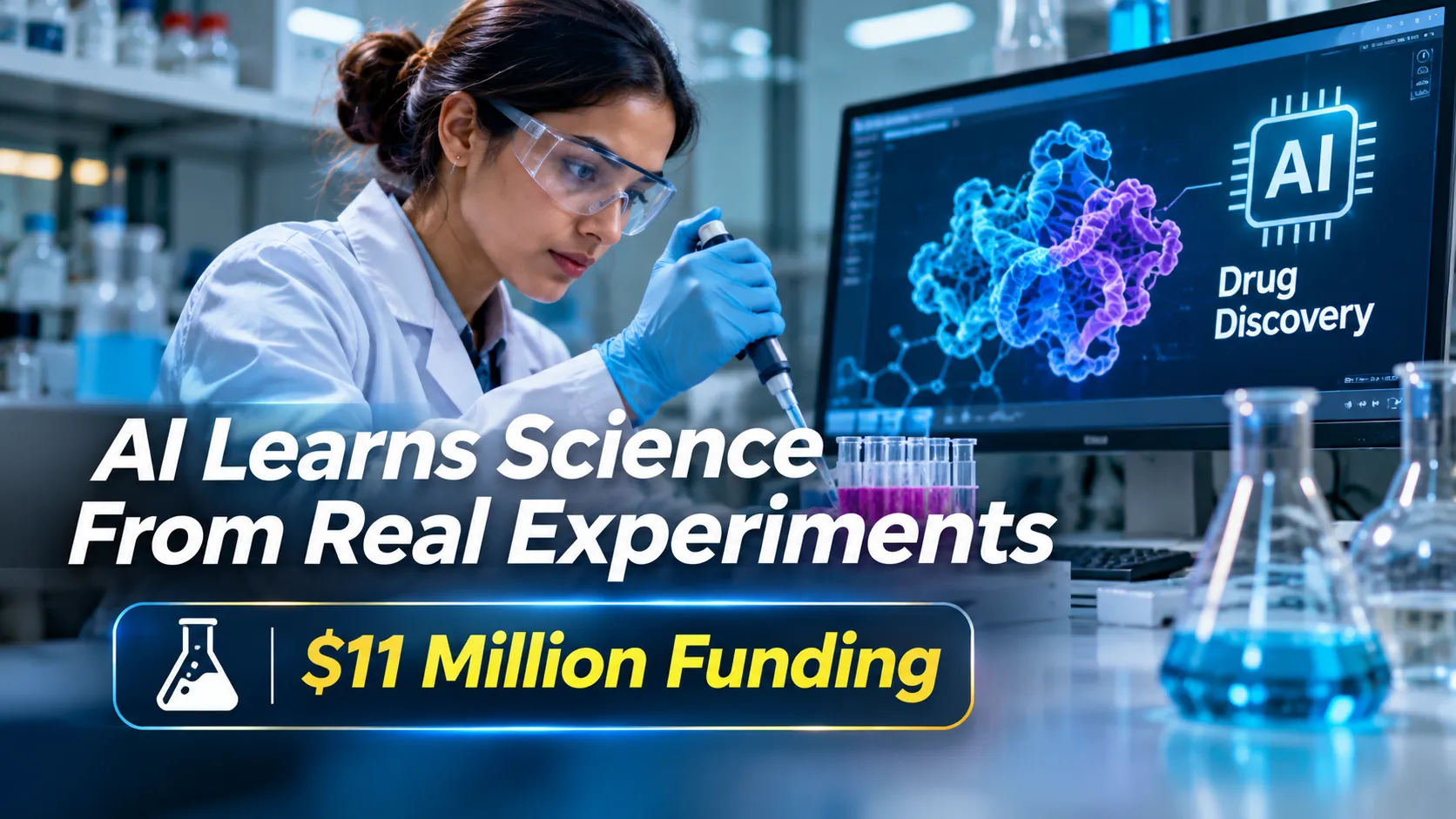
Leash is building environments in which AI agents can learn from the results of past experiments, starting with chemistry and biology, according to AI Funding Tracker.
In AI research, an "environment" is a setting in which an AI agent can take actions and receive feedback on the results, allowing it to learn through trial and error. Environments have been central to some of AI's most famous achievements, such as systems that learned to play complex games at superhuman levels.
For science, building environments means creating systems where AI agents can propose experiments, predict outcomes and learn from real experimental data about what works and what does not. Over time, such agents could become better at designing experiments, identifying promising molecules and understanding biological systems.
Why experimental data matters
Most AI models used in drug discovery are trained on published scientific literature and public databases. These sources have significant limitations: they often report only successful experiments, data quality varies, and important details may be missing.
Data from real experiments, including failed ones, can provide a richer and more reliable foundation for training AI. By learning from a broad range of outcomes, AI agents could develop a deeper understanding of how molecules interact with biological targets.
The investors
Innovation Endeavors is a venture capital firm co-founded by Eric Schmidt, the former chief executive of Google, which invests in companies applying technology to science, healthcare and other fields. Insight Partners is a large global venture capital and private equity firm that invests in software and technology companies at various stages.
Their joint backing signals confidence in the approach of combining AI agents with experimental science.
The AI for Science boom
Leash is part of a broader wave of investment in "AI for Science," the application of artificial intelligence to accelerate scientific discovery. The field gained prominence after Google DeepMind's AlphaFold system predicted the structures of proteins with remarkable accuracy, an achievement recognised with the 2024 Nobel Prize in Chemistry.
Since then, investors have backed numerous companies using AI for drug discovery, materials science and other scientific fields. Isomorphic Labs, a DeepMind spinout focused on drug discovery, raised $5 billion earlier this month, and Chinese lab automation company MegaRobo raised nearly $200 million.
Why drug discovery needs acceleration
Developing a new medicine typically takes more than a decade and can cost billions of dollars, with most candidate drugs failing in clinical trials. Even small improvements in the efficiency of early-stage discovery, such as identifying better molecules faster or predicting which will fail, could have significant economic and health benefits.
AI promises to help by analysing vast amounts of data, generating new molecular designs and predicting properties such as toxicity and effectiveness before expensive laboratory work and clinical trials.
The challenges
Applying AI to science faces significant challenges. Biology is extraordinarily complex, and AI predictions must ultimately be validated through laboratory experiments and clinical trials. High-quality experimental data is expensive to generate, and many of the most valuable datasets are held privately by pharmaceutical companies.
Companies in the field must also demonstrate that their approaches lead to real discoveries, rather than simply faster analysis.
What it means for India
India has a large pharmaceutical industry and a growing community of AI researchers, creating opportunities in AI for Science. Indian contract research organisations, which conduct laboratory work for global pharmaceutical companies, generate large volumes of experimental data and could become important partners for AI-driven discovery.
The Indian government has identified biotechnology and AI as strategic priorities, and initiatives under the BioE3 policy aim to strengthen biomanufacturing and research. Indian startups are also applying AI to drug discovery, diagnostics and agricultural science.
The diaspora connection
Many Indian-origin scientists and engineers work at the intersection of AI and life sciences in the United States and Europe, at universities, pharmaceutical companies and startups. Their expertise and networks could help connect India's research and data capabilities with global AI for Science efforts.
Agents in the laboratory
AI agents for science are designed to take on parts of the research process, such as designing experiments, analysing results and deciding which experiments to run next. When combined with automated laboratories, these agents could create closed-loop systems that conduct research with limited human intervention.
Such systems could dramatically increase the pace of experimentation, although human scientists remain essential for setting goals, interpreting results and ensuring rigour.
Data as a competitive advantage
In AI for Science, access to high-quality experimental data is often the most important competitive advantage. Companies that generate proprietary data through their own laboratories or partnerships can train models that competitors cannot easily replicate.
Leash's focus on learning from past experiments suggests a strategy built around accumulating and exploiting such data over time.
Salt Lake City's biotech scene
Salt Lake City has developed a growing life sciences and technology ecosystem, supported by the University of Utah, a strong genetics research tradition and companies such as Recursion Pharmaceuticals, which has pioneered the use of AI and automation in drug discovery.
The broader investment picture
Investment in AI for Science startups has grown sharply in 2026, as investors look beyond chatbots to applications where AI could create new knowledge and products. Large rounds for companies working on drug discovery, materials and lab automation reflect this shift.
Talent at the intersection
Companies working on AI for Science need rare combinations of skills in machine learning, chemistry, biology and laboratory automation. Competition for such talent is intense, and startups must offer compelling missions and equity to attract researchers who could otherwise join large technology or pharmaceutical companies. Leash will need to show early results from partnerships to justify continued investment in its approach.
What comes next
Leash is expected to use the funding to build its platform, expand its team and develop partnerships with research organisations and companies. Its progress will be watched as a test of whether AI agents can learn effectively from experimental data and accelerate discovery in chemistry and biology.