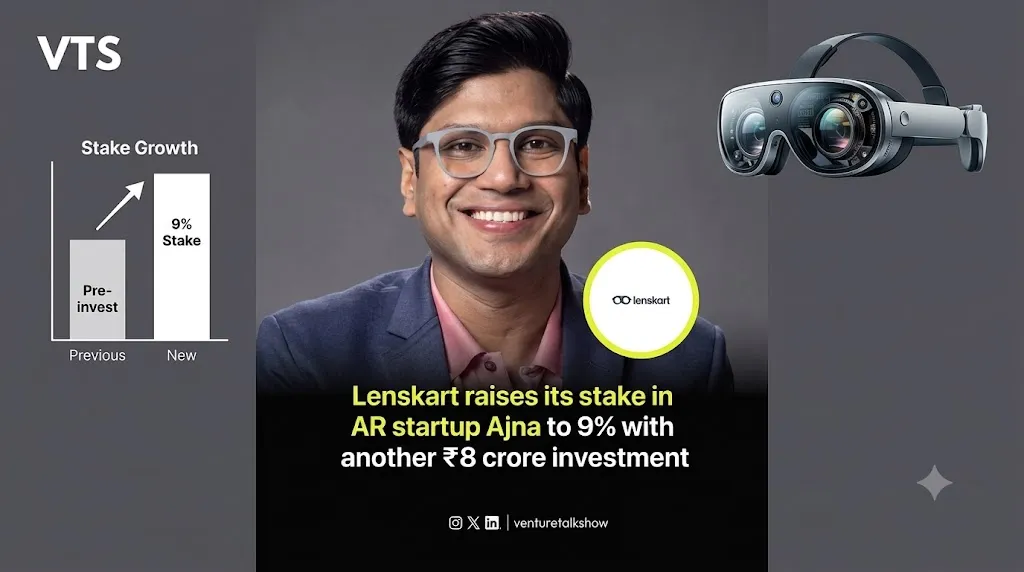
Lenskart, India's largest eyewear retailer, has increased its stake in the parent company of augmented-reality startup AjnaLens to 9%, a move that deepens the company's strategic investment in AR and smart-eyewear technology at a moment when global interest in AI-integrated eyewear has intensified considerably following a wave of high-profile smart-glasses launches from international technology companies. The increased stake builds on an earlier, smaller investment Lenskart had made in AjnaLens, and reflects a broader pattern among the company's leadership of positioning Lenskart not purely as a traditional eyewear retailer but as a technology-forward player preparing to compete in the emerging category of AI-enabled and AR-capable smart glasses as that category moves from early enterprise and defence applications toward mainstream consumer adoption. AjnaLens has built its technology primarily around enterprise and defence-oriented augmented-reality applications, including training simulation and industrial visualisation use cases, a positioning that differs from the primarily consumer-facing smart-glasses products that have drawn the most public attention globally. Lenskart's increased stake suggests the company sees strategic value in AjnaLens's underlying AR hardware and software capabilities that could eventually be adapted or extended toward consumer eyewear applications, even as AjnaLens's near-term commercial focus remains concentrated on its existing enterprise and government client base.
The investment comes as Lenskart continues preparations toward a public listing, a process that has drawn considerable attention from India's capital markets given the company's position as one of the country's most prominent consumer internet success stories and its potential to become one of the larger technology-adjacent listings on Indian exchanges in recent years. Strategic investments of this kind, made in the period leading up to an anticipated public offering, are sometimes read by market observers as an attempt to build out a broader technology narrative around a company's growth story ahead of the scrutiny that comes with public market disclosure requirements, positioning Lenskart not merely as an eyewear retailer with strong unit economics but as a company with genuine exposure to the emerging smart-eyewear and AR technology wave. For a retailer built primarily around prescription eyewear and sunglasses sold through a combination of physical stores and e-commerce, deepening exposure to AR technology represents a meaningful strategic extension, one that positions Lenskart to potentially participate in a category shift that industry observers increasingly view as a genuine long-term threat and opportunity for traditional eyewear retailers, as smart glasses incorporating cameras, AI assistants and augmented-reality displays gradually move from niche early-adopter products toward broader mainstream consideration.
AjnaLens's technology roadmap and existing client relationships within India's defence and enterprise training sectors give the company a differentiated position relative to the primarily consumer-electronics-focused smart-glasses makers that have dominated recent international headlines, and Lenskart's continued investment suggests the eyewear giant is betting that this enterprise and defence-oriented technical foundation could eventually translate into consumer-relevant capabilities as the underlying hardware, optics and AI components continue to mature and decline in cost. India's broader augmented and virtual reality startup ecosystem has remained considerably smaller than comparable ecosystems in the United States or China, making AjnaLens one of a relatively small number of Indian companies with meaningful, demonstrated AR hardware capability that a strategic investor like Lenskart could plausibly partner with domestically rather than seeking similar capabilities from an international technology partner. The scale of Lenskart's increased stake, at 9%, remains a minority position that stops well short of giving the eyewear retailer operational control over AjnaLens, a structure that allows Lenskart to build strategic optionality around AR technology without the capital commitment or integration complexity that a full acquisition would require, while still securing a meaningful enough ownership position to warrant close strategic collaboration between the two companies going forward.