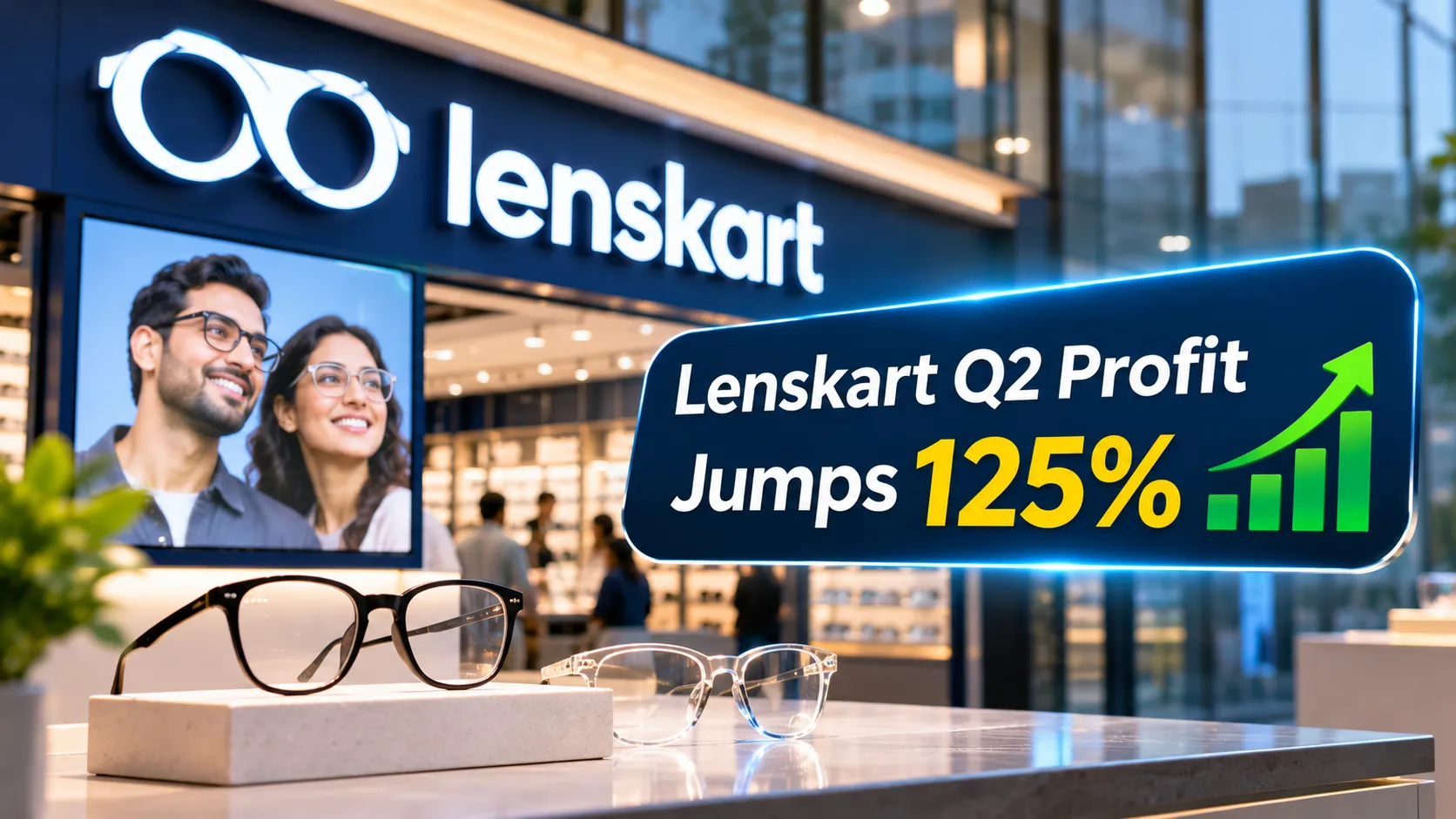
Lenskart, the eyewear company that listed on Indian stock exchanges a year ago, has reported a sharp rise in quarterly profit. The results suggest that its strategy of controlling design, manufacturing and retail across several countries is beginning to pay off at scale.
The company reported on Wednesday, November 4, that consolidated net profit for the quarter ended September 30, 2026 rose about 125% year-on-year to roughly ₹233 crore, up from about ₹103 crore a year earlier. Revenue from operations rose 36% to ₹2,845 crore.
Earnings before interest, taxes, depreciation and amortisation (EBITDA) rose about 50% to ₹622 crore. That points to significant operating leverage: costs are growing more slowly than sales, so a larger share of each additional rupee of revenue reaches the bottom line.
India and overseas grow in step
The most notable feature of the quarter was the balance between Lenskart's two main geographies. Revenue from India rose about 35.5% to ₹1,668 crore. International revenue rose about 36.5% to ₹1,201 crore.
That split matters. Many Indian consumer brands that expand abroad find their overseas business becomes a drag on profitability for years. Lenskart's international arm, which includes its operations in Southeast Asia, the Middle East and Japan through Owndays, now contributes more than 40% of revenue and is growing at the same pace as the domestic business.
The company's results also built on a strong June quarter, when it reported net profit of about ₹228 crore on revenue of ₹2,714 crore. That puts its first-half FY27 profit at more than ₹460 crore.
A vertically integrated model
Lenskart's model is unusual among Indian consumer companies. Rather than relying on third-party manufacturers and distributors, it designs its own frames, makes lenses and frames in its own facilities, and sells through a network of company-run stores and its website and app.
The company has invested heavily in manufacturing, including a large facility in Hyderabad intended to serve both domestic and international demand. Owning production gives Lenskart control over cost and quality, and allows it to deliver prescription glasses quickly through a centralised supply chain.
The trade-off is that the model requires significant capital. The strong rise in EBITDA this quarter suggests that the fixed costs of those factories and stores are being spread across a growing volume of sales.
Building a market rather than taking share
Co-founder and chief executive Peyush Bansal has long argued that Lenskart's opportunity lies in expanding the eyewear market itself, rather than simply winning customers from rivals.
A large share of people in India who need vision correction do not wear glasses. Low awareness, limited access to eye tests in smaller towns and the cost of traditional optical stores all play a part. Lenskart's strategy has been to offer free or low-cost eye tests, standardised pricing and a dense store network that reaches beyond the largest cities.
"We see our role as creating the market, not competing in it," Bansal has said in earlier comments on the company's strategy. When discussing the company's results at the start of 2026, he summed up the effect of scale with the phrase "The compounding has begun."
The September-quarter numbers are consistent with that view. Revenue growth of 36% in a category that is still under-penetrated suggests the business has not yet reached a ceiling.
From startup to listed company
Lenskart was founded in 2010 by Bansal, Amit Chaudhary and Sumeet Kapahi. Bansal, a former Microsoft engineer, became one of India's most recognisable startup founders, partly through his role as a judge on the television show Shark Tank India.
The company went public in November 2025, in one of the more closely watched Indian consumer listings of that year. Before the IPO, some analysts questioned whether its valuation was justified by its earnings. A year on, the company has delivered consecutive quarters of strong profit growth, which has shifted the debate towards how quickly it can keep expanding.
For investors, Lenskart is part of a group of new-age companies, including Nykaa, PhysicsWallah and others, that have moved from loss-making startups to profitable listed businesses. The ability to report steady profits each quarter has become the main test applied to these companies by public market investors.
Why the international business matters
Lenskart's overseas expansion is significant both commercially and symbolically. Its acquisition of Japanese eyewear brand Owndays gave it an established presence in Japan and other Asian markets. The company has also built operations in the Gulf and Southeast Asia, regions with large Indian diaspora populations as well as strong local demand.
International revenue of ₹1,201 crore in a single quarter shows that an Indian consumer brand can compete in developed markets with sophisticated retail sectors. That is still unusual. Most Indian consumer success stories have been built almost entirely on the domestic market.
The integrated model also plays a role internationally. Centralised design and manufacturing let Lenskart serve multiple countries from a common platform, with local stores and branding layered on top. The approach resembles the playbook of global fast-fashion and furniture retailers more than that of a traditional Indian optical chain.
Operating leverage in practice
The difference between 36% revenue growth and 50% EBITDA growth sums up the quarter. As Lenskart's store network matures and its factories run closer to capacity, fixed costs such as rent, salaries and depreciation grow more slowly than sales.
New stores typically take time to reach full productivity. A large share of Lenskart's network was opened in the past few years, so many of those stores are now moving into their more profitable phase. If that continues, margins could keep improving even if revenue growth slows.
Technology is another lever. Lenskart uses digital tools for virtual try-ons, online eye-test booking and inventory management. These allow it to run a large catalogue without holding excessive stock in every store.
What to watch next
Several factors will shape Lenskart's performance over the coming quarters. The first is the pace of store openings in India, particularly in smaller cities, where the potential to grow the market is largest. The second is whether international growth can stay in line with India as the company expands into new countries.
The third is competition. Global eyewear groups and Indian retailers have been watching Lenskart's success and expanding their own offerings. However, Lenskart's scale, vertical integration and brand recognition give it significant advantages in pricing and speed.
Currency movements are also worth monitoring. A large and growing share of revenue now comes from overseas, so changes in the rupee against currencies such as the yen and the dirham can affect reported results. With the rupee having been weak for much of 2026, international revenue has received some support when converted back into rupees.
A milestone for Indian consumer brands
For The Impactful Global Indian's readers, Lenskart's results show how an Indian company can build a global consumer brand by combining manufacturing scale, retail reach and technology. It is a model that other Indian consumer startups are likely to study closely.
Bansal has frequently said the company's aim is to give more people access to affordable vision correction. On the evidence of the September quarter, that mission is now underpinned by a business that is growing rapidly and earning steadily higher profits.
The second half of the financial year will show whether the company can sustain the pace. If it does, Lenskart is on track for its strongest year since its founding more than a decade and a half ago.