FundingMarket Data Women5 MIN READ

LIC's Profit Rises 20% to ₹12,076 Crore as Premium Income Jumps and Its New-Business Margin Climbs to 22.3%

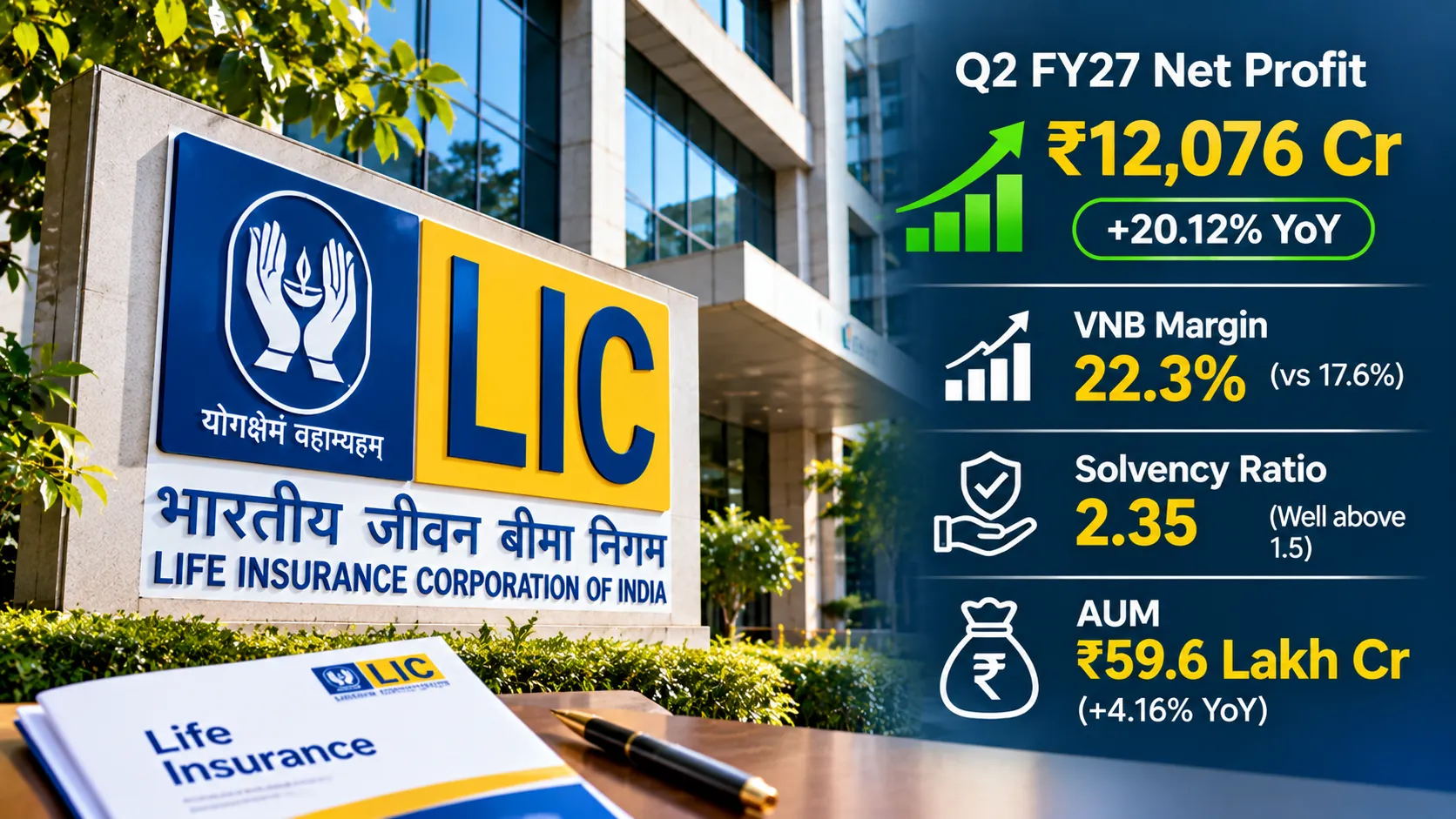
Life Insurance Corporation of India reported a 20% rise in standalone net profit to ₹12,076 crore for the September quarter, as total premium income grew to ₹1.47 lakh crore. The state-owned insurer's value of new business rose 34% in the first half, its margin improved to 22.3%, and its solvency ratio strengthened to 2.35, according to results announced on November 5.

By Shaym Kumar · Author6 November 2026New
LIC's Profit Rises 20% to ₹12,076 Crore as Premium Income Jumps and Its New-Business Margin Climbs to 22.3%

Life Insurance Corporation of India, the country's largest insurer and one of its biggest investors, reported a 20% rise in quarterly profit, with improvements in the profitability of its new business suggesting that its efforts to shift towards higher-margin products are paying off.

LIC posted a standalone profit after tax of ₹12,076.02 crore for the July-September quarter, the second quarter of the 2026-27 financial year, up 20.12% from ₹10,053.39 crore a year earlier, according to BW Businessworld, citing results announced on Thursday, November 5. Several outlets reported consolidated profit of ₹12,115 crore, also up about 20%.

Total premium income rose to ₹1,47,018.18 crore from ₹1,26,479.26 crore, an increase of about 16%. First-year premium was ₹10,432.40 crore, renewal premium was about ₹68,375 crore and single premium was ₹68,402.86 crore. Earnings per share were ₹9.55.

Margins improve sharply

The most closely watched measure of an insurer's profitability, the value of new business (VNB), rose 33.95% to ₹6,846 crore in the first half of the financial year, from ₹5,111 crore a year earlier, according to BW Businessworld. VNB measures the expected future profits from policies sold during a period.

The net VNB margin, which expresses VNB as a percentage of new business premiums, rose to 22.3% from 17.6%, an improvement of 470 basis points. This suggests that LIC is selling more profitable policies, a key goal of its management since its stock market listing in 2022.

A significant factor is the shift towards non-participating ("non-par") products, which do not share profits with policyholders and therefore tend to be more profitable for the insurer. The share of non-par products in LIC's individual business, measured on an annualised premium equivalent basis, was 34.03% in the first half.

Strong first half

For the first half of the financial year, net profit rose 21.52% to ₹25,568.05 crore from ₹21,039.90 crore, and total premium income rose 11.64% to ₹2,74,268.59 crore, according to BW Businessworld.

LIC's expense ratio improved by 87 basis points to 10.41%, indicating greater efficiency. Its solvency ratio, a measure of its capacity to meet obligations to policyholders, rose to 2.35 as of September 30, 2026, from 2.13 a year earlier, well above the regulatory minimum of 1.5.

A giant investor

LIC is one of the largest institutional investors in India. Its assets under management stood at ₹59,60,941 crore, or nearly ₹60 lakh crore, as of September 30, up 4.16% from a year earlier, according to BW Businessworld. It holds significant stakes in many of India's largest listed companies and is a major buyer of government bonds.

Its investment decisions can influence stock prices and the government bond market, and it often acts as a stabilising force when foreign investors sell Indian equities. Gross non-performing assets in its investment portfolio were 1.16% in the September quarter.

The commission reforms

LIC's chief executive and managing director, R Doraiswamy, welcomed proposed changes to insurance commission rules by the Insurance Regulatory and Development Authority of India (IRDAI). "We at LIC are very optimistic about the positive impact of the Proposed commission Regulations changes," he said, according to BW Businessworld.

IRDAI has proposed changes to how insurers pay commissions to agents and distributors, which could affect the economics of selling insurance. The proposals have been closely watched by the industry, and have weighed on the shares of insurance distributors such as PB Fintech, the parent of Policybazaar.

“We at LIC are very optimistic about the positive impact of the Proposed commission Regulations changes.”
— R Doraiswamy, CEO and MD, LIC

LIC relies heavily on its network of more than a million agents, which gives it unrivalled reach across India, including in smaller towns and rural areas.

dfabf5c0-3d99-42c8-995b-aaa8ae3f8f75.png

LIC's market position

LIC was the only life insurer in India for decades until the sector opened to private companies in 2000. It remains the largest life insurer by a wide margin, although private insurers such as SBI Life, HDFC Life, ICICI Prudential Life and Max Life have gained market share, particularly in individual policies and in urban markets.

The government listed LIC on Indian stock exchanges in May 2022 in what was then India's largest initial public offering, selling a 3.5% stake. The government still owns the vast majority of the company and is required to reduce its holding over time to meet minimum public shareholding rules.

The insurance opportunity

India's insurance penetration, measured as premiums relative to economic output, remains low compared with developed economies, leaving significant room for growth. The government has set a goal of "Insurance for All" by 2047 and has taken steps to open the sector further, including raising the foreign direct investment limit for insurers.

IRDAI is also developing Bima Sugam, an online marketplace for insurance products, which aims to make it easier for consumers to compare and buy policies.

Challenges ahead

LIC faces several challenges, including competition from private insurers and new digital distribution channels, pressure to improve customer service and technology, and the need to keep shifting towards more profitable products while maintaining growth. Its large exposure to equity markets also means its investment income can be affected by market volatility, such as the global sell-off that hit markets on November 5 and 6.

Why it matters

LIC's performance is important not only for its shareholders but also for India's financial system. As the custodian of the savings of hundreds of millions of policyholders and one of the largest investors in Indian markets, its financial health has broad implications. The improvement in margins and solvency suggests that the insurer is becoming more profitable and resilient.

The policyholder base

LIC serves hundreds of millions of policyholders, many of them in smaller towns and rural areas where private insurers have a limited presence. Its traditional endowment and money-back policies, which combine insurance with savings, remain popular among Indian households seeking guaranteed returns. The company's challenge is to balance these products, which are important to its customers, with higher-margin protection and non-par products.

Digital transformation is another priority. LIC has been investing in technology to improve customer service, speed up claims and support its agents, as younger customers increasingly expect to buy and manage insurance online.

What comes next

Investors will watch the final form of IRDAI's commission rules, the continued growth of non-par products and LIC's ability to sustain margin improvements. The government's plans for further stake sales will also be a factor for the stock. With strong profit growth and improving margins, LIC is making progress in its transformation from a state monopoly into a more commercially focused listed company.

TagsLICLife Insurance Corporation of Indiainsurancelife insuranceQ2 FY27 resultsR Doraiswamyvalue of new businessVNB marginpremium incomeIRDAIcommission regulationssolvency rationon-par productspublic sectorIndian stocksassets under managementinsurance penetrationBima Sugamfinancial inclusioninvestors

Reader reviews

Sign in to rate and review this article.
Loading reviews…