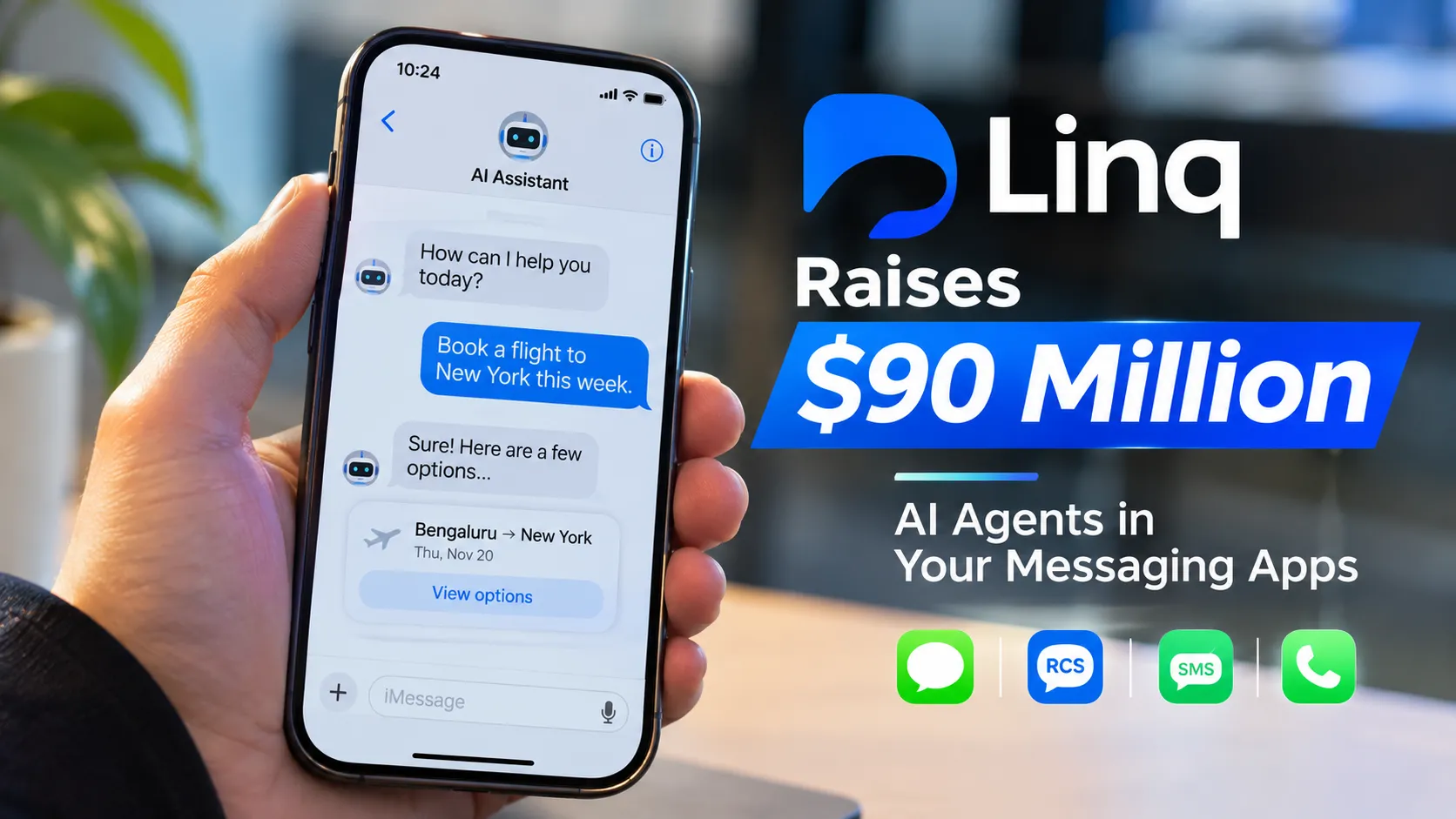
Most people already spend hours a day in their messaging apps. A startup is betting that the AI assistants of the future will meet them there, rather than asking them to download yet another app.
Linq, a company that provides infrastructure allowing AI agents to communicate through iMessage, RCS, SMS and voice calls, has raised $90 million in a Series B funding round led by Andreessen Horowitz, it was reported on Thursday, November 19. Ben Horowitz, the firm's co-founder, will join Linq's board.
Existing investors TQ Ventures, Mucker Capital, Abstract Ventures, Anthos Capital and Left Lane Capital also participated.
Rapid growth in funding
The round comes about nine months after Linq raised a $20 million Series A led by TQ Ventures in February 2026. The rapid succession of rounds reflects intense investor interest in infrastructure for AI agents.
What Linq does
Linq offers an application programming interface (API) that developers can use to connect their AI agents to messaging channels. Instead of building their own integrations with each messaging platform, companies can use Linq to let their AI assistants send and receive messages through iMessage on iPhones, RCS (Rich Communication Services) on Android phones, traditional SMS and voice calls.
This allows businesses to deploy AI agents that can, for example, answer customer questions, schedule appointments, provide updates or act as personal assistants, all within the familiar interface of a text conversation.
Linq counts Poke, an AI assistant that interacts with users through text messages, among its customers.
The founders
Linq was founded by Elliott Potter, Patrick Sullivan and Jared Mattsson, who previously worked at Shipt, the grocery delivery company acquired by Target. The company is based in Birmingham, Alabama, although some reports have described it as based in San Francisco.
The company originally focused on digital business cards and contact sharing before pivoting to messaging infrastructure for AI agents as demand for conversational AI grew.
Why messaging matters for AI
AI agents, software that can carry out tasks on behalf of users, are one of the most active areas of AI investment. Many technology companies believe agents will become a primary way people interact with AI, handling tasks such as booking travel, managing schedules, shopping and communicating with businesses.
Messaging is a natural interface for agents, because people are already comfortable texting and messaging apps are installed on virtually every smartphone. Reaching users through iMessage and RCS gives AI agents rich features such as images, links and typing indicators, without requiring users to download a new app.
The Apple risk
Linq's reliance on iMessage carries platform risk. Apple tightly controls iMessage, and it does not offer an official public API for businesses to send messages through it in the same way as Linq's product. Apple could change its policies or technical systems in ways that affect services built on iMessage.
Apple has its own business messaging service, Messages for Business, and could expand its offerings for AI agents, potentially competing with or restricting third-party providers.
RCS, which has been adopted by Google and, since 2024, supported by Apple on iPhones, offers a more open standard for rich messaging across platforms.
The competitive landscape
Linq competes with established communications platform providers, such as Twilio, Sinch and MessageBird, which offer APIs for SMS, voice and messaging. These companies are also adding AI capabilities and targeting the agent market.