
TechFuture Tech5 MIN READ

Madhya Pradesh Draws ₹5,800 Crore in Semiconductor Proposals as Indore Bids to Join India's Chip Map

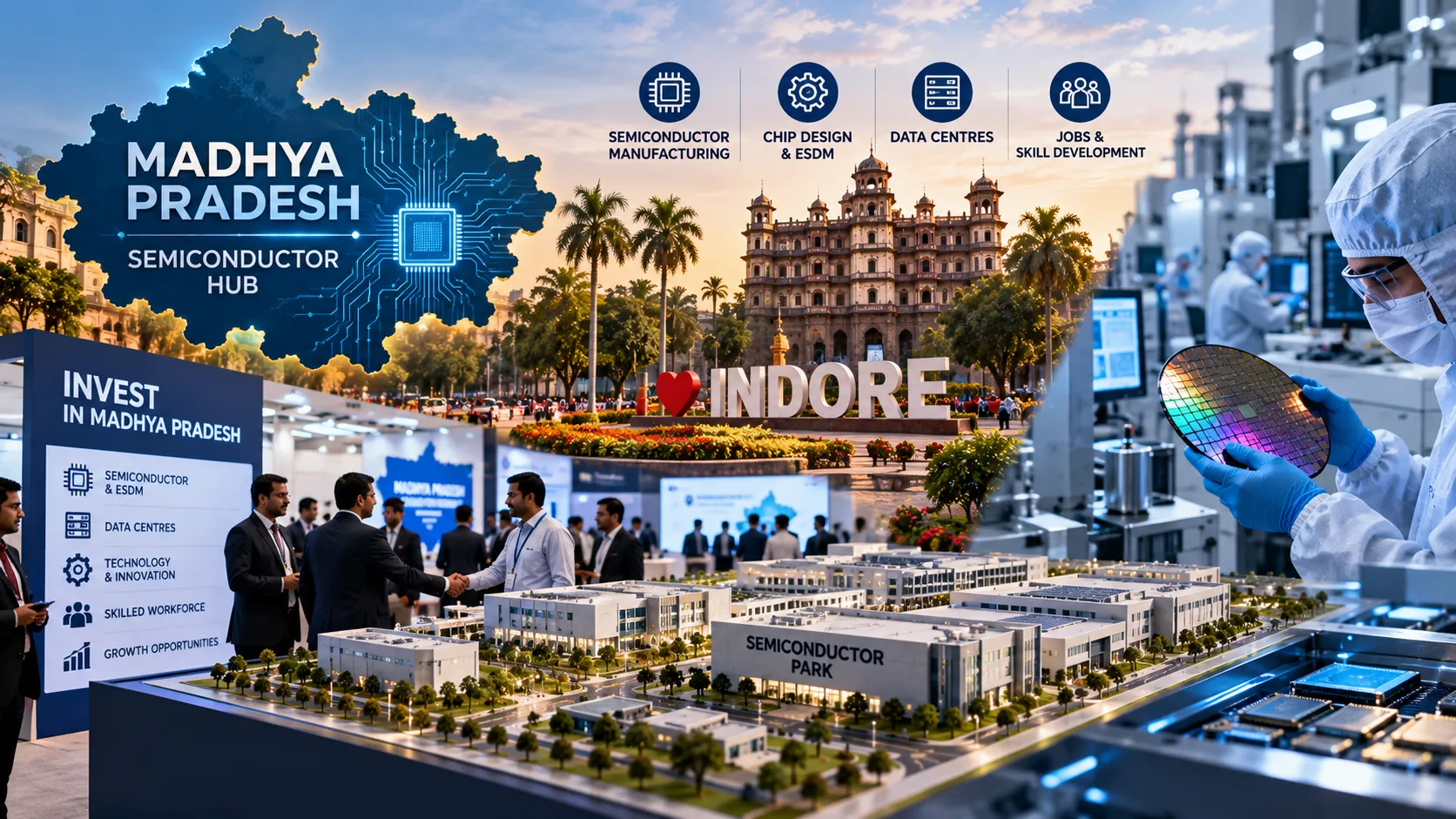
Madhya Pradesh received about ₹5,800 crore in semiconductor and technology investment proposals at a summit in Indore on October 23, which Chief Minister Mohan Yadav said could create more than 10,000 jobs. Separately, five companies received letters of intent for land for projects worth ₹9,625 crore, including a 50 MW hyperscale data centre in Gwalior.

By Aravind Kumar · Author26 October 2026New
Madhya Pradesh Draws ₹5,800 Crore in Semiconductor Proposals as Indore Bids to Join India's Chip Map

Madhya Pradesh is making its pitch to become a player in India's emerging semiconductor industry, attracting thousands of crores in investment proposals as states compete for a share of one of the country's most strategic sectors.

At a semiconductor summit in Indore on Friday, October 23, the state received investment proposals worth about ₹5,800 crore in the semiconductor and technology sectors, Business Standard reported. Chief Minister Mohan Yadav said the proposals "could create more than 10,000 jobs."

The summit was held ahead of the state's Global Investors Summit, scheduled for January 2027.

The proposals

The largest proposal came from Una Ecosystems, which plans to invest ₹2,000 crore in an electronics system design and manufacturing (ESDM) facility, creating 2,000 jobs. Spintronics AI Semiconductors proposed ₹1,800 crore, to be invested in two phases, and Lalwala Industries proposed ₹1,200 crore for semiconductor manufacturing and chip design.

Smaller proposals came from Dhanush Healthcare Systems (₹400 crore, 500 jobs), Beyond Studios (₹110 crore, 360 jobs), Indusilica Semiconductors (₹100 crore, 150 jobs), Nanodrites Technology (₹65 crore, 140 jobs) and Truechip Solutions (₹10 crore, 50 jobs).

Land allotments for larger projects

Separately, five companies received letters of intent for land allocation for projects totalling ₹9,625 crore and more than 4,450 direct jobs.

The biggest is a ₹6,415 crore, 50 MW hyperscale data centre proposed by Cytech RE at Ganga Malanpur in Gwalior. Auriga IT Solutions plans a ₹500 crore global capability centre in Indore employing 3,500 people. Meena Circuits plans a ₹400 crore ESDM unit, and Kaynes Electronics a ₹310 crore electronics manufacturing unit at Badwai IT Park in Bhopal, employing about 950 people.

These follow a July 2026 memorandum of understanding with Paras Semiconductors, a subsidiary of Paras Defence and Space Technologies, for a greenfield advanced packaging and testing facility, known as an OSAT unit, in the Indore-Ujjain region, with proposed investment of about ₹6,200 crore.

The state's semiconductor policy

Madhya Pradesh's Semiconductor Policy 2025 offers a range of incentives designed to complement the central government's programmes. These include a capital expenditure incentive of 25% of eligible capital costs or 50% of central incentives, whichever is lower; reimbursement of 10% or 25% of eligible development expenditure for fabless chip design and intellectual property companies, capped at ₹25 crore per project; reimbursement of stamp duty and registration charges; a 6% interest subsidy up to ₹10 crore over five years; and a power tariff subsidy of ₹2 per unit for the first 10 years.

The state has identified semiconductor manufacturing, electronics manufacturing, advanced packaging and chip design as priority sectors in the Indore-Ujjain Economic Corridor. It plans a Semiconductor Centre of Excellence and a Centre of Excellence for Photonics and Quantum Technologies.

Ashok Chandak, president of SEMI India and the India Electronics and Semiconductor Association, said the policy could help attract investment by combining fiscal incentives with an ecosystem for design and manufacturing.

India's chip ambitions

India has made semiconductors a national priority. The India Semiconductor Mission, launched in 2021, offers fiscal support of up to 50% of project costs for chip fabrication plants, display fabs and assembly and testing facilities. Several major projects have been approved, including Tata Electronics' fab in Dholera, Gujarat, in partnership with Taiwan's PSMC, and assembly and testing plants by Micron, Tata, CG Power and Kaynes in Gujarat and Assam.

“The race for India's chip industry is no longer just between Gujarat, Karnataka and Tamil Nadu.”
— TIGI Tech Desk

States have competed fiercely to host these projects, offering additional incentives on top of central support. Gujarat, Assam, Uttar Pradesh, Karnataka, Tamil Nadu and Odisha have all attracted semiconductor-related investments. Madhya Pradesh's push reflects its ambition to join this group.

2a79ecf3-9184-4079-9bfb-37c50a3a5e13.png

Why Indore

Indore, the state's commercial capital, has developed a growing technology and services sector, with IT companies, startups and educational institutions including an Indian Institute of Technology and an Indian Institute of Management. The state government argues that land availability, power supply, lower costs and a central location make it attractive for manufacturing.

Madhya Pradesh has also sought to position itself as a destination for data centres, which require large amounts of land and reliable power. The proposed hyperscale facility in Gwalior is part of that strategy.

From proposals to projects

Investment proposals and memoranda of understanding do not always translate into actual projects. Industry analysts caution that semiconductor projects, in particular, are capital-intensive and complex, requiring specialised talent, ultra-pure water, stable power and strong supply chains.

The chief minister said the state had received proposals worth about ₹34 lakh crore through its 2025 Global Investors Summit and other initiatives, and that more than 30% had moved to implementation. The proportion of semiconductor proposals that materialise will be a key test of the state's strategy.

The talent question

Semiconductor manufacturing and design require highly specialised skills. India has a large pool of chip design engineers, many working in global capability centres of companies such as Intel, Qualcomm, Nvidia, AMD and Texas Instruments, but manufacturing expertise is scarcer. Building fabs and assembly units requires engineers and technicians trained in clean-room operations, process engineering and equipment maintenance.

The central government's Semicon India programme includes initiatives to train tens of thousands of engineers, and states are partnering with universities and industry to develop courses. Madhya Pradesh's planned Centres of Excellence aim to contribute to this effort. Indore's educational institutions, including IIT Indore, could play a role in developing talent for the sector.

Data centres as a parallel play

The proposed 50 MW hyperscale data centre in Gwalior reflects a broader trend of states competing for data centre investment, which has surged across India due to cloud adoption, data localisation and AI. CBRE estimates that India's data centre sector has attracted $173 billion in investment since 2021. Data centres require large plots of land, reliable power and water, areas where states outside traditional hubs like Mumbai and Chennai hope to compete.

What comes next

Madhya Pradesh will now work to convert the proposals into projects, with the Global Investors Summit in January 2027 expected to bring further announcements. For India, the expansion of semiconductor activity across more states could help build a broader ecosystem of suppliers, talent and infrastructure, strengthening the country's position in global electronics supply chains. The state's success could also encourage other states without established electronics hubs to pursue semiconductor investment more aggressively. Investors and industry bodies will be watching closely to see how many proposals reach the ground.

TagsMadhya PradeshsemiconductorsIndoreMohan Yadavchip designESDMOSATdata centresKaynes ElectronicsParas DefenceIndia Semiconductor Missionelectronics manufacturinginvestment proposalsIndore-Ujjain corridorGlobal Investors Summitjobsstate policyMake in Indiatechnology investmentIESA

Reader reviews

Sign in to rate and review this article.
Loading reviews…

