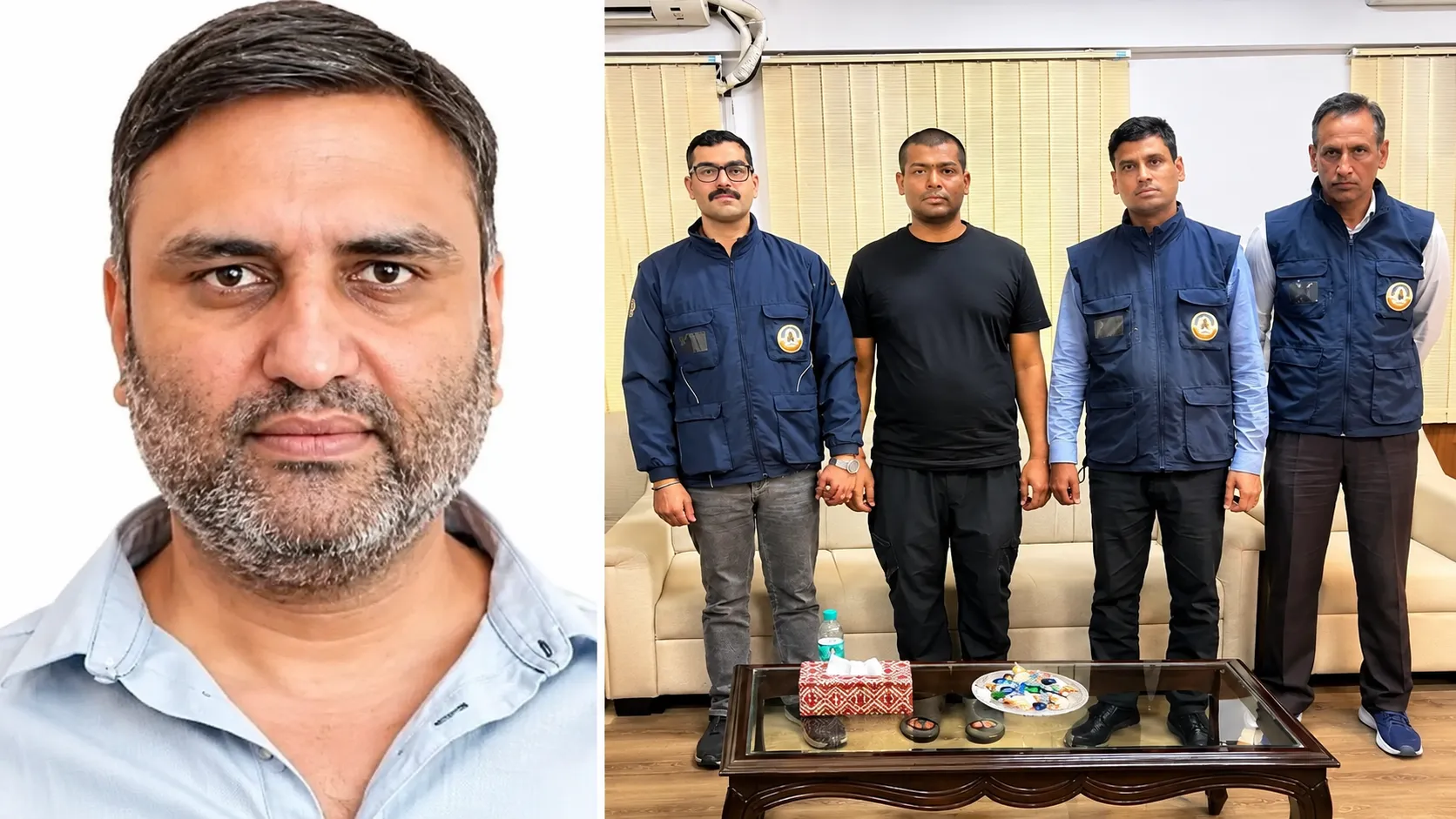
Ravi Uppal, one of the alleged promoters of the Mahadev online betting app, has reportedly been arrested in the United Arab Emirates on the basis of an Interpol Red Notice. The arrest is the latest development in one of India's largest investigations into illegal online betting and money laundering.
According to a report by the Press Trust of India (PTI) on Wednesday, November 4, Uppal, 46, was taken into custody in Dubai. India's Central Bureau of Investigation (CBI) and the Enforcement Directorate (ED) are seeking his extradition. Indian agencies were awaiting formal confirmation of the arrest from UAE authorities at the time of the report.
Uppal has not been convicted of any offence, and the allegations against him have not been tested in court. Like other accused in the case, he is entitled to the presumption of innocence.
A second detention in the UAE
This is not the first time Uppal has been detained in the UAE. He was held in Dubai in December 2023, also on the basis of an Interpol Red Notice issued at India's request. He was released after about 45 days and later went missing, frustrating Indian efforts to bring him back to face investigation.
His disappearance became a point of contention in the case. India's Supreme Court had asked the ED to trace him, reflecting the importance that investigators placed on his role in the alleged operation.
The fresh arrest therefore marks a significant development for Indian authorities. Whether it leads to extradition will depend on legal proceedings in the UAE and on cooperation between the two countries.
The co-promoter extradited earlier
The Mahadev app is alleged to have been run by Uppal and Sourabh Chandrakar, both from Chhattisgarh. Chandrakar has reportedly been extradited from Oman, giving Indian agencies custody of one of the two men they consider central to the operation.
Investigators allege that the two men ran a large network of online betting platforms from the UAE, targeting users in India, where most forms of online betting are illegal. Authorities allege that money from the platforms was laundered through a network of bank accounts, shell companies and hawala channels.

The scale of the alleged operation
Estimates of the money involved in the case vary widely. Reports have put the amount allegedly involved at between about ₹6,000 crore and ₹15,000 crore, depending on what is included in the calculation.
The ED has been investigating the case under the Prevention of Money Laundering Act (PMLA). It has carried out raids, frozen assets and filed charge sheets against a number of individuals allegedly linked to the network.
The case drew wide public attention after reports that a lavish wedding held in the UAE, allegedly linked to Chandrakar, cost around ₹200 crore and featured performances by several Indian celebrities. Investigators have alleged that the expenses were paid in cash, including through hawala channels. Several celebrities who attended or performed at events linked to the promoters were questioned by investigators, although being questioned does not imply wrongdoing.
Political dimension
The case also has a political dimension. The ED has alleged that payments of about ₹508 crore were made to former Chhattisgarh Chief Minister Bhupesh Baghel. Baghel and his party, the Indian National Congress, have strongly denied the allegations and described them as politically motivated.
The allegations against Baghel are under investigation and have not been proven. The case has been the subject of intense political debate in Chhattisgarh and at the national level.
Investigators have also reported that Uppal acquired a passport from Vanuatu, a Pacific island nation that offers citizenship through investment. The use of second passports by individuals facing investigation has become an issue in several Indian financial crime cases, as it can complicate extradition efforts.
Online betting and Indian law
The Mahadev case highlights the challenges India faces in regulating online betting and gambling. Most forms of betting are illegal in India, but online platforms operated from overseas jurisdictions have found ways to reach Indian users.
These platforms often advertise through social media and messaging apps, and accept payments through a range of channels, some of which are designed to evade the controls of the formal banking system. Authorities have repeatedly blocked betting websites and apps, but new ones often appear in their place.
In 2025, India introduced legislation to ban online real-money gaming, including games that previously operated legally, such as fantasy sports and online rummy played for money. The government cited concerns about addiction, financial losses and the use of platforms for money laundering. The ban has significantly reshaped India's online gaming industry.
The role of international cooperation
The case also underlines the importance of international cooperation in tackling cross-border financial crime. Interpol Red Notices are requests to law enforcement agencies worldwide to locate and provisionally arrest a person pending extradition. They are not international arrest warrants, and each country decides how to act on them under its own laws.
India and the UAE have an extradition treaty, and the two countries have cooperated on several high-profile cases in recent years. However, extradition proceedings can take time, and the outcome depends on the legal process in the country where the person is held.
The UAE has become an important hub for international business, finance and trade, including for many Indian businesses and the large Indian diaspora in the Gulf. It has also faced scrutiny from international bodies over financial crime, and has taken steps in recent years to strengthen its anti-money-laundering framework.
Implications for India's digital economy
For India's fast-growing digital economy, the Mahadev case is a reminder of the risks that come with widespread digital payments and online platforms. The same infrastructure that has made payments faster and more convenient can be exploited by illegal operations if controls are not strong enough.
Indian regulators and law enforcement agencies have been tightening rules on payment intermediaries, digital wallets and online platforms to reduce the risk of misuse. Banks and payment companies are under increasing pressure to detect suspicious transactions and to report them to authorities.
What comes next
The immediate question is whether Uppal will be extradited to India. That will depend on legal proceedings in the UAE, and on whether Indian authorities can present the necessary documentation and meet the requirements of the extradition treaty.
If he is brought back to India, he would face questioning by the ED and CBI and could be charged under multiple laws. His testimony could also have implications for other individuals allegedly linked to the case.
For now, Indian agencies are awaiting formal confirmation from the UAE. The case remains under investigation, and the allegations against Uppal, Chandrakar and others will ultimately need to be proven in court.


