MakeMyTrip, India's largest online travel company, returned to profit in the September quarter, as steady growth in bookings offset the drag from a sharp depreciation of the Indian rupee against the US dollar.
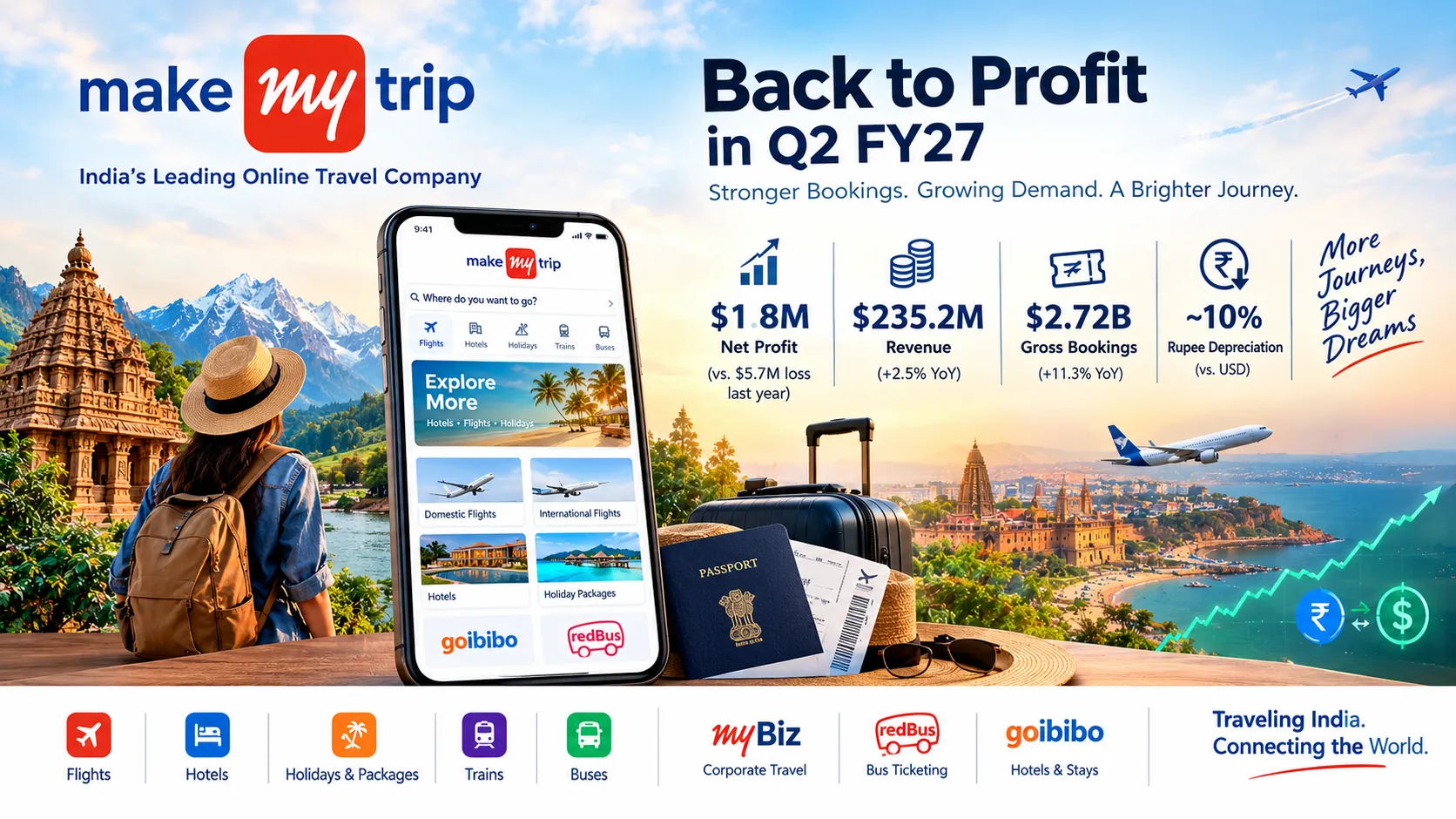
The Nasdaq-listed company reported a net profit of $1.8 million for the quarter ended 30 September, the second quarter of its 2027 financial year, compared with a net loss of $5.7 million in the same period a year earlier, according to results announced on 26 October.
Revenue rose 2.5 per cent to $235.2 million. In constant currency terms, which strip out the effect of exchange-rate movements, revenue grew 11.2 per cent. Gross bookings, the total value of travel booked through the platform, increased 11.3 per cent to $2.72 billion.
The Currency Effect
The gap between constant-currency and reported growth highlights the impact of the rupee's decline. The currency weakened by about 10 per cent against the dollar over the past year, according to reports on the results, meaning that rupee-denominated revenue translated into fewer dollars when reported.
Because MakeMyTrip reports in US dollars but earns most of its revenue in India, a weaker rupee reduces its reported figures even when underlying business is growing healthily. The effect has become more pronounced this year as the rupee has come under pressure from high crude oil prices, foreign capital outflows and global interest rate movements.
The rupee's weakness has been one of the defining features of Indian financial markets in recent months. Elevated oil prices linked to disruption in the Strait of Hormuz have widened India's import bill, while rising bond yields in the United States have drawn capital away from emerging markets.
Travel Demand Holds Up
Despite the currency headwinds, the growth in gross bookings suggests that demand for travel among Indian consumers remains resilient. India's growing middle class, rising disposable incomes and increasing appetite for leisure travel have made the country one of the world's fastest-growing travel markets.
MakeMyTrip operates across air ticketing, hotels and holiday packages, buses, trains and other travel services, through its MakeMyTrip, Goibibo and redBus brands. Hotels and packages have become increasingly important to its business because they generate higher margins than air tickets, where airline commissions are thin.
Domestic tourism has been a particular bright spot. Religious and spiritual tourism, weekend getaways and travel to smaller destinations have grown strongly, supported by new airports, improved roads and expanding hotel supply in tier-2 and tier-3 cities.
Pressures on International Travel
International travel has faced greater challenges. A weaker rupee makes overseas trips more expensive for Indian travellers, while geopolitical tensions and higher airfares linked to fuel costs have affected demand on some routes. Disruption in the Middle East, a major transit hub for Indian travellers flying to Europe and North America, has added uncertainty.
Even so, outbound travel from India remains a long-term growth story. Indians are among the fastest-growing groups of international tourists globally, and destinations in Southeast Asia, the Middle East, Europe and beyond have actively courted Indian visitors with easier visa processes and targeted marketing.
A Founder-Led Journey
MakeMyTrip was founded in 2000 by Deep Kalra, initially to serve Indians living in the United States who wanted to book travel back home. The company listed on Nasdaq in 2010 and has since grown into India's dominant online travel platform through organic growth and acquisitions, including its 2017 merger with Ibibo Group, which brought the Goibibo and redBus brands under its ownership.
The company is one of a small number of Indian technology businesses listed on US exchanges, giving international investors direct exposure to India's consumer internet economy. Its results are often viewed as a barometer of Indian travel demand.
Competition and Margins
MakeMyTrip faces competition from global travel platforms such as Booking.com and Agoda, from airlines and hotel chains selling directly to customers, and from newer Indian players including EaseMyTrip and Ixigo. Quick-commerce and super-app platforms have also experimented with travel bookings.
The company's ability to maintain profitability depends on balancing growth investments, such as marketing and technology, against margins. The return to a net profit, even a small one, suggests it has managed costs effectively despite the currency drag.
The Diaspora Dimension
MakeMyTrip's origins in serving the Indian diaspora remain relevant. Millions of non-resident Indians travel between India and their countries of residence each year, and diaspora travel has been an important source of demand for airlines and travel platforms. A weaker rupee can make trips to India more affordable for those earning in dollars, pounds or dirhams, potentially supporting inbound diaspora travel even as outbound travel by Indian residents becomes more expensive.
Hotels, Packages and the Margin Mix
The composition of MakeMyTrip's business has shifted over the past decade. Air ticketing still generates large booking volumes, but airlines pay thin commissions and increasingly push customers to book directly. Hotels and holiday packages, by contrast, carry higher take rates and allow the platform to bundle services such as transfers, activities and insurance. Growth in these segments therefore has an outsized effect on profitability.
The company has also invested in corporate travel through its myBiz platform, as well as in bus ticketing through redBus, which has expanded into several international markets in Southeast Asia and Latin America. These businesses diversify revenue and reduce dependence on the cyclical air travel market, where fuel prices, airline capacity and fares can swing sharply. Investors will look for continued progress in these higher-margin areas as evidence that the company can grow profits faster than bookings over time.
What Comes Next
The coming quarters include India's peak festival and wedding seasons, as well as winter holidays, traditionally strong periods for travel demand. Investors will watch whether bookings growth accelerates and whether the company can expand margins in hotels and packages.
The trajectory of the rupee will also be important. Further depreciation would continue to weigh on reported dollar figures, while stabilisation could allow underlying growth to show through more clearly.
For now, MakeMyTrip's results paint a picture of an Indian travel market that is growing steadily in local terms, even as global financial conditions make that growth harder to see in the company's dollar-denominated accounts.


