FundingLatest Deals5 MIN READ

Toothsi Parent MakeO Raises ₹90 Crore to Build an India–Southeast Asia Dental Platform After Turning EBITDA Positive

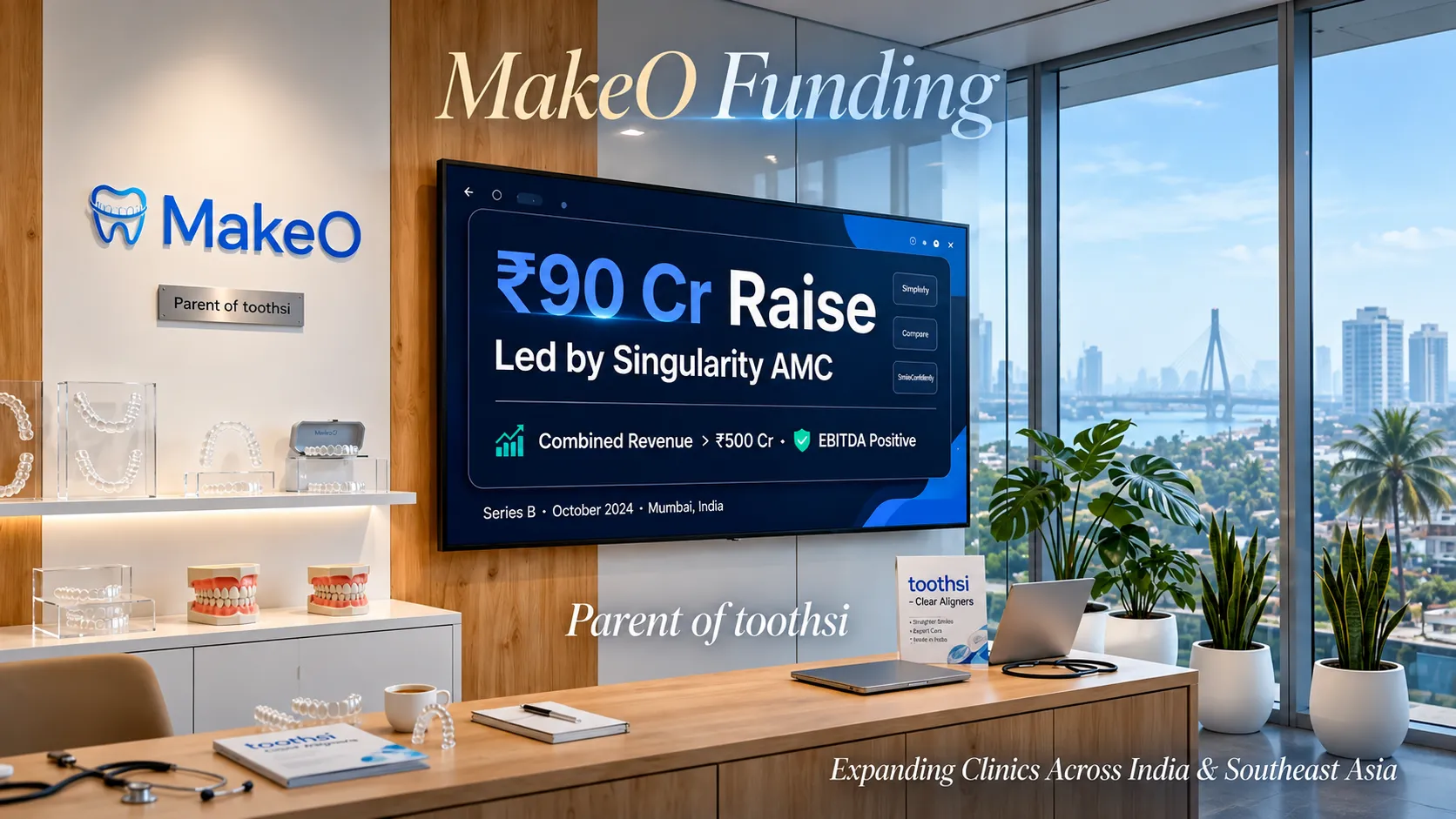
MakeO, the company behind clear aligner brand Toothsi, has raised ₹90 crore in a round led by Singularity AMC to expand clinics and manufacturing across India and Southeast Asia, and to pursue acquisitions after crossing ₹500 crore in revenue and turning EBITDA profitable.

By Nisha Omkumar · Author14 October 2026New
Toothsi Parent MakeO Raises ₹90 Crore to Build an India–Southeast Asia Dental Platform After Turning EBITDA Positive

MakeO, the parent company of clear aligner brand Toothsi, has raised ₹90 crore (about $9.4 million) in a funding round led by Singularity AMC. The company plans to deepen its clinical and manufacturing footprint across India and Southeast Asia and to keep buying smaller dental businesses.

The DSP family office, Genesis and Unispace Ventures also took part in the round, which was announced on October 13. MakeO did not disclose its valuation.

The raise comes at an interesting moment for the company. According to MakeO, its combined business has crossed ₹500 crore in revenue and turned EBITDA profitable earlier this year. That is a milestone many Indian consumer health startups have struggled to reach, and the company now aims to double revenue over the next two to three years.

Where the money will go

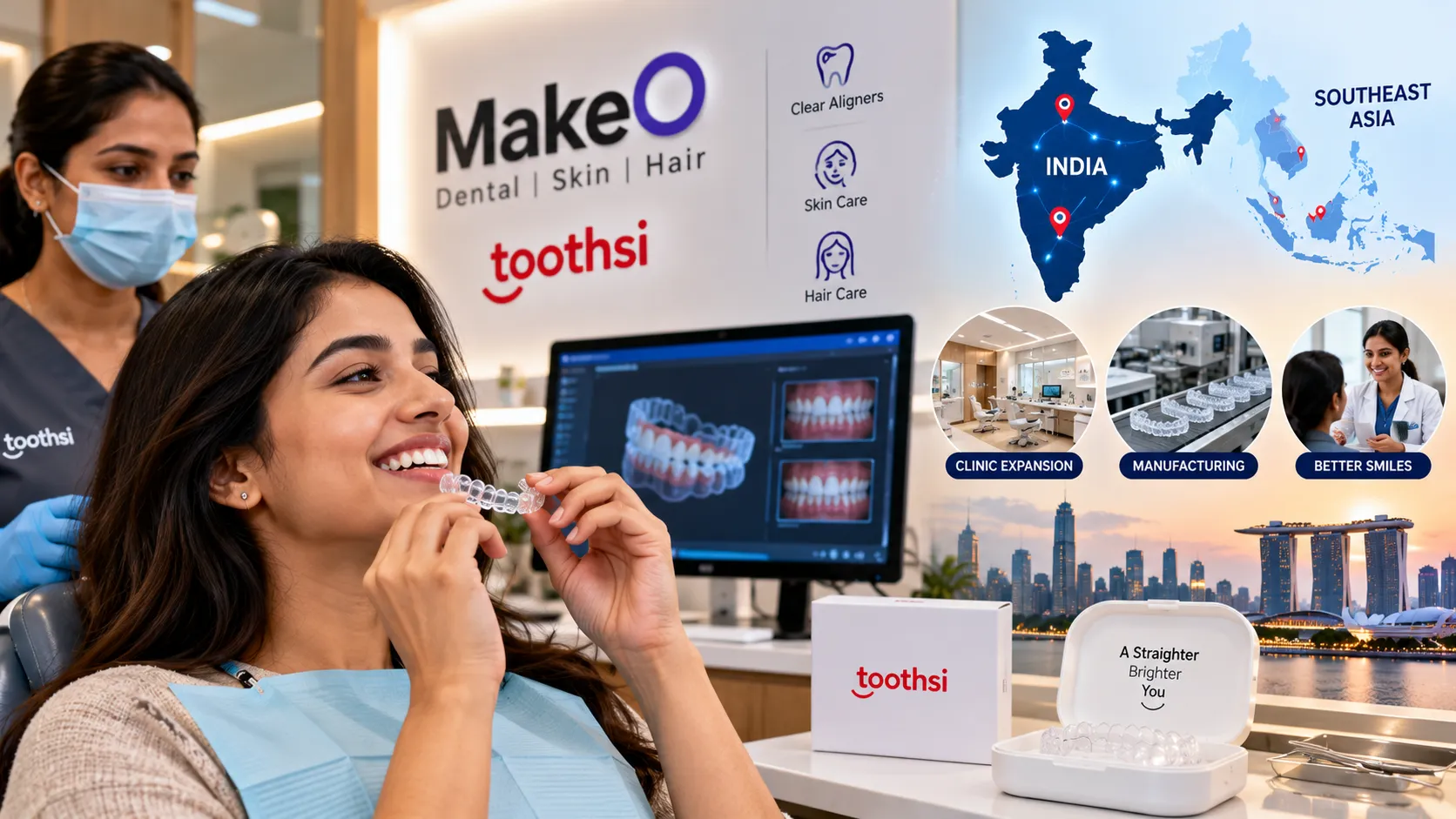
MakeO has outlined four priorities. It will expand its offline presence across India and Southeast Asia, strengthen its manufacturing operations, and invest in consumer experience, clinical centres and backend technology. It will also evaluate acquisitions of dental and aligner businesses in both regions.

The emphasis on offline clinics marks a significant evolution in the company's model. Toothsi built its early brand as a largely direct-to-consumer business, offering at-home teeth scans and aligners delivered to customers' doors. That approach helped it grow quickly and differentiate itself from traditional orthodontics. Over time, however, the company has concluded that physical clinical touchpoints matter for consumer trust, treatment quality and the wider range of services it wants to offer.

MakeO now operates more than 60 offline clinical centres and says it has served over four lakh consumers.

An acquisitive growth strategy

Acquisitions have become central to MakeO's expansion. In 2025, the company bought Apple Dental, which runs 20 clinics across Andhra Pradesh and Telangana, for ₹10.9 crore in a cash-and-stock deal. The acquisition gave MakeO an immediate clinical presence in two large southern states.

Its most ambitious move came in February, when it announced the acquisition of Singapore-headquartered Zenyum, a clear aligner and aesthetic dentistry company with a strong presence in Southeast Asia. The deal turned MakeO from a primarily Indian company into a regional player. The combined group now works with about 1,100 partner dentists across 10 countries.

With fresh capital and acquisition experience under its belt, MakeO is signalling that it intends to consolidate further. The dental market in both India and Southeast Asia remains highly fragmented, dominated by independent practices. That gives a well-capitalised platform room to grow through acquisitions while bringing standardised technology, procurement and branding to the clinics it absorbs.

From aligners to a broader aesthetics platform

MakeO was founded in 2018 by Arpi Mehta, Pravin Shetty, Manjul Jain and Anirudh Kale, and began with teeth aligners under the Toothsi brand. In 2022, the company brought Toothsi together with skincare brand Skinnsi under the MakeO umbrella, broadening its offering to dental, skin and hair treatments.

The logic is that consumers who pay for aesthetic dental treatment are often interested in other appearance-related services, and a trusted brand with a network of clinics can serve them across categories. Building that kind of multi-service relationship can raise lifetime value per customer and spread the fixed costs of clinics and marketing across more revenue lines.

“The next phase is less about convincing consumers that aligners work and more about building the clinical footprint to deliver them at scale.”
— TIGI Funding Desk
5d4daef1-829a-42c1-967b-934ee384aad6.png

How the aligner business works

Clear aligners are a series of transparent, removable plastic trays, each slightly different, that gradually move teeth into a planned position over months. The process begins with a digital scan of the patient's mouth, from which software plans the treatment and generates a sequence of 3D-printed moulds. The aligners are then formed over those moulds and shipped to the patient in batches, with progress monitored remotely or at clinic visits.

That workflow rewards scale and vertical integration. A company that controls scanning, treatment planning and manufacturing can lower its cost per case, shorten turnaround times and keep tighter control over quality, while clinical partners and in-house dentists handle diagnosis and supervision. It also explains why MakeO is investing in both manufacturing and clinics: the two together form the backbone of a business that can deliver treatment reliably at volume.

Why Southeast Asia

Southeast Asia offers many of the same growth drivers as India: young populations, rising incomes, high smartphone penetration and a strong influence of social media on consumer preferences. Several of its markets also have higher average spending power, which can support premium pricing. By combining India's lower-cost manufacturing and engineering base with Zenyum's established regional brand, MakeO hopes to serve those markets more efficiently than competitors operating from a single country.

A growing market

The clear aligner market in India is still small by global standards but expanding quickly. According to Market Research Future, India's clear aligner market is projected to grow from about $467 million in 2025 to roughly $2.83 billion by 2035, a compound annual growth rate of nearly 20%. Rising disposable incomes, the influence of social media on appearance, and greater awareness of orthodontic options beyond traditional metal braces are all fuelling demand.

Competition is intensifying. Global aligner companies have expanded in India, local challengers have emerged, and dentists themselves increasingly offer aligner treatments through partnerships with manufacturers. In this environment, scale in manufacturing and access to clinical networks are becoming important differentiators. Manufacturing in-house, as MakeO does, allows tighter control over costs and turnaround times.

The funding history and what comes next

Before this round, MakeO had raised more than $100 million from investors including Eight Roads Ventures, 360 ONE Asset and Paramark Ventures. It raised ₹100 crore in June 2025, and earlier secured $16 million in January 2024 in a round led by 360 ONE Asset and the investment office of Ashish Kacholia.

The latest round is smaller than some previous rounds, but its context is different. MakeO is raising as a profitable, acquisitive company with a regional footprint, not as a cash-burning startup chasing growth at any cost. That shift mirrors a broader change in India's venture market, where investors have become far more selective and favour businesses that can show a clear path to sustainable profits.

The next chapter will test MakeO's ability to integrate acquisitions across very different markets, maintain clinical quality across a growing network, and keep its consumer brand strong as it adds services and geographies. If it can, the company could become one of the few Indian consumer healthcare businesses to build a genuinely multinational platform, starting from a product as simple as a clear plastic aligner.

TagsMakeOToothsiSingularity AMCclear alignersdental techhealthtechD2CZenyumSoutheast Asiastartup fundingSeries fundingEBITDAconsumer healthcareMumbaiacquisitionsApple Dentaloral careIndiastartupsfunding

Reader reviews

Sign in to rate and review this article.
Loading reviews…

