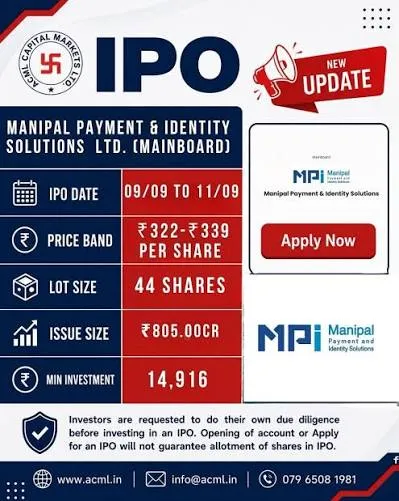
Manipal Payment raised Rs 362 crore from anchor investors ahead of its initial public offering, part of a broader wave of anchor book allocations completed across several Indian IPOs during the same window, which collectively saw Kanohar Electricals raise Rs 317 crore, LCC Projects raise Rs 128.14 crore and Steamhouse India raise Rs 124.2 crore from their respective anchor investor allocations. The anchor investor round, which typically closes one to two days ahead of an IPO's public bidding window, allows companies to secure firm commitments from institutional investors including mutual funds, insurance companies and other qualified institutional buyers at the upper end of the price band, providing an important early signal of institutional demand ahead of the broader public offering.
For Manipal Payment specifically, operating within India's competitive fintech payments infrastructure sector, securing a substantial anchor allocation carries particular significance given the scrutiny institutional investors typically apply to payments companies' underlying unit economics, regulatory compliance posture and competitive positioning relative to both established payment incumbents and the numerous fintech challengers that have entered India's payments infrastructure market over recent years. The strength of anchor investor commitment ahead of the public offering provides an early indicator of how institutional investors are likely to evaluate the broader IPO once bidding opens to the full range of investor categories. India's payments infrastructure sector has seen a steady stream of company listings and fundraising activity over recent years, as the sector has matured from its earlier growth-focused, loss-making expansion phase toward a period where investors increasingly expect demonstrated profitability or a clear, credible path to profitability as a precondition for strong IPO reception, a shift in investor expectations that mirrors the broader recalibration that has occurred across India's fintech sector more generally following the more permissive growth-at-all-costs funding environment that characterised the sector's earlier development.
The concurrent anchor allocations across Manipal Payment, Kanohar Electricals, LCC Projects and Steamhouse India, collectively raising over Rs 900 crore from anchor investors within the same trading window, illustrates the continued depth and breadth of India's active IPO pipeline through the latter half of 2026, spanning companies across fintech, electrical equipment manufacturing, construction and hospitality sectors, reflecting the diverse range of Indian businesses currently pursuing public listings rather than any single sector-specific IPO wave. Anchor investor allocations serve a dual purpose within India's IPO process, providing companies going public with an early, locked-in demonstration of institutional confidence that can help build broader market momentum ahead of the public bidding window, while also giving the anchor investors themselves privileged access to allocation at a guaranteed price before the uncertainty of the broader public subscription process determines final allocation outcomes for other investor categories. Anchor investors are subject to a mandatory lock-in period following listing, typically 30 to 90 days depending on the specific allocation tranche, a structural feature designed to signal genuine medium-term conviction in the listing rather than purely short-term trading interest.
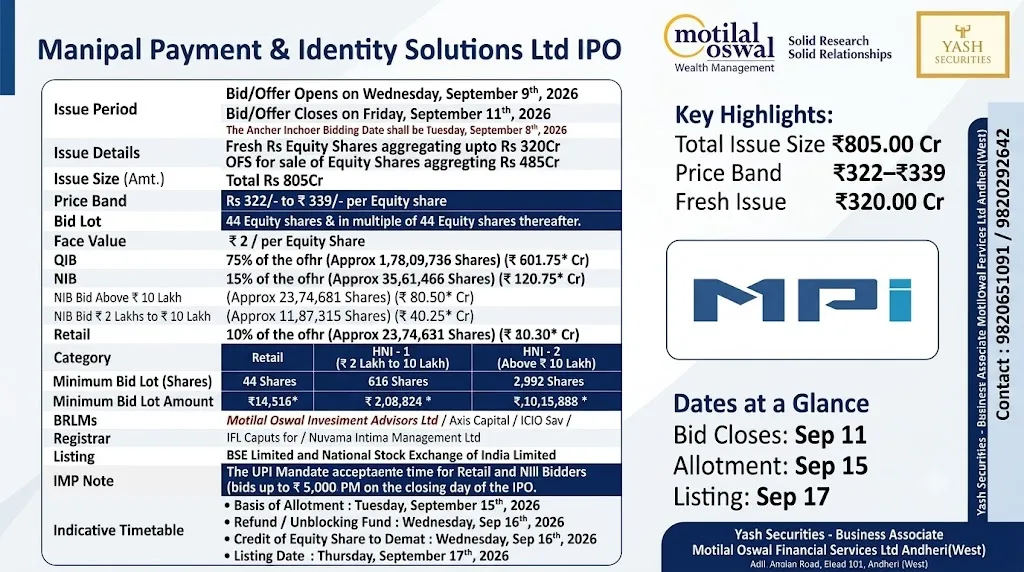
As Manipal Payment moves from its anchor allocation into the broader public bidding window, the company's ability to sustain the institutional interest reflected in its anchor book performance across the retail and non-institutional investor categories will determine the ultimate overall subscription level for the offering, a dynamic that book-running lead managers across India's active IPO pipeline continue to monitor closely as an early indicator of how each individual listing within this busy period of Indian primary market activity is likely to be received by the broader investing public once bidding opens more widely. The concurrent timing of anchor allocations across Manipal Payment and the other three companies raising anchor capital in the same window reflects how book-running lead managers across India's primary markets frequently coordinate IPO timing to some degree, both to avoid excessive overlap that might dilute available institutional investor attention and capital across too many simultaneous offerings, and to take advantage of periods when overall market sentiment toward new listings appears particularly favourable based on recent comparable IPO performance. For Manipal Payment specifically, the fintech sector's recent IPO track record in India has been somewhat mixed, with some payments and financial technology listings performing strongly in early trading while others have faced more tempered investor reception tied to specific concerns about competitive intensity or regulatory uncertainty within particular fintech sub-sectors, making the strength of Manipal Payment's anchor book an especially closely watched early indicator given this more varied recent performance history across comparable fintech listings on Indian exchanges. Manipal Payment's prospectus reportedly highlights its merchant acquiring and payment gateway infrastructure as core growth drivers, positioning the company within a fintech payments infrastructure segment that has continued attracting institutional investor interest even as broader consumer fintech lending categories have faced more cautious reception on Indian exchanges. Payment industry analysts tracking Manipal Payment's IPO note that the company's anchor investor list reportedly includes several domestic mutual funds with existing exposure to India's broader payments and fintech sector, a pattern of concentrated sector expertise among anchor investors that IPO analysts frequently interpret as a positive signal for how the broader institutional investor community is likely to receive the offering. Manipal Payment's management has indicated listing proceeds will partly fund expansion of its merchant acquiring network into smaller Indian cities, a geographic expansion strategy several fintech peers have pursued with mixed success. Manipal Payment's existing merchant base spans several thousand small businesses, a customer foundation the company says provides a stable transaction volume base to build additional value-added services upon following listing. The company's technology stack reportedly supports both online and offline merchant payment acceptance, a dual capability increasingly standard among competitive Indian payment infrastructure providers today. Management reiterated its commitment to transparent quarterly disclosure post-listing. The listing is expected to value the company at a meaningful premium to its last private funding round, reflecting strong public market appetite for payments infrastructure names. Institutional analysts covering the payments sector will publish updated coverage notes shortly after listing, incorporating final allotment and opening-day trading performance details. These figures will be finalised and published in the company's post-listing investor materials. Regulatory filings confirm this.