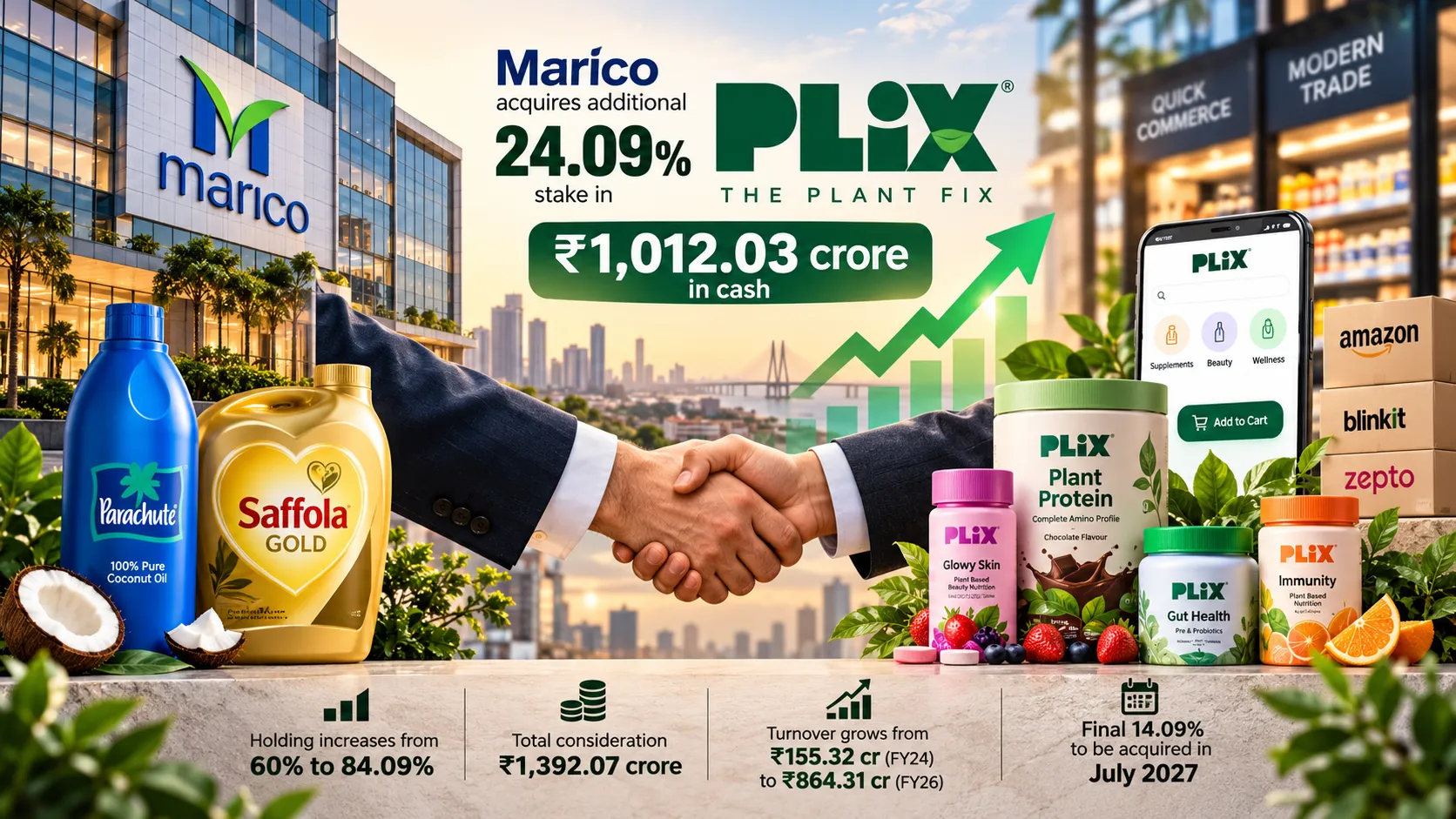
Marico, the Mumbai-based consumer goods company behind Parachute and Saffola, has taken decisive control of plant-based wellness brand Plix, paying ₹1,012.03 crore in cash for an additional 24.09% stake in its parent company, Satiya Nutraceuticals Private Limited.
The transaction, completed on 5 October 2026 according to Marico's regulatory filing, lifts the FMCG group's holding from 60% to 84.09% on a fully diluted basis. Marico has entered into definitive agreements to acquire a total of 38.18% from Plix's founders and certain other shareholders in tranches. The remaining 14.09% is expected to change hands in July 2027, subject to the terms of those agreements.
The deal is one of the largest exits yet for a homegrown direct-to-consumer brand and offers a clear signal of how established Indian consumer companies now value digital-first businesses that have proven they can scale profitably.
The numbers behind the deal
With the latest tranche, Marico's aggregate consideration for its 84.09% stake stands at ₹1,392.07 crore. That implies the company paid roughly ₹380 crore for its initial 60% holding, acquired in earlier transactions, before committing more than two and a half times as much for a further quarter of the business.
The price reflects how sharply Plix has grown since Marico first invested. Satiya Nutraceuticals' turnover rose from ₹155.32 crore in FY24 to ₹864.31 crore in FY26, according to the disclosures. Market commentators calculated that the latest tranche values the company at approximately five times its FY26 sales, a multiple that would be generous for a mature FMCG business but is consistent with the premium attached to fast-growing wellness and nutrition brands.
The consideration for the final 14.09% will be determined at the time of acquisition. It comprises a base consideration of up to ₹592 crore, along with additional payments linked to milestones and other terms. That structure gives the founders an incentive to keep growth on track through 2027 while capping Marico's base exposure.
Who Plix is, and why Marico wants it
Satiya Nutraceuticals was incorporated in February 2020 and is headquartered in Mumbai. Its brand, The Plant Fix, better known as Plix, sells plant-based nutrition supplements and personal care products, a portfolio that sits at the intersection of two of the fastest-growing consumer categories in urban India: preventive health and clean-label beauty.
Plix built its early following online, using social media and marketplaces to reach younger consumers who were comfortable buying supplements and skincare without first seeing them on a shop shelf. It subsequently expanded into quick commerce and modern trade, giving it the multi-channel reach that larger FMCG companies prize.
For Marico, the brand fills a strategic gap. The company has spent several years diversifying away from its dependence on hair oils and edible oils, categories that are large but relatively mature. Its earlier acquisitions of digital-first labels, including men's grooming brand Beardo and food brand True Elements, were part of the same effort. Plix extends that push into health and wellness, a segment where Indian consumers are increasingly willing to pay a premium.
Marico has said the investment expands its addressable market in value-added foods and nutrition while strengthening its presence in personal care and wellness. Fuller ownership also gives it greater control over Plix's product pipeline, pricing and distribution, particularly as the brand moves deeper into offline retail where Marico's existing network offers obvious advantages.
Related-party structure and governance
Because the shares are being acquired from Plix's founders and their relatives or related entities, the transaction constitutes a related-party transaction. Marico said it had been carried out on an arm's-length basis and that its own promoter and promoter group had no interest in the deal. Such disclosures are standard, but they matter to institutional investors who track how listed companies price acquisitions involving insiders of the target business.
Market reaction and the wider earnings picture
Marico announced the transaction alongside a business update for the September quarter. The company indicated that it expects double-digit revenue growth in Q2 FY27 and operating profit growth in the mid-twenties, an outlook that investors welcomed. Marico's shares traded between about 1% and 3% higher in the session following the announcement, according to market reports.
The two disclosures together paint a coherent picture. Marico's traditional franchises continue to generate steady cash, while its newer brands, including Plix, are being relied on to lift the overall growth rate. The company has previously highlighted that its digital-first portfolio is becoming a meaningful contributor, and it has said its digital channels now account for around a fifth of its India revenue as quick commerce gains ground.
What the deal says about India's D2C market
The Plix transaction arrives at a moment when India's direct-to-consumer sector is maturing. The exuberant funding environment of 2021 produced hundreds of digital brands, many of which struggled once customer acquisition costs rose and venture capital became more selective. The survivors tend to be companies that achieved scale and moved beyond a single online channel.
For those brands, strategic acquisition by a large FMCG group has become one of the most reliable exit routes. Global and domestic consumer companies, from Hindustan Unilever to ITC and Emami, have bought stakes in digital-first brands to access younger consumers and faster innovation cycles. Marico's staggered, milestone-linked approach, in which it acquires control first and the remainder later, has become a common template because it keeps founders engaged while giving the acquirer time to integrate operations.
The valuation also offers a benchmark for other wellness and nutrition brands considering their options. A multiple of around five times sales signals that strategic buyers will pay well for proven growth, but only once a brand has demonstrated it can build substantial revenue.
The road to July 2027
For Plix's founders and early investors, the transaction delivers a substantial liquidity event while leaving a final payout tied to future performance. For Marico, the priority now is to sustain the growth that justified the price. Integrating a founder-led digital brand into a large corporate structure is notoriously difficult, and many such acquisitions have lost momentum once the original culture was diluted.
Marico's own track record with Beardo and its other digital acquisitions will be watched closely as a guide. If Plix can continue to grow at the pace seen between FY24 and FY26 while improving margins through Marico's sourcing and distribution scale, the deal could become one of the more successful examples of an Indian FMCG incumbent buying its way into a new category.
For the wider startup ecosystem, the message is straightforward. India's large consumer companies remain active buyers, and well-run D2C brands with real scale can command premium valuations. With the full buyout scheduled for July 2027, the Plix story is not yet complete, but its first major chapter has ended with a decisive outcome.